
Beyond the Grid: Predicting Electricity Consumption via Cyber-Physical-Social Systems (CPSS)
Abstract -Considering that the economic indicators have a great impact on electricity consumption, social sensors are used to capture massive social signals and intelligent sensors are used to collect electricity data based on the cyber-physical-social system(CPSS) theoretical framework. In this paper, an economic-power cyber-physical-social system is built to integrate the data from different spaces. In cyberspace, the data will be fused, normalized before training, then a deep belief network(DBN) model is established to perform data mining and realize mid-long term electricity consumption forecasting. In the DBN training process, economic-power data from 31 provinces are used. DBN can achieve feature extraction automatically without variable selection steps and can achieve higher forecasting accuracy than traditional methods. The application of CPSS in electricity consumption forecasting has expanded the data border of physical power system researches and can provide a reference for subsequent multi-space data modeling
This paper introduces a mid-long term electricity consumption (EC) forecasting framework based on the Cyber-Physical-Social System (CPSS) architecture. By integrating socio-economic signals via web crawlers and physical power data, and utilizing a Deep Belief Network (DBN), the method achieves superior forecasting accuracy compared to traditional statistical and shallow learning models.
Executive Summary
TL;DR: This research breaks the limitations of traditional power forecasting by treating the power grid not just as a physical entity, but as a Cyber-Physical-Social System (CPSS). By crawling 21 macro-economic indicators (social signals) and using a Deep Belief Network (DBN), the authors achieved a remarkably low MAPE of 3.278% in mid-long term forecasting, proving that the "pulse" of the economy is the best predictor of the "thirst" for electricity.
Positioning: This work moves beyond traditional time-series smoothing (ARIMA) and shallow learning (SVM), positioning itself as a pioneer in multi-space data fusion for energy informatics.
The "Blind Spot" in Power Forecasting
Why is mid-long term forecasting so difficult? Traditional models often treat electricity consumption as an isolated physical variable. However, power demand is a "barometer" of economic health. Existing methods typically suffer from:
- Linear Bias: Assuming a simple direct relationship between GDP and power.
- Data Isolation: Ignoring the "Social Space"—the human and economic behaviors that drive industry.
- Manual Feature Engineering: Relying on experts to pick symbols rather than letting the data speak.
Methodology: The Economic-Power CPSS Architecture
The core innovation lies in the CPSS framework, which adds a "Social" layer to the traditional Cyber-Physical model.
1. Data Fusion (Social + Physical)
The system uses web crawlers (social sensors) to capture signals from the National Bureau of Statistics, covering indices like the Consumer Price Index (CPI), Industrial Added Value, and Real Estate investment. These are combined with physical power grid data to form a holistic dataset.
2. Deep Belief Network (DBN) Logic
Rather than a standard Feed-Forward network, the authors use a DBN composed of Restricted Boltzmann Machines (RBMs).
- The Intuition: DBNs are excellent at unsupervised feature discovery. The model first "learns" the internal structure of economic fluctuations before it ever tries to predict the power load.
- The Architecture: A two-hidden-layer structure optimized via a greedy search algorithm.
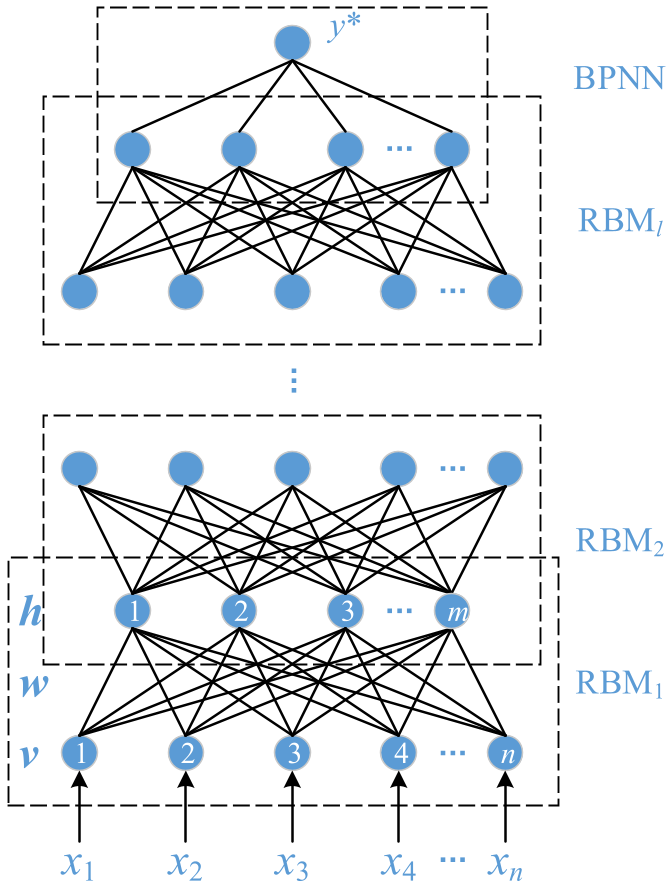 Figure 1: The DBN Structure used for extracting features from 21 economic variables.
Experimental Battle: DBN vs. The Old Guard
The authors tested their approach against ARIMA (the statistical standard) and LS-SVM (the traditional machine learning baseline) using 20 years of data across 31 provinces.
Performance Metrics
| Model | MAPE (%) | RMSE |
|---|---|---|
| DBN (Proposed) | 3.278 | 0.0080 |
| ARIMA | 5.140 | 0.0687 |
| LS-SVM | 12.672 | 0.0372 |
Visual Evidence
The comparison reveals that while ARIMA can follow general trends, it fails at the "turnaround points"—the peaks and valleys where economic policy or seasonal shifts hit hardest. The DBN model, bolstered by social data, tracks these fluctuations with much higher fidelity.
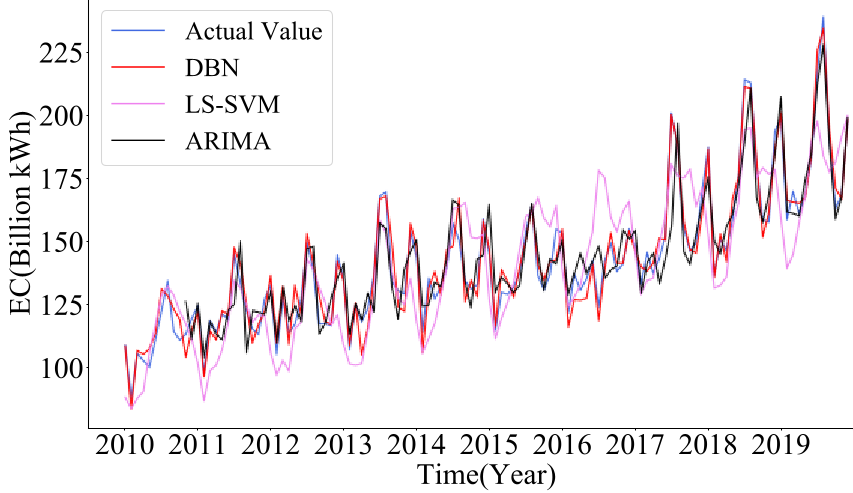 Figure 2: 10-year forecasting results showing DBN's superior tracking of actual consumption.
Critical Insight & Conclusion
Why it Works
The success of this model isn't just the DBN algorithm; it's the Economic-Power Nexus. By acknowledging that the power system is fundamentally a social system, the authors capture the "causality" of power demand rather than just the "correlation" in time-series data.
Limitations & Future Work
- Data Latency: Social indicators are often released with a lag (monthly/quarterly). Developing real-time social sensors (e.g., sentiment analysis from news) could further sharpen the short-term accuracy.
- Extrapolation: While DBNs are strong, the emergence of Graph Neural Networks (GNNs) could better model the geographical dependencies between the 31 provinces.
Final Takeaway: This paper is a significant step toward "Knowledge Automation" in power systems, proving that the future of energy management lies in the seamless integration of social dynamics and physical reality.