
Economical Microgrid Operation: Balancing Supply and Demand via Distributed Optimization
17805_Economical Operation of Microgrid With Various Devices Via Distributed Optimization.
This paper presents a distributed optimization framework for the economical operation of microgrids, integrating shiftable appliances, battery storage, thermal generators, and wind turbines. The core method employs dual decomposition and Benders' decomposition to solve a large-scale mixed-integer nonlinear programming (MINP) problem, achieving efficient parallel scheduling across diverse devices.
TL;DR
This research tackles the "Economical Operation" problem of microgrids by transforming it into a distributed optimization task. By integrating shiftable appliances, batteries, and thermal generators under a unified framework, the authors propose a decomposition strategy that allows each device to compute its own optimal schedule. The result? A system that remains computationally efficient even as the number of devices grows tenfold.
Background: The Microgrid Complexity
As we shift toward decentralized energy, microgrids—mini-grids that can operate independently—are becoming essential. However, managing them is a nightmare of constraints:
- Demand Side: Appliances have specific windows and total energy needs.
- Storage Side: Batteries exhibit binary "Charge/Discharge" states and degradation costs.
- Supply Side: Thermal generators have "Start-up" costs and "Minimum uptime," while wind turbines are frustratingly unpredictable.
The authors identify that standard centralized solvers cannot handle these large-scale mixed-integer programs (MINP) in real-time.
Methodology: The "Divide and Conquer" Strategy
1. Handling Wind Uncertainty
Instead of treating wind power as a fixed constant, the authors use a Chance Constraint. They assume wind speed follows a Weibull distribution and require that the probability of supply failing to meet demand stays below a tolerance level . This converts a stochastic nightmare into a manageable deterministic constraint.
2. Dual Decomposition
The global problem is coupled by the "Supply = Demand" balance. By using Lagrangian Relaxation, the central controller (CC) broadcasts a "Price Signal" (Lagrangian Multiplier) to all devices. Each device then solves its local subproblem independently.
3. Specialty Solvers for Each Device
- Appliances: The paper introduces a clever binary search method based on the piecewise linear nature of the appliance cost function.
- Batteries: Because batteries have binary state variables, the authors employ Benders' Decomposition, which separates the problem into a Master Problem (integer decisions) and a Subproblem (continuous charging rates).
 Fig. 2: The distributed framework involving Local Controllers (LC) and a Central Controller (CC).
Experiments & Scalability
The simulation compared a system with 100 appliances to one with 1,000.
- Centralized Solvers: The time taken increased linearly.
- Proposed Distributed Method: The computation time remained flat.
This is the "killer feature" of the paper—true horizontal scalability.
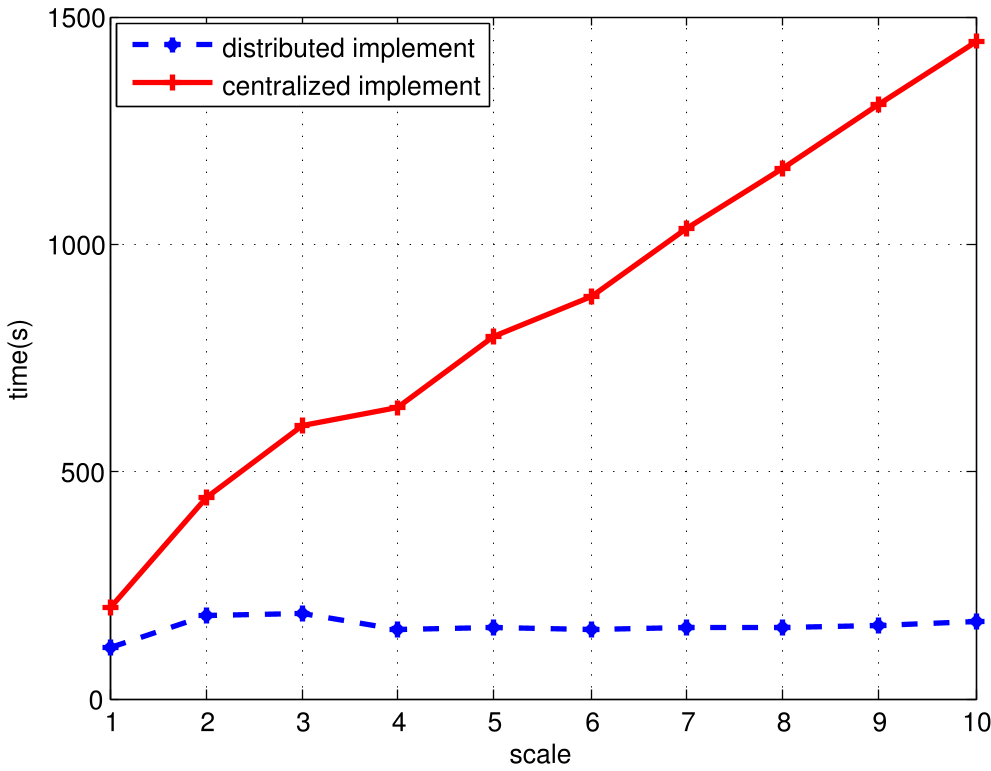 Fig. 8: Computation time: Centralized vs. Distributed implementation as the system scale increases.
The results also verified that the system successfully shifts energy usage to "valley" price periods, charging batteries when electricity is cheap and discharging when it's expensive.
Critical Insight & Conclusion
While many papers talk about "Smart Grids," this work provides a mathematically rigorous way to handle heterogeneous devices. By combining Dual Decomposition (for coupling) with Benders' Decomposition (for local integer constraints), the authors bridge the gap between theoretical optimization and practical, scalable engineering.
Future Outlook: The model currently assumes perfect forecasting of prices and non-shiftable loads. The next frontier is incorporating real-time online updates into this distributed architecture to handle sudden weather changes or consumption spikes without re-solving the entire 24-hour horizon.