
Economical and Plant Friendly Input Design: Balancing Information Gain with Operational Profit
Economical and plant friendly input design for system identification
This paper introduces an economic-driven framework for optimal input design in system identification, primarily for linear time-invariant (LTI) systems. It proposes a novel approach to minimize the economic loss incurred by departing from a nominally optimal operating point (OOP) due to perturbations, while ensuring plant constraints and model accuracy requirements are met.
TL;DR
System identification is necessary to build accurate plant models, but the required perturbations can push a plant into dangerous or non-profitable zones. This paper proposes a method to design identification experiments that minimize economic loss by calculating the optimal "back-off" from constraints. Using a 2-stage iterative convex optimization approach, the authors determine both the best operating point and the specific input signal (via an FIR filter) to keep the system safe and profitable.
Context: Why Traditional Design Isn't Enough
In industrial process control, "Optimal Input Design" usually means making the input signal just "noisy" enough to estimate parameters accurately (A, D, or L-optimality). However, most real plants are optimized to run right at the edge of their physical constraints (e.g., maximum pressure or temperature) because that is where they are most profitable.
If you add an identification signal to a plant running at the edge, you will likely violate a constraint. To avoid this, operators "back-off" into a safer, but less profitable, region. The missing link in the literature has been how to mathematically optimize this back-off distance so that the identification is "least costly" in terms of lost dollars, not just signal variance.
Methodology: The Geometry of Safety
The core insight of this paper is treating the plant's operational safety as a geometric problem.
1. The Ellipsoidal Operating Region
The authors define the Expected Dynamic Operating Region (EDOR). Since the system is driven by Gaussian noise and a filtered input, the path of the input/output variables forms an ellipsoid in the state space.
2. The 2-Stage Iterative Solution
The optimization problem is non-convex, which usually makes it hard to solve. The authors break it down into two manageable steps:
- Stage 1 (Variance Minimization): Find the smallest feasible covariance ellipsoid () that satisfies the information requirements (Fisher Information Matrix ).
- Stage 2 (Center Optimization): Using that ellipsoid, find the Backed-Off Operating Point (BOP) as close as possible to the Constrained Optimal Operating Point (OOP).
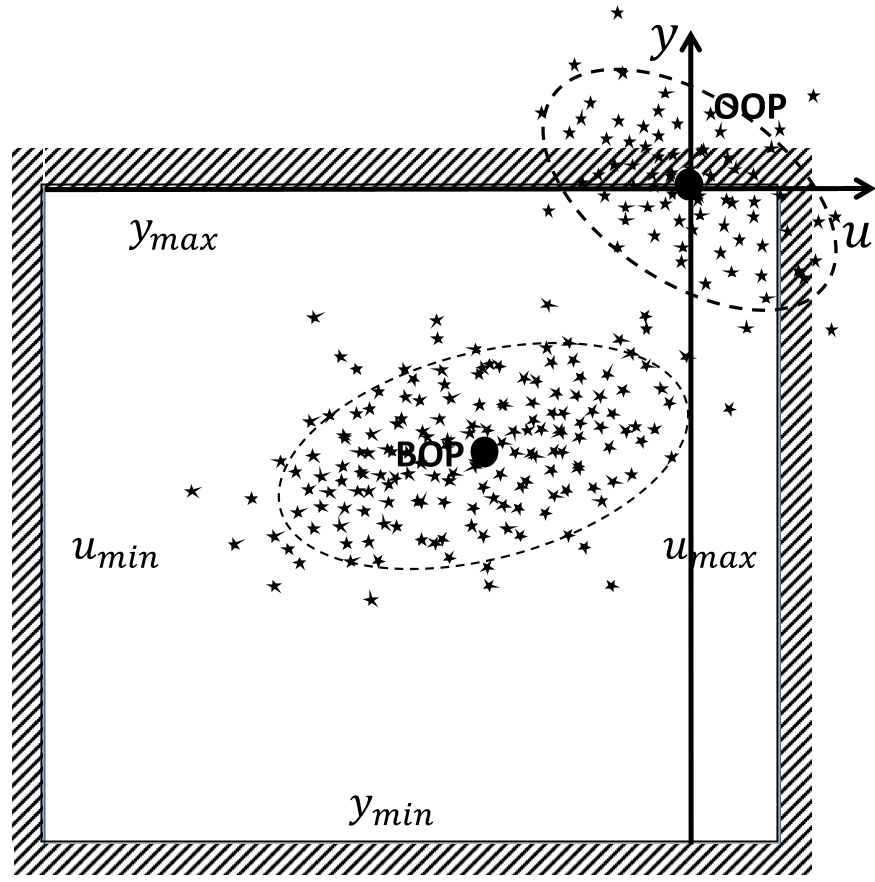 Figure 1: Visualizing the gap between the Profitable (OOP) and Feasible (BOP) dynamic operating regions.
The algorithm iterates between these stages until the distance between successive operating points reaches a predefined tolerance.
Experimental Validation: Mass-Spring-Damper System
The authors tested their framework on a classic engineering problem: a mass-spring-damper system modeled via ARMAX. The goal was to keep the mass position as high as possible while estimating the system parameters.
Results:
- Constraint Handling: The system stayed within the input [0, 17] and output [-2, 1] bounds.
- Input Shaping: The resulting input was realized via a 6-tap FIR filter, ensuring it was "Plant Friendly" (not too jerky or unpredictable).
- Convergence: The iterative method successfully found a BOP , representing the best trade-off between identifying the model and losing mass position height.
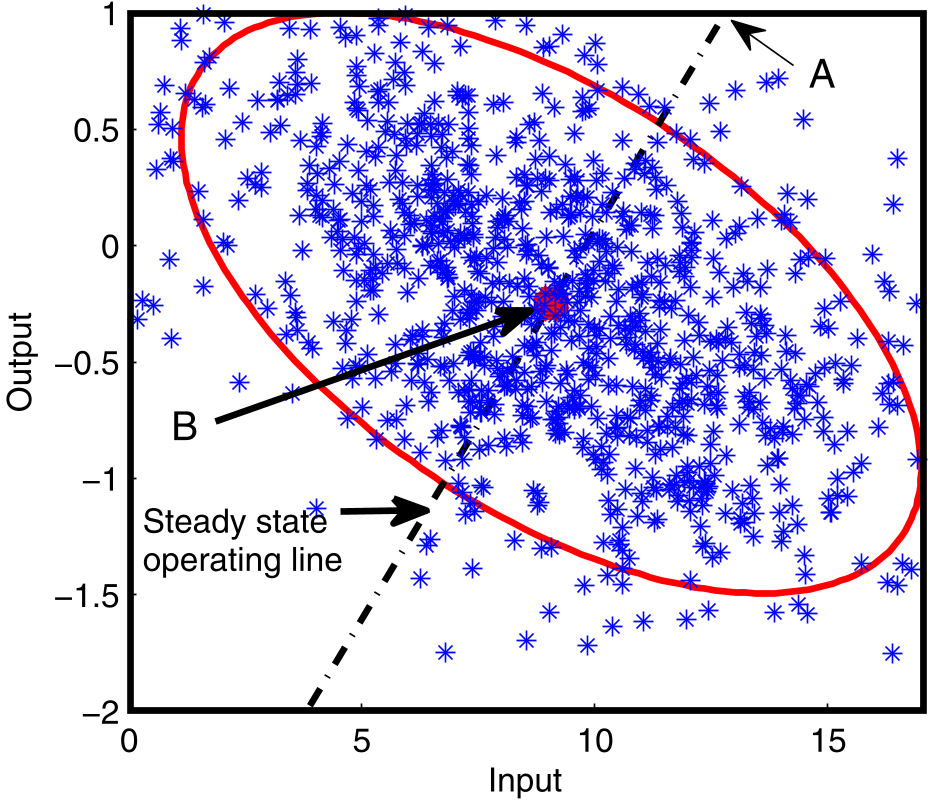 Figure 2: The result of the identification experiment. Point A is the impossible theoretical optimum, and Point B is the calculated safe, economical point for identification.
Critical Analysis & Conclusion
Takeaway
The value of this paper lies in its holistic view of identification. It acknowledges that system identification does not happen in a vacuum—it happens on a plant that needs to make money. By incorporating economic cost directly into the optimization objective, this method provides a bridge between the theoretical needs of the control engineer and the practical needs of the plant manager.
Limitations & Future Work
While the paper solves the SISO (Single-Input Single-Output) case brilliantly, real-world chemical plants are often MIMO (Multiple-Input Multiple-Output). The authors suggest that extending this to state-space constraints and closed-loop identification is the next frontier. Furthermore, the assumption of a linear cost function is a simplification; non-linear economic models might complicate the convex optimization landscape.
Nonetheless, this work provides a robust foundation for "Economic System Identification," ensuring that the quest for better models doesn't break the bank—or the plant.