
Beyond Feasibility: Defining the Economic Boundaries of Power System Flexibility
8016_Economically Optimal Uncertainty Set Characterization for Power System Operational Flexibility.
The paper proposes a novel robust optimization framework to characterize an "Economically Optimal Uncertainty Set" (US) for power system flexibility. It utilizes a two-step Column-and-Constraint Generation (C&CG) algorithm to ensure both feasibility robustness and optimality robustness against wind power volatility.
TL;DR
As renewable energy penetration grows, power systems face unprecedented volatility. Conventional wisdom focuses on Feasibility Robustness—ensuring the grid doesn't crash. This paper argues that feasibility is not enough. It introduces a framework for Optimality Robustness, calculating an uncertainty set that is not just "safe" but "economically optimal," preventing the grid from being forced into exorbitant redispatch costs when wind output fluctuates.
The Missing Link in Flexibility Metrics
The primary challenge of modern grid operation is "Operational Flexibility": the ability to deploy resources to meet sudden changes in net load. Existing research treats the Uncertainty Set (US)—the range of possible wind/solar outputs—as fixed or focuses only on whether a dispatch solution exists.
The authors identify a critical gap: Prior work ignores the cost of the "Recourse." Even if a system is technically capable of handling a massive swing in wind power, the cost of firing up emergency units or shifting storage might be higher than simply limiting the allowable uncertainty range (e.g., through strategic wind spillage).
Methodology: The Two-Step Robust Approach
The paper proposes a master-subproblem structure using Robust Optimization (RO) with variable boundaries. Unlike standard RO where the uncertainty set is an input, here the boundaries (, ) are decision variables.
1. The Architecture of Economic Robustness
The model is split into two distinct phases to handle the complexity of mixed-integer recourse (caused by quick-start units and storage):
- Step 1: Feasibility Search: It identifies the physical limits of the grid—the widest possible "Safe Zone" where no load shedding occurs.
- Step 2: Economic Refinement: Within that safe zone, it shrinks the boundaries to ensure that the cost of handling the "worst-case scenario" remains within an optimal economic range.
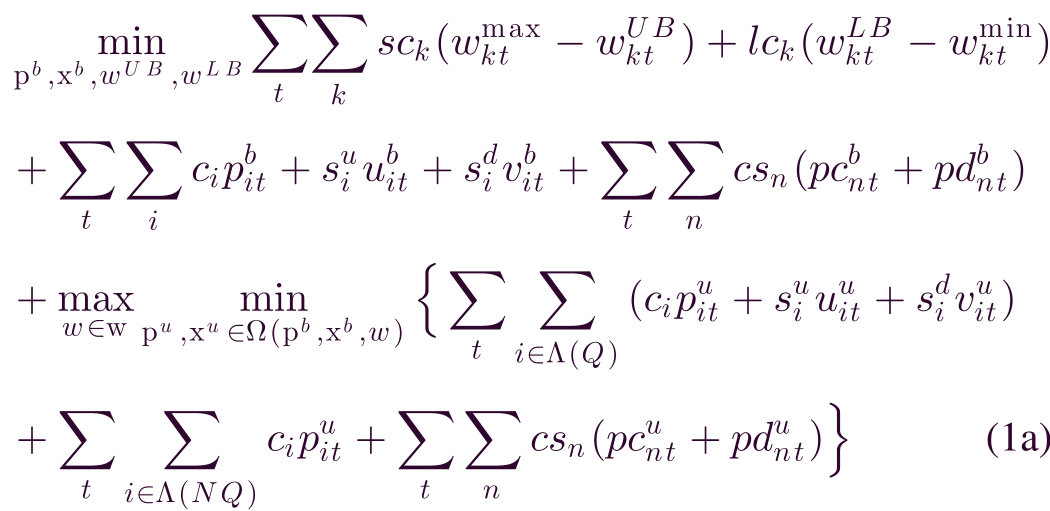 The objective function (1a) uniquely co-optimizes base-case costs, the penalty for shrinking the uncertainty set (spillage/curtailment), and the maximized second-stage redispatch cost.
Experiments & Critical Insights
The framework was tested on a modified IEEE 73-bus system featuring 19 wind farms and 40 battery storage units.
The Storage Paradox
A fascinating result of the study is the role of storage. While batteries generally increase flexibility, the authors noted that during specific hours (e.g., hours 17–20), storage units might actually decrease downward reserve capacity due to energy capacity limitations (the "State of Charge" constraint).
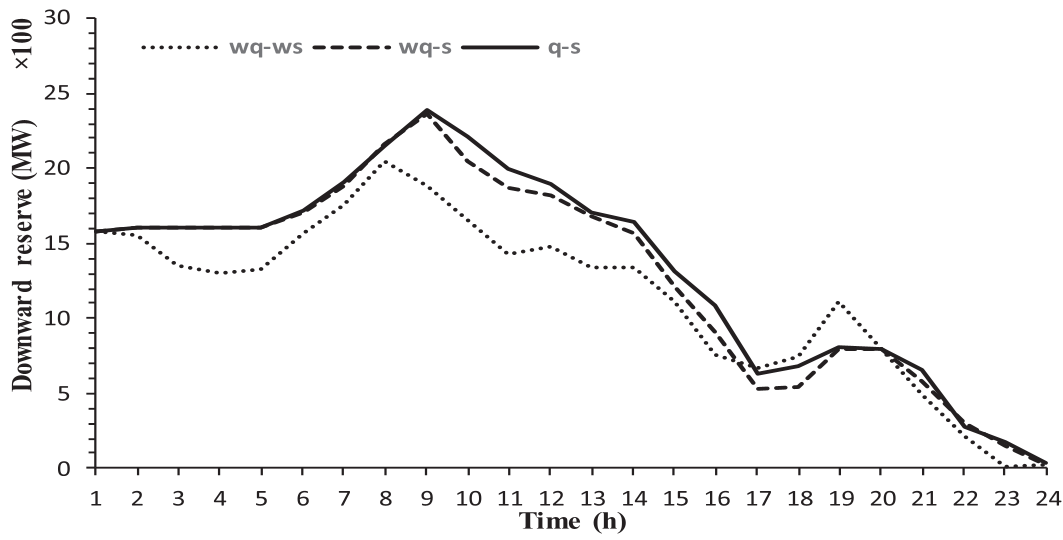 This graph highlights how different resource mixes (Storage vs. Quick-start) impact the system's ability to provide downward flexibility.
Feasible vs. Optimal Sets
The core contribution is visualized in the gap between the "Feasible US" and the "Optimal US." In scenarios where redispatch costs are extreme, the "Economically Optimal" set is significantly narrower than the "Feasible" set. This suggests that grid operators should proactively limit renewable intake (DNE limits) even when the grid could technically handle more, simply to protect against economic volatility.
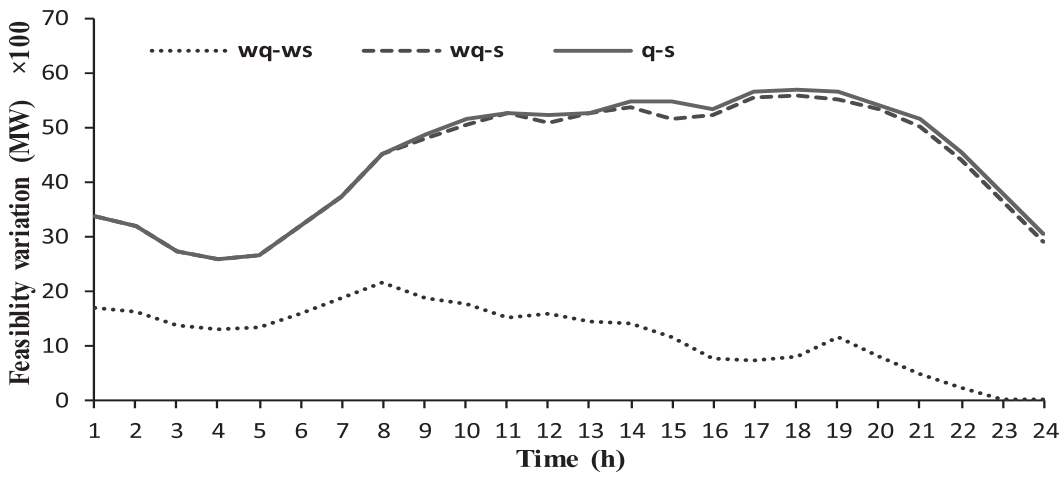 Comparison of upper boundary variations show that economic considerations (Fig 6 in paper) shift the uncertainty boundaries differently than pure feasibility (Fig 7 in paper).
Academic Perspective: Why This Matters
This paper elevates the discussion of grid flexibility from a purely topological/system-security problem to a Decision-Theoretic one.
Key Takeaway: By making the uncertainty set boundaries "endogenous" (decided within the model), the authors provide a mathematical basis for Do-Not-Exceed (DNE) limits. This is a vital tool for regulators and market operators who need to balance the "Green" goal of maximum renewable penetration with the "Economic" goal of affordable electricity.
Limitations: The model assumes a centralized dispatch and may require further adaptation for decentralized, market-clearing environments where participants' localized costs are not transparently known to the operator.