
The Hidden Cost of "Free" Stays: Behavior Mining in Hospitality Exchange
The Economy of Internet-Based Hospitality Exchange
This paper presents a behavioral economics analysis of non-profit hospitality exchange (hospex) services, specifically Bewelcome.org (BW) and Warmshowers.org (WS). By applying data mining techniques to message latencies and interaction success rates, the author quantifies the communication effort required to achieve real-life altruistic interactions.
TL;DR
Is gratuitous hospitality truly free? This study analyzes data from Bewelcome.org and Warmshowers.org to reveal that the "currency" of hospitality exchange is time. By mining communication latencies, the research discovers that while high-effort messages leads to significantly higher success rates, most users fail to optimize their behavior over time, often falling into inefficient messaging patterns.
Context: Beyond the Couchsurfing Paywall
In the world of hospitality exchange (hospex), the shift of Couchsurfing (CS) to a for-profit model closed the door on public academic research. This paper pivots to non-profit alternatives, treating the interaction not as a financial transaction but as a social market. Here, the objective is to understand the "Economy of Effort": how many minutes of typing is a night on a stranger's couch worth?
The Problem: The Efficiency of Altruism
In a standard market, price dictates quality. In a social market shaped by altruism, the "signal" of sincerity is paramount. The author identifies a core tension:
- The Efficiency Trap: Users want to minimize effort by sending "copy and paste" bundles to many hosts.
- The Sincerity Signal: Hosts are more likely to accept guests who invest time in a personalized request.
The study seeks to determine if users recognize this and adapt their strategies through experience.
Methodology: High-Resolution Latency Analysis
The author uses Behavior Mining to interpret the semantics of time. By analyzing the intervals between messages, two distinct clusters emerge (a mixed log-normal distribution):
- Cluster 1 (The "Active" Hill): Short intervals, representing active message writing (usually under 1 hour).
- Cluster 2 (The "Interrupted" Hill): Long intervals, where users left the site and returned later.
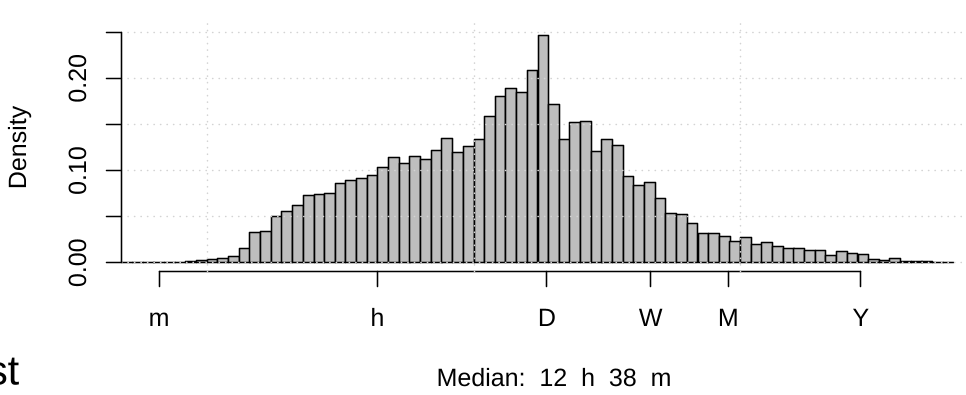 Figure: Distribution of time intervals for Warmshowers.org, showing the log-normal hills.
The "Success Rate" is defined as an initiation resulting in a real-life meeting (verified by mutual references).
The "Effort vs. Success" Paradox
The results show a stark contrast between platforms. Warmshowers (WS), a niche service for cyclists, has a success rate of 10.5%, nearly triple that of the generalist Bewelcome (BW) at 3.7%.
Key findings include:
- Labor-Intensive Success: In both platforms, requests that took longer to write (measured by the interval since the last sent message) had significantly higher reply and success rates.
- The Bundle Strategy: Users on BW send more "bundles" (subsequent initiations), likely because general travelers have more host options in major cities than rural cyclists.
- Quality vs. Quantity: While "copy-pasting" allows for a higher volume of requests, it sends a "wrong signal" in an altruistic community, leading to lower per-message success.
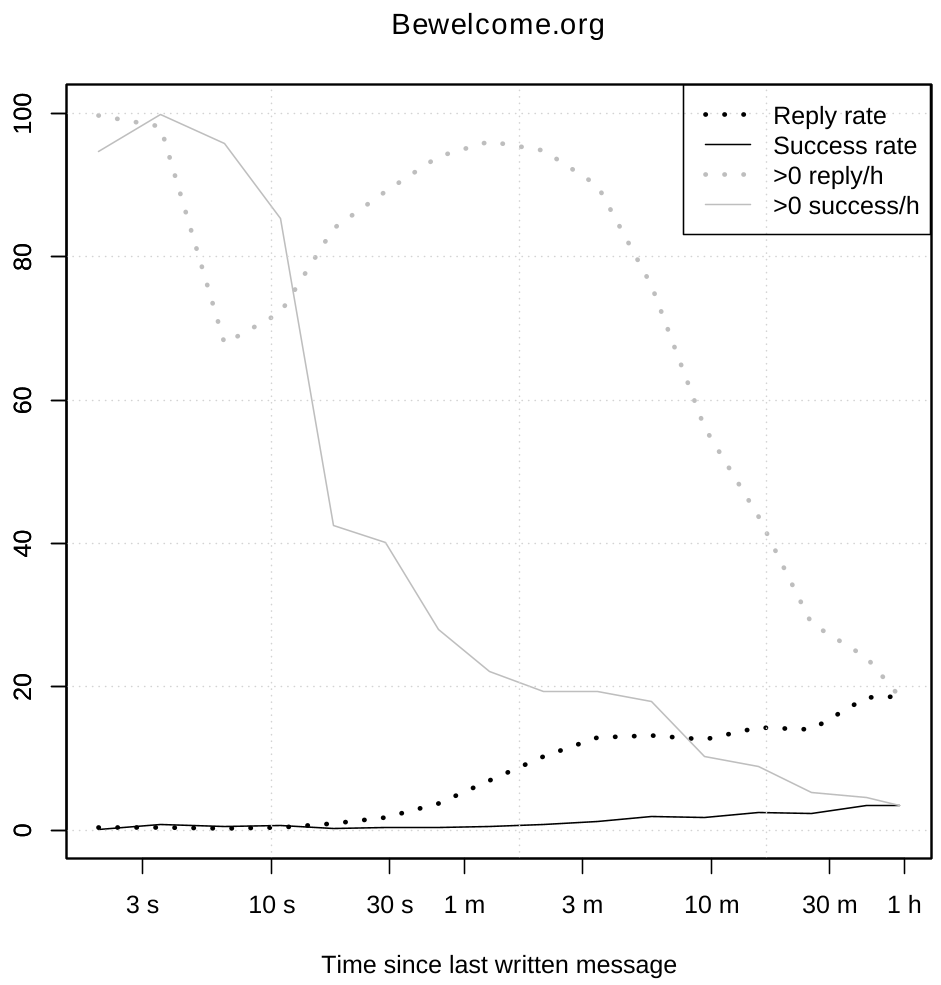 Figure: The positive correlation between time spent writing (effort) and the success rate of the interaction.
Behavioral Insight: Do Humans Learn?
Perhaps the most surprising finding is the lack of behavioral adaptation. One would expect that after several failed low-effort attempts, a user would increase their message quality.
However, the correlation between an individual's current effort and their previous success/failure ratio is near zero. Users do not seem to adjust their "typing time" based on what worked in the past. Their behavior is more correlated with their own "professionalism" (becoming slightly faster at writing over time) than with the platform's social rewards.
Critical Analysis & Conclusion
Takeaway
The research confirms that in non-monetary economies, effort is the signal of value. On niche platforms like Warmshowers, the high success rate is driven by a high-stakes environment (cyclists needing specific rural stops) where quality communication is mandatory.
Limitations
- Data Incompleteness: The study relies on "comments" as a proxy for real-life meetings, which might undercount actual interactions where no review was left.
- Privacy Constraints: Approximative text categorization was not possible, meaning "mass-welcoming" messages might skew some BW data.
Future Outlook
As major platforms formalize and monetize, these non-profit enclaves offer a "pure" laboratory for Behavioral Economics. Future work could apply Reinforcement Learning to see if "nudge" notifications—reminding users that longer messages yield 2x better results—could artificially improve the community's overall efficiency.