
ECRModel: Mapping the Laws of Physics to the Chaos of Online Rumors
ECRModel: An Elastic Collision-Based Rumor-Propagation Model in Online Social Networks
The paper introduces ECRModel, a novel rumor-propagation model for Online Social Networks (OSN) inspired by the physical laws of ball elastic collisions. It departs from traditional epidemic models by mapping social influence and rumor confusingness to kinetic energy and friction, achieving superior predictive accuracy over the standard SIR model in real-world network simulations.
TL;DR
How does a rumor "gain speed"? Researchers have moved beyond the biological "virus" analogy to propose a physics-based perspective. The ECRModel (Elastic Collision-based Rumor-propagation Model) treats social interactions like a game of billiards: a spreader’s influence is the kinetic energy, and a follower's skepticism is the friction. If the energy is high enough, a collision occurs, and the rumor continues its path.
Beyond Infection: Why Epidemic Models Fail social networks
For decades, we viewed rumors through the lens of the SIR (Susceptible-Infected-Removed) model. While effective for the flu, it fails for Facebook or Twitter because:
- Human Choice: Users aren't "infected" randomly; they choose to share based on trust and the rumor's "vibe."
- Node Heterogeneity: A celebrity’s whisper (high mass) carries more energy than a stranger’s shout.
- Repetitive Exposure: Seeing a rumor twice (accumulated energy) changes the probability of sharing it.
The ECRModel Methodology: Social Billiards
The core innovation lies in the Kinetic Energy Transformation. The authors map social variables to the classic equation for a ball rolling down a track to strike another:
- Mass (): Represents a node's comprehensive influence, derived from its out-degree (breadth) and past re-spreading rate.
- Height (): The specific influence of user over user .
- Friction (): The "non-confusingness" of the rumor. A clear, logical rumor has high friction (hard to spread as a rumor), while a confusing, "clickbaity" rumor has low friction.
- Track Length (): The individual resistance of a user to being misled.
Architecture of Interaction
The model identifies four propagation rules moving from simple 1-to-1 interactions to complex many-to-many cascades, mirroring how information actually flows through newsfeeds.
 Figure: The three states of the ECRModel: (1) Inactive/Never spread, (2) Active/Spreading, and (3) Inactive/Formerly spread.
Experimental Results: Physics vs. Biology
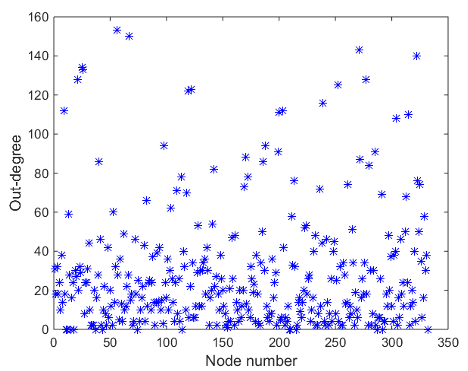
Testing the model on real-world Facebook data (333 nodes, 5038 edges), the researchers analyzed how rumors reach "steady states."
1. The Power of "Confusingness"
The simulations confirmed a vital social truth: the more confusing a rumor is, the faster it spreads. In the ECRModel, low (high confusion) acts like a Greased track, allowing kinetic energy to transfer almost effortlessly between nodes.
 Left (a): Active Spreaders over time. Right (b): Nodes that have completed spreading.
2. ECRModel vs. SIR (The SOTA Killer)
When compared to the traditional SIR model, the ECRModel showed a much more realistic propagation curve. While SIR tends to predict a massive, sudden spike, ECRModel captures the nuanced, iterative "burn" of an online rumor that accounts for the history of user interactions.
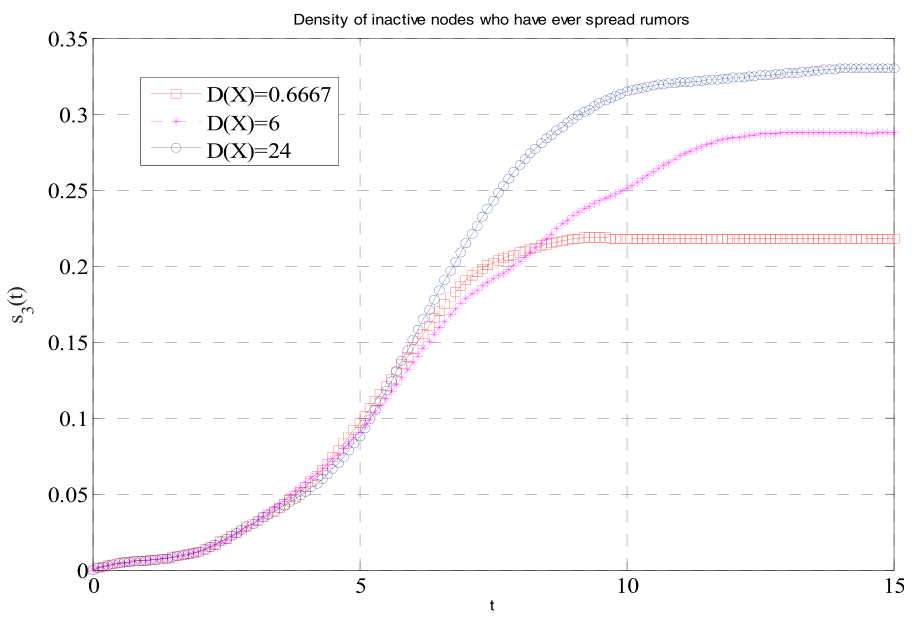 Figure: Accuracy comparison. ECRModel (red line) tracks the actual rumor propagation (blue circles) much closer than the SIR model (black dots).
Deep Insight: The Stability Condition
The authors mathematically proved that the "rumor threshold" depends on the formula . This implies that to stop a rumor, one must either:
- Increase : Clarifying the rumor (truth-seeking) to increase "friction."
- Decrease : Reducing the average connectivity (quarantining) to prevent collisions.
Conclusion
The ECRModel shifts the paradigm of social network analysis from "biology" to "mechanics." By treating social nodes as objects with mass and momentum, we can better predict the trajectory of misinformation. Future platforms might use these "friction" coefficients to automatically flag content that is mathematically designed to "collide" and spread too easily.
Senior Editor's Note: This paper is a fascinating bridge between classical mechanics and modern social science. Its reliance on "interaction history" makes it particularly relevant for today's algorithmic feeds that prioritize engagement over truth.