
Game Theory Meets Edge Intelligence: Optimizing Layered Video Caching in Social Networks
Edge Caching for Layered Video Contents in Mobile Social Networks
This paper introduces a novel edge caching scheme for layered video delivery in Mobile Social Networks (MSNs) using Scalable Video Coding. By employing a Stackelberg game and non-cooperative game theory, the method optimizes the number of video layers cached at the edge while balancing caching costs, node capacity, and social group dynamics to achieve SOTA performance in latency reduction.
TL;DR
With the explosion of mobile video traffic, edge caching has become vital. This paper tackles the inefficiency of "all-or-nothing" caching by using Layered Video Coding and Game Theory. By modeling the edge node as a "seller" and social groups as "buyers," the authors find a mathematical equilibrium that maximizes provider profit while minimizing user latency, outperforming standard random allocation methods.
Problem & Motivation: The "Heavy" Video Bottleneck
In Mobile Social Networks (MSNs), users aren't just isolated consumers; they form social groups with shared interests. Standard caching faces two major hurdles:
- Capacity Constraints: High-definition videos are too large to store in their entirety at every edge node.
- Diverse Demands: Some users (High-Priority) demand 4K quality and are willing to pay, while others are satisfied with 720p.
The authors' central insight is that we shouldn't cache the whole video. By using Multiple Description Coding (MDC), a video can be split into layers. The base layer provides basic quality, and additional layers enhance it. The key question is: How many layers should the edge node cache for each specific social group?
Methodology: The Two-Stage Game
The researchers developed a hierarchical model to solve the conflict between the limited supply of cache space and the varying demand of user groups.
1. The Stackelberg Game (Macro-Level)
The Cache Node acts as the leader. It sets a price for its storage. The Social Groups are followers who decide how much storage to "buy" based on that price. The goal is to find a price where the cache node's revenue is maximized after accounting for its maintenance costs.
2. The Non-Cooperative Game (Micro-Level)
Within the second stage, different social groups compete with each other. Since cache space is finite, Group A's decision to cache more layers affects the available space for Group B. The authors proved the Existence and Uniqueness of the Nash Equilibrium (NE), ensuring the system reaches a stable state where no group can improve its utility by changing its request unilaterally.
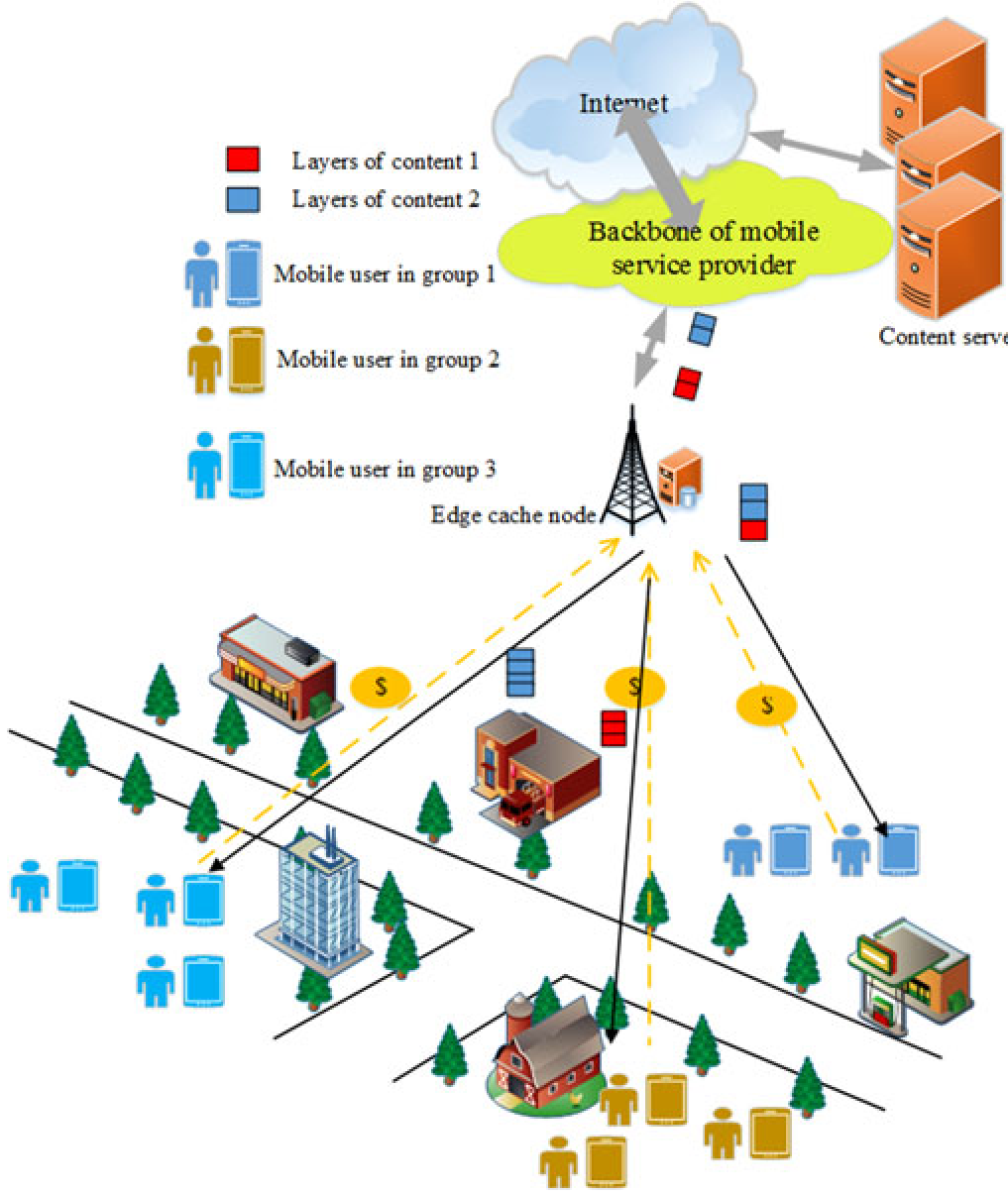 Figure 1: The framework comprising Content Servers, the Edge Cache Node, and multiple Social Groups.
Algorithms for Optimization
To solve this complex interaction, the authors utilized:
- Backward Induction: Solving the game from the followers' reaction back to the leader's initial move.
- Gradient-Based Iteration: An algorithm for the cache node to adjust its price dynamically until it converges to the optimal "Stackelberg Equilibrium."
Experimental Validation
The paper compared their approach against Uniform Cache Allocation (UCA) and Random Cache Allocation (RCA).
- Equilibrium Stability: The results confirm that regardless of the initial starting price, the system converges to a stable optimal point (see Figure 5).
- Latency Reduction: By prioritizing popular content and groups with higher "Importance Degrees," the proposed scheme achieved significantly lower delays than traditional baseline methods.
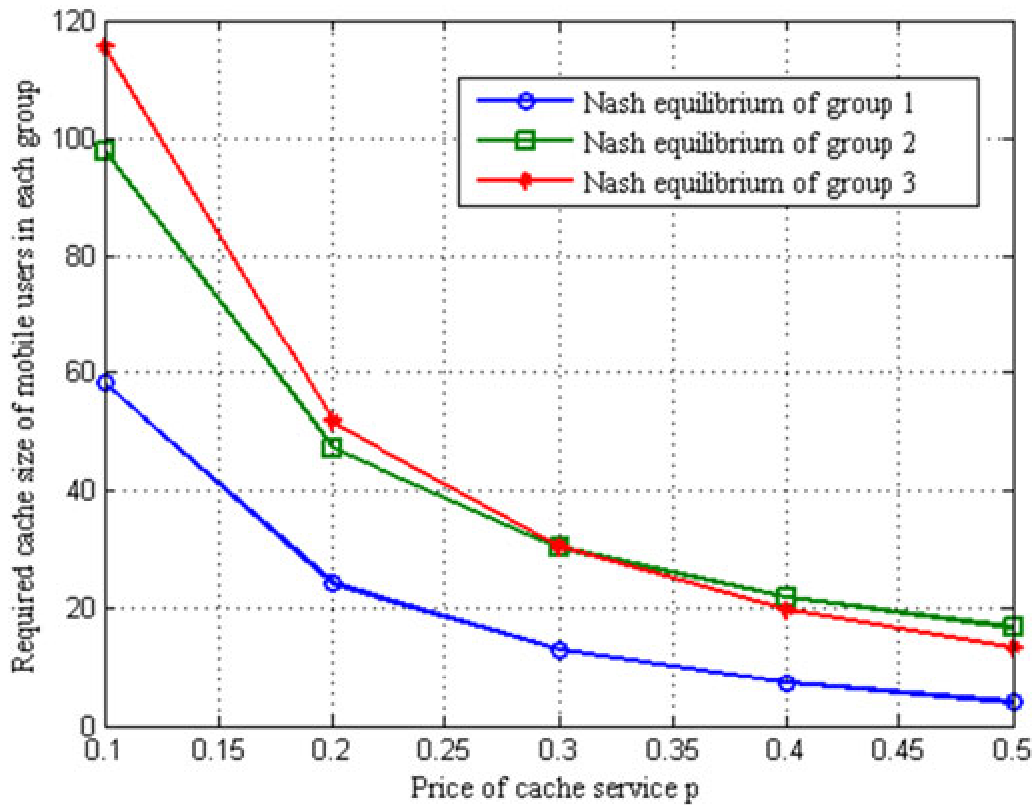 Figure 2: The price of caching service converges to an optimal point across different initial settings.
Critical Insight & Conclusion
The true value of this work lies in its Social Awareness. By incorporating parameters like social group priority () and content popularity based on Zipf distribution, the model moves beyond "dumb" caching to "intent-aware" caching.
Takeaway: Future 6G networks will likely rely on these types of economic-mathematical models to manage decentralized resources. However, a potential limitation is the assumption that social groups are static; in reality, group interests shift rapidly, suggesting a need for more "online" or "real-time" learning extensions in future research.