
Edge Concierge: Democratizing AI-Driven Operations for Private Network Edges
Edge Concierge: Democratizing Cost-Effective and Flexible Network Operations using Network Layer AI at Private Network Edges
The paper introduces Edge Concierge, an autonomous network layer AI system designed for private 5G/Local 5G edges. It leverages a Multi-Level Hidden Markov Model (ML-HMM) to perform real-time, unsupervised context estimation (e.g., user activity or camera states) directly from network traffic statistics without requiring labeled data or packet inspection.
TL;DR
Managing private 5G networks is notoriously complex for non-telecom experts. Edge Concierge addresses this by introducing a "Network Layer AI" that uses unsupervised learning (ML-HMM) to sense application contexts—like whether a security camera sees a person or a user is downloading a file—without ever looking at encrypted packet content. It enables "unattended" network operations and significant energy savings by only activating heavy edge-AI tasks when the network layer detects relevant activity.
The Motivation: Making Private 5G "Out-of-the-Box"
The "democratization" of mobile networking (e.g., Local 5G in Japan) allows vertical players like smart cities to run their own infra. However, these players face two brutal hurdles:
- Complexity: They don't have the staff to label thousands of traffic samples to train traditional AI.
- Cost/Energy: Running deep-learning-based anomaly detection (like video analytics) 24/7 on GPUs is prohibitively expensive and energy-intensive.
The authors' insight is simple: The network layer knows what the application is doing. By analyzing traffic patterns (bursts, intervals, volume), we can infer the "context" and use that as a low-cost trigger for higher-level services.
Methodology: The ML-HMM Architecture
The core innovation is the Multi-Level Hidden Markov Model (ML-HMM). While standard HMMs are great for sequence modeling, network traffic is noisy and influenced by both application logic and network jitter.
1. Multi-Level Abstraction
The model doesn't just look at raw packets. It flows through a pipeline:
- Sampling (): Extracts basic features (Volume, Packet Size, Intervals).
- Chunking (): Groups features into sequences for the HMM.
- Hierarchical States: The first level quantizes continuous traffic values; deeper levels categorize these into similar behavioral patterns (Contexts).
2. Self-Learning & Updating
Unlike supervised models that break when they see a new app, Edge Concierge uses unsupervised EM (Expectation-Maximization). It uses the Bayesian Information Criterion (BIC) to automatically decide how complex the model needs to be. When it detects a traffic pattern with low similarity to its current "knowledge base," it identifies it as a new context and updates the model autonomously.
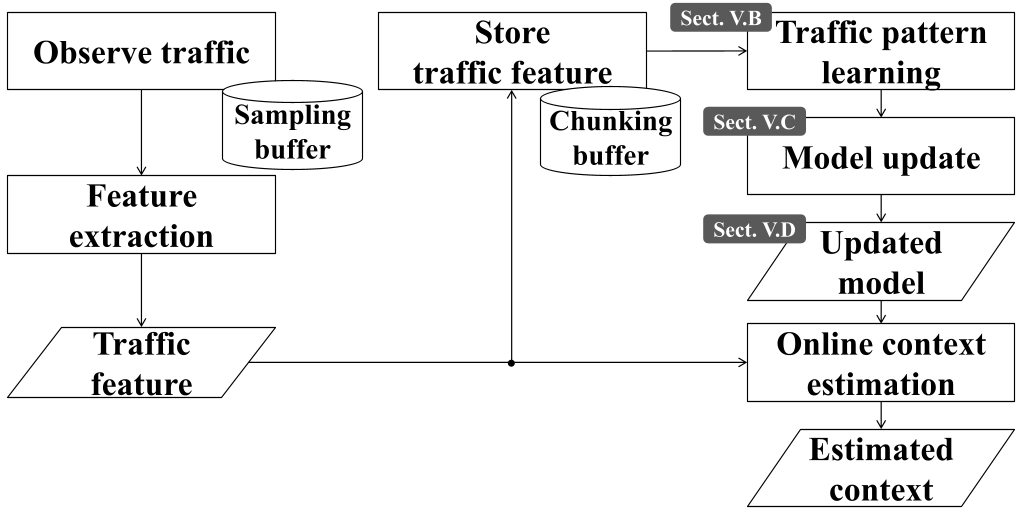 Figure 1: The Edge Concierge workflow, showing the transition from raw packet capture to online context estimation.
Performance: Precision Without Labels
The researchers tested the system against a common baseline: Sliding Window + Random Forest (SW+RF).
- Offline Accuracy: In a 3-activity smartphone scenario (Watching Video, Web Browsing, No Action), the proposed ML-HMM achieved 83% accuracy, whereas the SW+RF method failed to maintain stability across different window sizes.
- Real-Time Capability: The system processed context estimations in roughly 32ms, making it fast enough to trigger energy-saving "sleep/wake" cycles for edge applications.
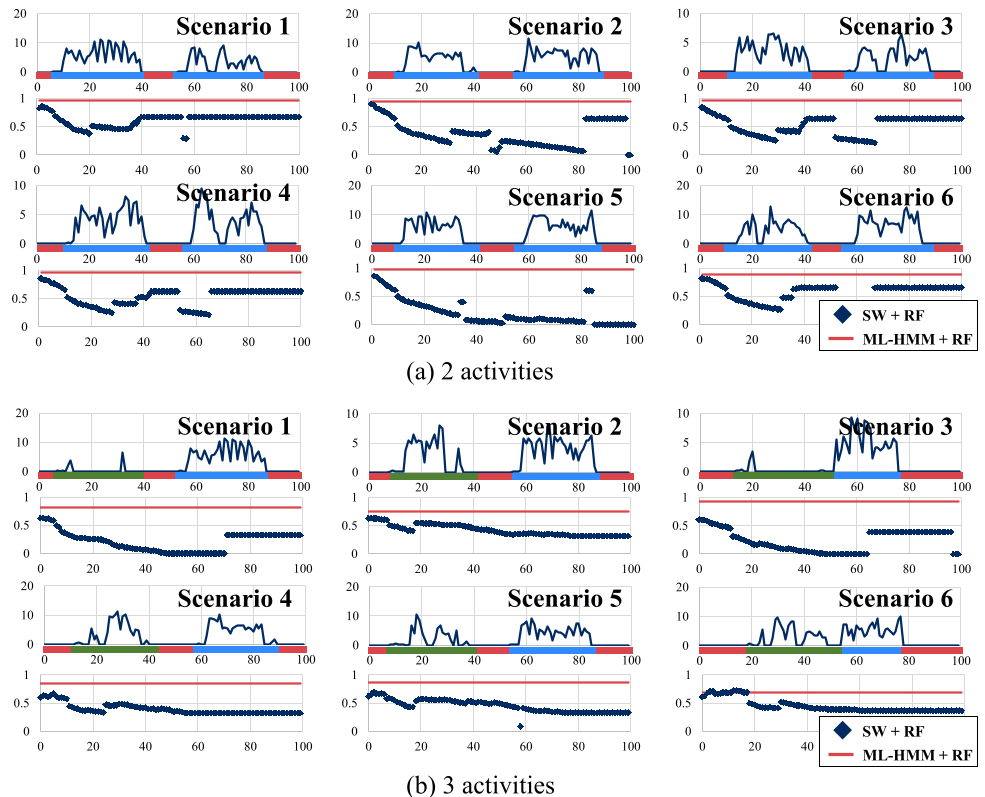 Figure 2: Comparison of activity estimation. Note how the ML-HMM (Proposed) aligns closely with the Ground Truth compared to the erratic predictions of Sliding Window methods.
Deep Insight: Why This Matters
The real value of Edge Concierge isn't just "higher accuracy"—it's the shift from reactive to proactive, unattended management.
By using the Network Layer as a "concierge," we treat network traffic as a proxy for physical reality. In a smart city surveillance use-case, the GPU only spins up when the network layer AI "senses" person-like movement in the video stream's bit-rate patterns. This cross-layer optimization (using L3 info to manage L7 applications) is the key to making edge computing sustainable for vertical industries.
Limitations & Future Work
While impressive, the paper notes that accuracy temporarily drops when unlearned activities first appear (until the next model update cycle). Future iterations might look into Continuous Learning to reduce this "adaptation lag" and testing performance in high-mobility environments where network quality shifts might be misinterpreted as context changes.
Summary: Edge Concierge proves that you don't need "Big Data" or "Big Labels" to run a smart network. You just need a clever way to model the rhythms of the data already flowing through your pipes.