
Robust Social Network Analysis: Using Edge-Dual Graphs to Unmask Criminal Connections
Using an edge-dual graph and <i>k</i> -connectivity to identify strong connections in social networks
This paper introduces a novel framework for Social Network Analysis (SNA) specifically designed for law enforcement, utilizing an edge-dual graph transformation combined with k-connectivity analysis. The method successfully identifies "strong connections" between entities across a massive 450GB dataset involving 5 million individuals in Alabama.
Executive Summary
TL;DR: This research addresses the problem of "noisy" data in large-scale social networks by reimagining relationships not just as links, but as robust structures. By transforming social graphs into edge-dual representations and measuring k-connectivity, the system can distinguish between a single coincidental encounter and a hardened criminal association.
Positioning: This work serves as a practical bridge between theoretical graph topology and real-world law enforcement informatics, moving beyond simple "shortest path" metrics to a "robustness-based" evaluation of social ties.
Problem & Motivation: The "Noise" in the Net
In law enforcement, identifying how "close" two suspects are is critical. However, real-world data is messy.
- The Shared Address Trap: Two people living in the same large apartment complex at different times might appear "connected," but this is often an artifact of data truncation or high-density housing.
- Weighting Weakness: Traditional algorithms like Dijkstra's Shortest Path are highly sensitive to edge weights. A single high-weight error (e.g., a misidentified alias) can compromise the entire analysis.
- Clustering Failures: Clustering coefficients often struggle in networks with low interconnectivity or where relationships are sparse but significant.
The authors' insight is that connectivity is not about distance; it is about redundancy. A strong connection is one that persists even when certain "relation contexts" are removed.
Methodology: The Edge-Dual Transformation
The core innovation is a two-phased approach to graph refinement.
1. Context-Oriented Transformation
The researchers transform the standard graph (where nodes are people and edges are relations) into an edge-dual graph .
- Natural Nodes: Represent individuals.
- Relation Nodes: Represent the context of the connection (e.g., a specific vehicle tag, a crime case number, or a physical address).
- Logic: Each edge in the original graph is replaced by a "Relation Node" connected to the participating individuals.
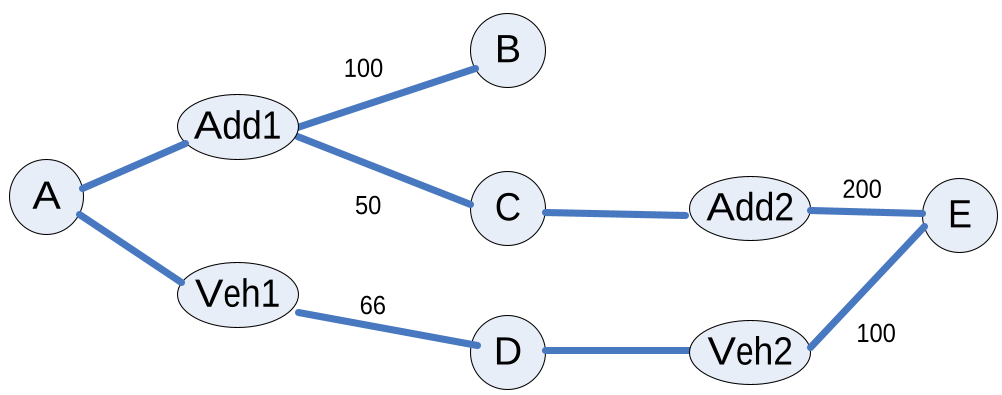 Figure 1 & 2: The conceptual shift from direct edges (left) to context-mediated relation nodes (right).
2. Measuring k-Connectivity
Instead of asking "how far is Person A from Person B?", the system asks: "How many unique relation nodes must be removed to disconnect A from B?"
- If , the connection is fragile (e.g., they only share one address).
- If , the connection is robust (e.g., they share a car, a home, and were arrested in the same case).
Experiments & Results: Real-World Scale
The system was tested on a massive 450GB dataset from Alabama state agencies (AOC, DPS, ALDOT), covering driver licenses, vehicle registrations, and arrest records.
Key Findings:
- Efficiency: Despite the dataset size (5 million people, 211 million relations), the system generates local subgraphs and performs k-connectivity analysis in under 20 seconds.
- Accuracy over Distance: In one case study, two people appeared "close" via the shortest path and clustering metrics. However, the edge-dual transformation revealed a 1-connectivity (see Figure 3 below). They only shared a single address, suggesting the connection was likely noise or an error, not a "strong" association.
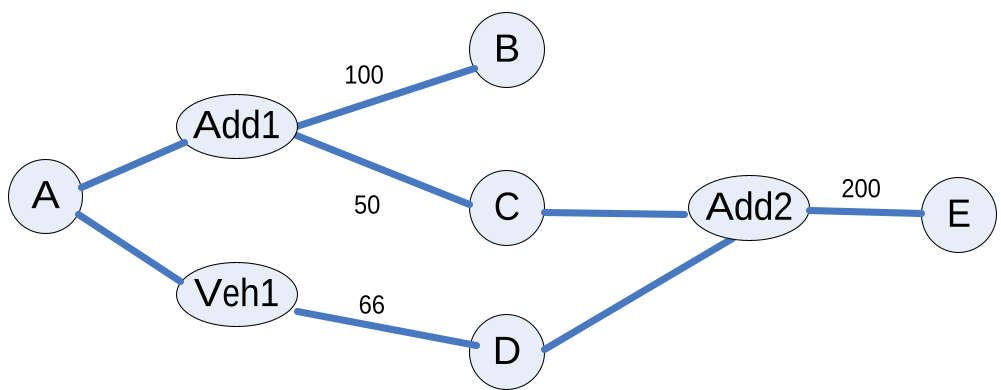 Note: A 1-connectivity result indicates a fragile, potentially coincidental link.
Critical Analysis & Conclusion
Takeaway
The shift from distance-based SNA to connectivity-based SNA is vital for high-stakes domains like law enforcement. By forcing the graph to explicitly represent the "context" of a link (via the edge-dual), the model provides investigators with an intuitive way to audit why two people are considered connected.
Limitations & Future Work
- Weight Subjectivity: The weighting formula for shared addresses (based on years) is heuristic-based and may need dynamic tuning.
- Data Silos: The system currently relies on structured data; incorporating unstructured crime reports via NLP would significantly enrich the "Relation Nodes."
- Dynamic Resilience: Future research could explore how these "strong connections" evolve over time, potentially predicting the formation of new criminal cells.
This framework proves that in the world of social networks, redundancy is the ultimate signature of truth.