
Modeling the Pulse of Mobile Social Networks: An Edge-Markovian Perspective
Edge-Markovian dynamic graph based information dissemination model for mobile social networks
This paper introduces an analysis framework using Edge-Markovian Dynamic Graphs to evaluate information dissemination delay in Mobile Social Networks (MSNs). It provides the first closed-form expression for average delay considering message size, transmission willingness, and node density.
TL;DR
This research establishes a mathematical framework to predict how fast information travels across Mobile Social Networks (MSNs). By leveraging Edge-Markovian Dynamic Graphs, the authors provide a closed-form expression for dissemination delay that accounts for real-world constraints: message size, battery-saving "selfishness," and community structures.
Background & Motivation: Moving Beyond Static Graphs
Traditional network analysis often treats connections as static or quasi-static. However, in MSNs (where nodes are smartphones carried by people), links appear and disappear as users move. The fundamental challenge is: How do we quantify "delay" when the infrastructure itself is constantly flickering?
Previous works struggled to integrate the physical layer constraint (message size) with the social layer constraint (willingness to share). This paper bridges that gap by treating the network as a dynamic system where the probability of a successful "handshake" depends on how long two people stay in proximity versus how large the file being transferred is.
Methodology: The Geometry of Chance
The core of the paper lies in the transition from simple connectivity to Effective Link Generation Speed.
1. The Bundle Size Factor
If a message requires time to transmit, and a contact duration follows an exponential distribution with intensity , the probability of a successful transfer is . The authors brilliantly use this to "scale down" the link generation rate. If your file is too big, the network effectively "slows down" because many contacts are too brief to complete the transfer.
2. The Multi-Community Markov Chain
The model divides users into two groups ( and ). The state of the network is defined by , where and are the numbers of infected nodes in each community.
 The transition probability calculates the likelihood of reaching the "target" infection threshold based on both intra-group and inter-group contact rates.
By constructing a Generator Matrix , the authors solve for the Mean Time to Absorption, providing a deterministic calculation for what was previously a stochastic mystery.
Experimental Insights
The performance evaluation yields three critical takeaways for network architects:
- The Exponential Wall: As message size increases, delay doesn't just grow—it explodes. This justifies the use of "chunking" or compression in opportunistic protocols.
- The Density Dividend: Interestingly, adding more users to the network decreases average delay. Each new node acts as a potential relay, increasing the "epidemic" pressure of the information.
- Community Sensitivity: Intra-group relationships are the backbone of dissemination. Efforts to increase user "willingness to share" (incentive schemes) are much more effective when focused on close-knit communities rather than strangers across groups.
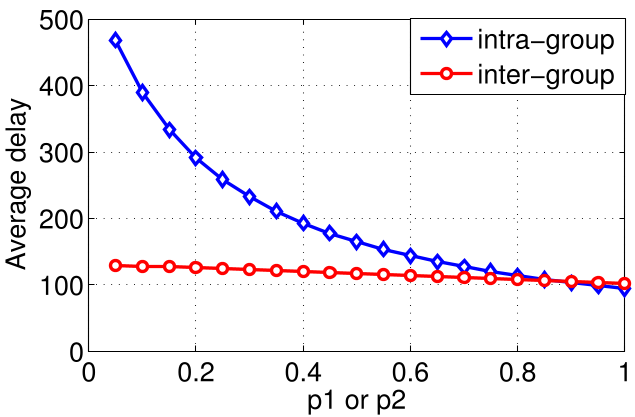 Graph (a) illustrates the exponential relationship between message bundle size and dissemination delay.
Critical Analysis & Future Outlook
While the model is elegant, it assumes exponential distributions for contact times. In reality, human mobility often follows "Power Law" distributions (heavy tails), where people stay together for a very long or very short time.
Future Directions:
- Integrating non-exponential contact models into the Markovian framework.
- Applying this model to "Fake News" or "Malware Propagation" in mobile environments to design better containment strategies.
Conclusion
This work transforms the "chaos" of mobile movement into a rigorous mathematical matrix. By quantifying the hidden costs of message size and user selfishness, it provides the essential "speedometer" needed for the next generation of decentralised social applications.