
Edge2vec: Revolutionizing Social Network Analysis via Direct Edge Embedding
Edge2vec: Edge-based Social Network Embedding
The paper introduces edge2vec, the first edge-based social network embedding method that directly maps edges to low-dimensional vectors. It combines a Deep Autoencoder with a Skip-gram model to preserve both local and global edge proximity, achieving superior performance in edge-centric tasks across multiple real-world social network datasets.
TL;DR
While traditional graph embedding methods focus on nodes, edge2vec represents a paradigm shift by mapping social network edges directly into low-dimensional space. By combining the reconstruction power of Deep Autoencoders with the local context capturing of Skip-gram, this method provides a high-fidelity representation of social ties, leading to State-of-the-Art (SOTA) results in link prediction, tie sign prediction, and direction recovery.
The "Edge" Case: Why Node-based Embeddings Fall Short
The current graph embedding landscape is dominated by node-centric algorithms like DeepWalk, node2vec, and LINE. These methods excel at capturing node similarities but treat edges as mere "connectors."
The Problem: To analyze an edge (e.g., predicting if a friendship is "strong" or "weak"), researchers typically perform an operation (like concatenation) on the vectors of the two endpoints. The Insight: This indirect mapping is lossy. An edge possesses its own structural identity (its own neighborhood and local role) that cannot be fully reconstructed from node metadata alone. Edge2vec addresses this by treating the edge as the primary unit of learning.
Methodology: The Dual-Proximity Architecture
Edge2vec is built on a sophisticated neural architecture designed to preserve two distinct types of structural information:
1. Global Proximity (The Deep Autoencoder)
Each edge is characterized by a neighborhood vector representing its -step reachability to other nodes. Using a deep autoencoder, edge2vec compresses these high-dimensional vectors.
- Goal: Ensure that edges with similar structural roles (even if far apart in the graph) have similar embeddings.
- Innovation: A -step adjacency matrix calculation that handles indirect relationships without the exponential growth in vector length.
2. Local Proximity (The Skip-gram Model)
Similar to how Word2vec treats words in a sentence, edge2vec treats edges sharing a vertex as "contextual."
- Goal: Maximize the probability that edges sharing a source or target node are close in the embedding space.
- Mechanism: Negative sampling to efficiently differentiate between truly adjacent edges and random noise.
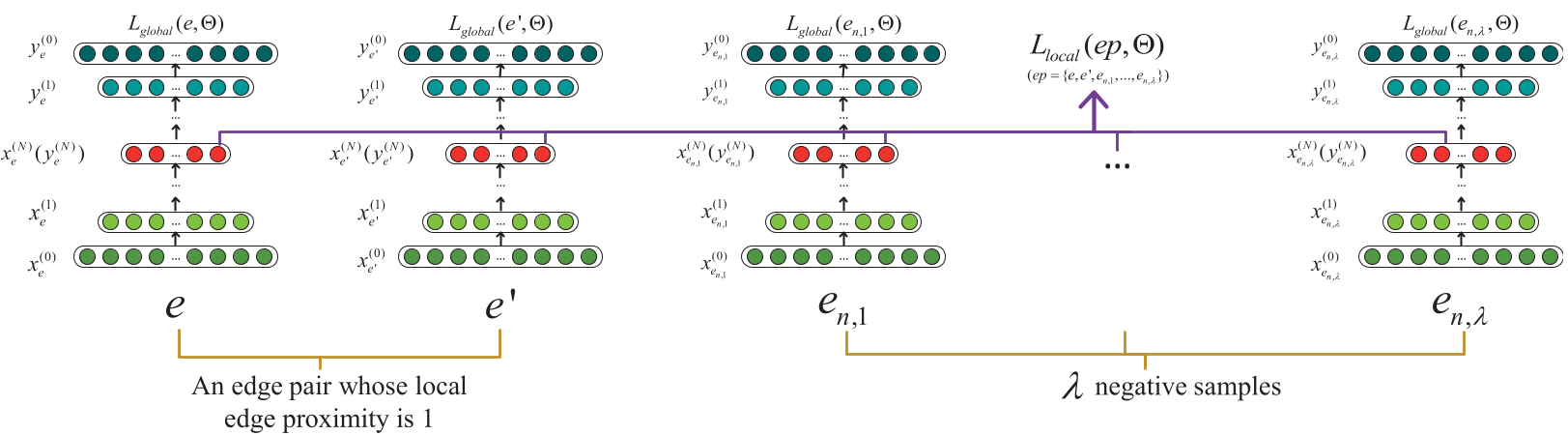 Figure 1: The edge2vec framework. Multiple deep autoencoders share parameters to process edge groups (target edge, context edge, and negative samples) simultaneously.
Experimental Performance: Direct Mapping Pays Off
The authors tested edge2vec against heavyweights like node2vec and SDNE across three critical tasks:
Link Prediction
Predicting future connections is the bread and butter of social network analysis. Edge2vec achieved significantly higher AUC scores across Epinions, LiveJournal, and Slashdot. Unlike node-based methods, edge2vec's direct focus on edge structure allows it to distinguish subtle connection patterns.
Social Tie Sign & Direction Prediction
In signed networks (Trust vs. Distrust), edge2vec showed a remarkable ability to predict tie signs (Positive/Negative) even when training on small fractions of data. Its performance in recovering the hidden directionality of social ties proves that the model successfully captures the "flow" of social influence.
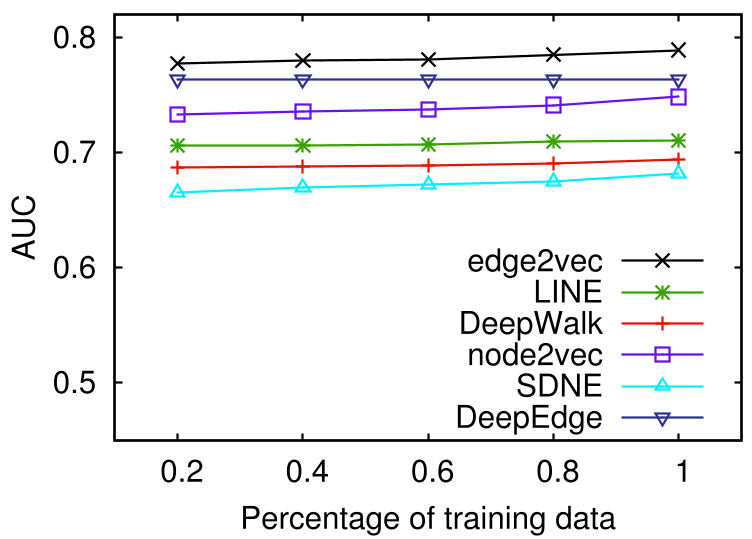 Figure 2: Performance comparison in Link Prediction and Direction Prediction. Edge2vec (blue line) consistently occupies the top position.
Critical Analysis & Takeaways
Key Strength: Edge2vec solves the "Line Graph" problem. While one could theoretically create a line graph (where edges become nodes) and run standard node2vec, that approach fails to capture global structure. Edge2vec’s neighborhood vector approach overcomes this limitation.
Limitations:
- Computational Cost: Using deep autoencoders on edge-sets is more expensive than node-sets (), though the authors argue that the bounded average degree in social networks makes this manageable.
- Unsupervised Nature: Currently, the model doesn't use edge labels (like "trust") during training, only during evaluation.
Future Outlook: The transition from node-based to edge-based representation is vital for the next generation of Recommender Systems. By understanding the relationship itself rather than just the entities, AI can better model social dynamics, fraud cascades, and influence propagation.
Summary Citation: Changping Wang, et al. "Edge2vec: Edge-based Social Network Embedding." ACM TKDD, 2020.