
Decoding the Invisible College: Structural Power in KM–IC Research
Editorial board interlocking in knowledge management and intellectual capital research field
This paper utilizes Social Network Analysis (SNA) to investigate Editorial Board Interlocking (EBI) within the Knowledge Management and Intellectual Capital (KM–IC) fields. By mapping 27 journals, it identifies a cohesive "invisible college" of influential publications, with the Journal of Knowledge Management (JKM) emerging as the central SOTA authority in structural influence.
TL;DR
Scholarship isn't just about citations; it's about the people who guard the gates. This study maps the Editorial Board Interlocking (EBI) in the Knowledge Management and Intellectual Capital (KM–IC) fields. It reveals that while the field is diverse, a tiny "invisible college" of interconnected journals—led by the Journal of Knowledge Management (JKM)—effectively sets the pace for what is considered legitimate science in the domain.
Background: Beyond the Citation Impact Factor
We usually judge a journal's prestige by its Impact Factor or ranking. However, these are "lagging" indicators. The authors argue that Editorial Boards are the "leading" indicators. They define the editorial policies, choose reviewers, and ultimately decide which theories live or die. When one scholar sits on multiple boards (EBI), they create a bridge—a conduit for paradigms to flow from one journal to another.
Methodology: Mapping the Power Grid
Using data from 27 top-tier KM–IC journals, the researchers applied Social Network Analysis (SNA) to 1,295 editorial positions held by 1,178 scholars. They measured influence using three dimensions:
- Degree Centrality: Who has the most "channels" (connections) to other journals?
- Betweenness Centrality: Who acts as the ultimate "gatekeeper" or broker between different research silos?
- Closeness Centrality: Whose ideas can spread through the network with the fewest hops?
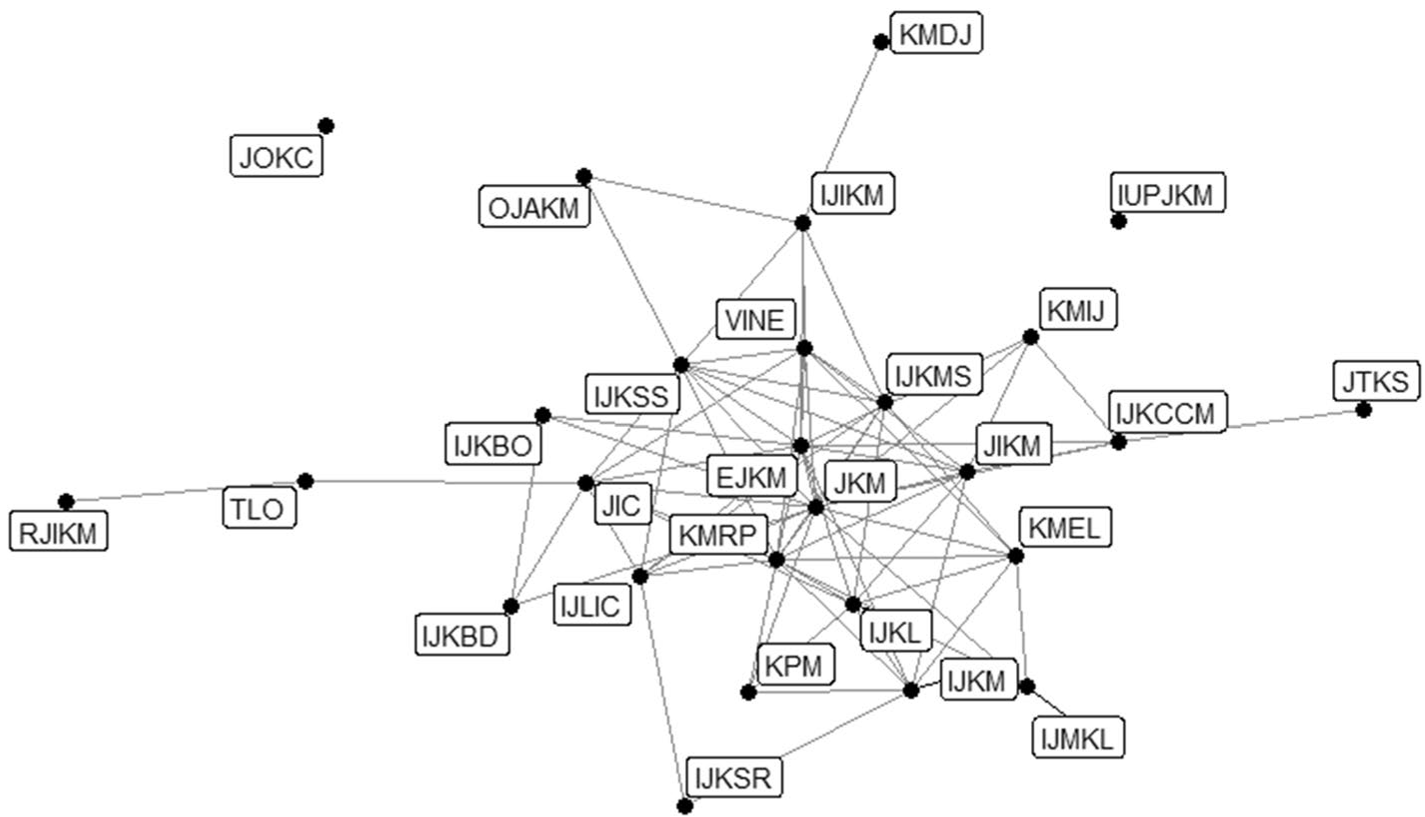 Figure 1: The structural map of KM-IC journals. Note the central positioning of JKM and the relative isolation of peripheral journals.
The Core Discovery: The "Invisible College"
The study finds that KM–IC is more cohesive (22% density) than fields like Statistics (14%) or Economics (2.3%). However, this cohesion is not uniform.
The researchers identified a "5-core" subgroup—a dense nucleus of 13 journals where everyone is connected to at least 5 others. Within this core, a smaller "invisible college" exists: JKM, KMRP, EJKM, and JIC. These four journals are not just highly ranked; they are intensely interlocked, meaning a small elite group of scientists is essentially curating the "gold standard" for the entire discipline.
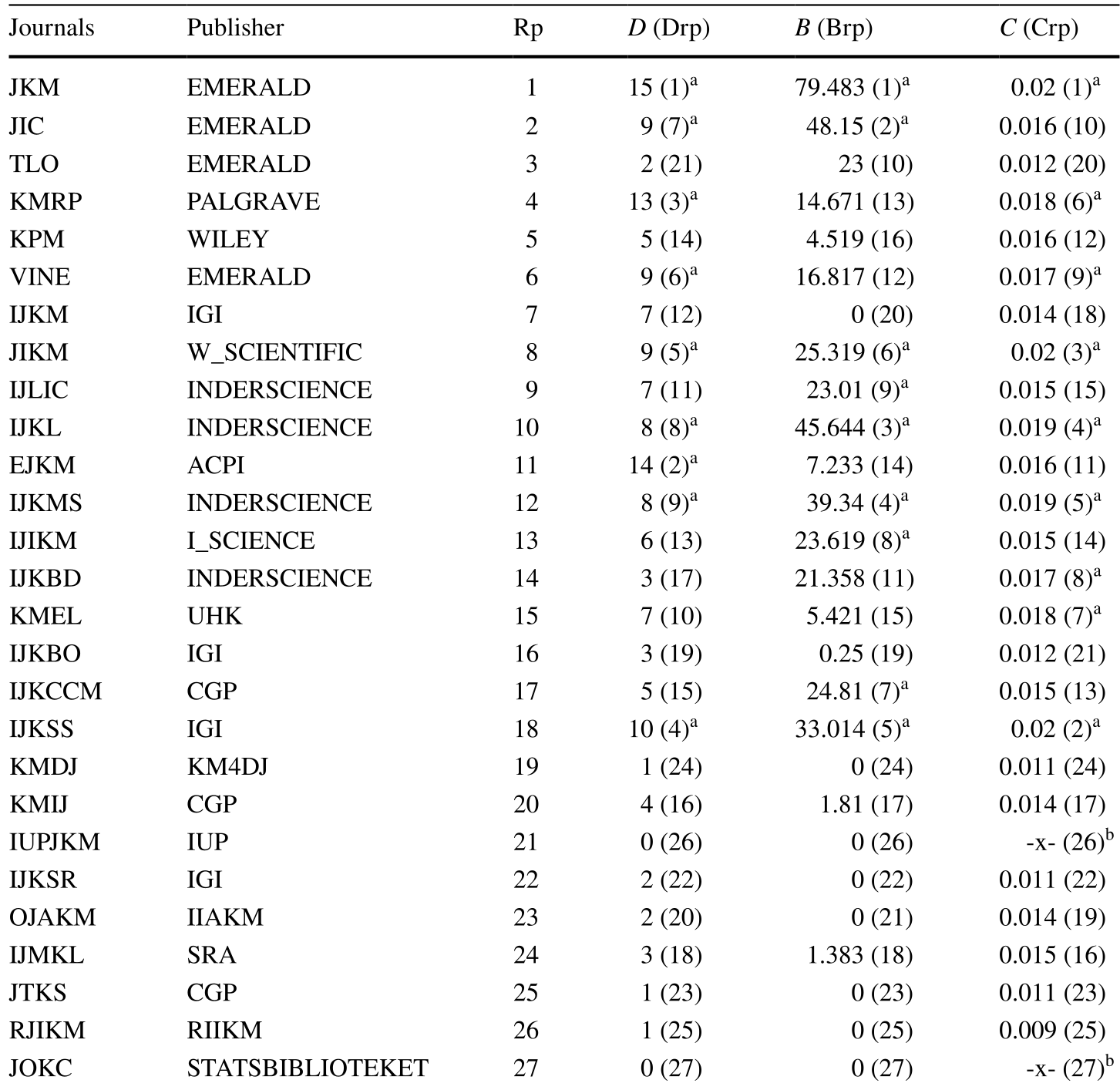 Table 1: Comparison of rankings vs. structural centrality. Note that some journals like IJKSS have much higher structural influence than their citation rank suggests.
Strategic Insights: Why This Matters
The most striking finding is the "De-coupling" of Rank and Centrality. Specifically:
- The Hidden Influencers: Journals like International Journal of Knowledge and Systems Science (IJKSS) rank 18th in traditional lists but are in the top 5 for "Closeness" and "Betweenness." This means if you want a new methodology to go "viral" in the editorial circuit, IJKSS might be a more effective entry point than a higher-ranked but structurally isolated journal.
- The Power of Weak Ties: The Journal of Information and Knowledge Management (JIKM) acts as a vital bridge between the tightly knit "5-core" and the rest of the network, echoing Granovetter’s famous theory on the strength of weak ties.
Critical Analysis & Future Outlook
While the KM–IC field avoids a "superstar" monopoly, the existence of a high-density core suggests that breaking into the field with radical, "outside-the-box" theories might be difficult if they don't align with the values of the "invisible college."
Limitations: The study focuses on structural potential for influence. It does not analyze the content of the journals to see if editorial interlocks actually lead to "groupthink" in published papers.
Conclusion: For authors and academic strategists, this paper proves that the "political map" of a field is just as important as its "citation map." If you want to change a field, you don't just need citations—you need to understand the network of the gatekeepers.