
Culturally Familiar Graphical Passwords: A Security Paradox in the Age of Social Media
Educated Guessing Attacks on Culturally Familiar Graphical Passwords Using Personal Information on Social Networks
This paper investigates the vulnerability of recognition-based graphical passwords to educated guessing attacks. It specifically explores how cultural familiarity and personal data shared on social networks (e.g., Facebook, Instagram) can be exploited to compromise security.
TL;DR
Recognition-based graphical passwords (selecting a set of images instead of typing text) are great for memory but may be a "sitting duck" for social engineering. This research proves that if your password images are culturally familiar to you, they are significantly easier for friends, family, or social media stalkers to guess. The study highlights a critical trade-off: the more meaningful a picture is to a user’s background, the more vulnerable it is to an educated guess.
Background Positioning
In the landscape of authentication, this paper serves as a vital security audit of existing recognition-based schemes. It shifts the focus from collective guessing (what most people choose) to individualized educated guessing, specifically highlighting the vulnerability created by our digital shadows on social networks.
The Problem: The Usability-Security Trade-off
Traditional alphanumeric passwords (e.g., Pa$$w0rd123) are notorious for being weak or forgotten. Graphical passwords solve the memory issue because humans are wired for image recognition. However, the authors' previous research showed that users prefer images from their own culture.
The insight here is that "meaning" equals "predictability." If an attacker knows your culture and your hobbies (thanks to Instagram), the search space for your password shrinks from thousands of random images to a handful of culturally relevant icons.
Methodology: Simulating the Social Engineer
The researchers set up a "friendly attack" scenario:
- Participants: 48 attackers (friends/family) targeting 17 victims.
- Data Sources: Attackers used direct knowledge of the victim and their social media profiles (Facebook, Instagram).
- The Challenge: Guess a 4-image password from challenge sets containing 1 target and 15 decoys.
Architecture of the Guessing Attack
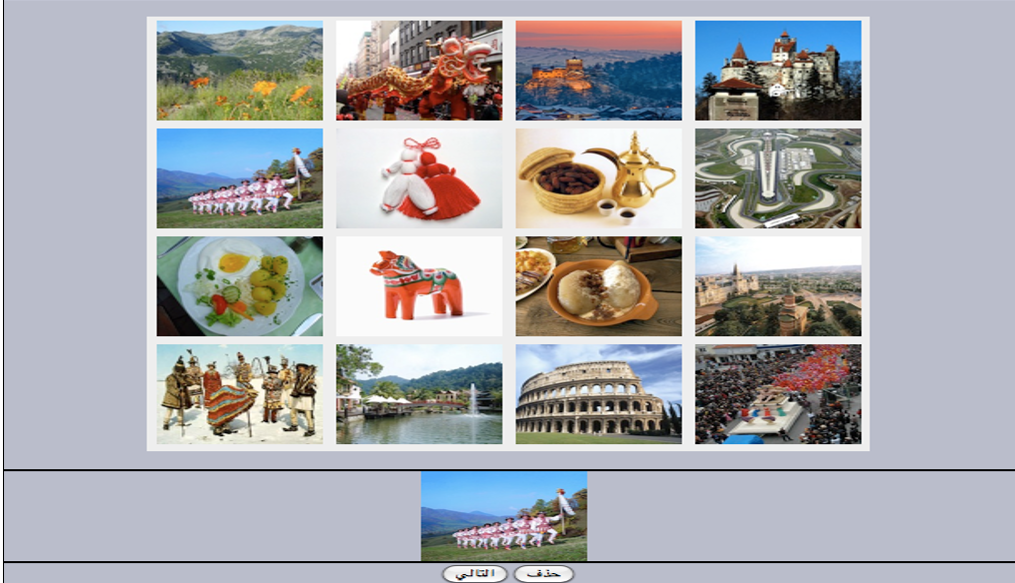 Figure 1: A challenge set featuring a mix of culturally familiar and unfamiliar pictures.
Experiments & Results: The Social Media Advantage
The findings were stark. Cultural familiarity provides a clear "roadmap" for attackers.
- Familiar vs. Unfamiliar: Familiar pictures were significantly easier to guess. In the second attempt, familiar pictures had a success rate nearly 10x higher than unfamiliar ones.
- The Social Media Factor: Attackers who used social media info were much more successful at identifying familiar target images compared to those relying solely on memory.
- The "Popularity" Trap: The top 10% most-chosen images in the database (e.g., religious landmarks or iconic buildings) were the most vulnerable.
Performance Comparison
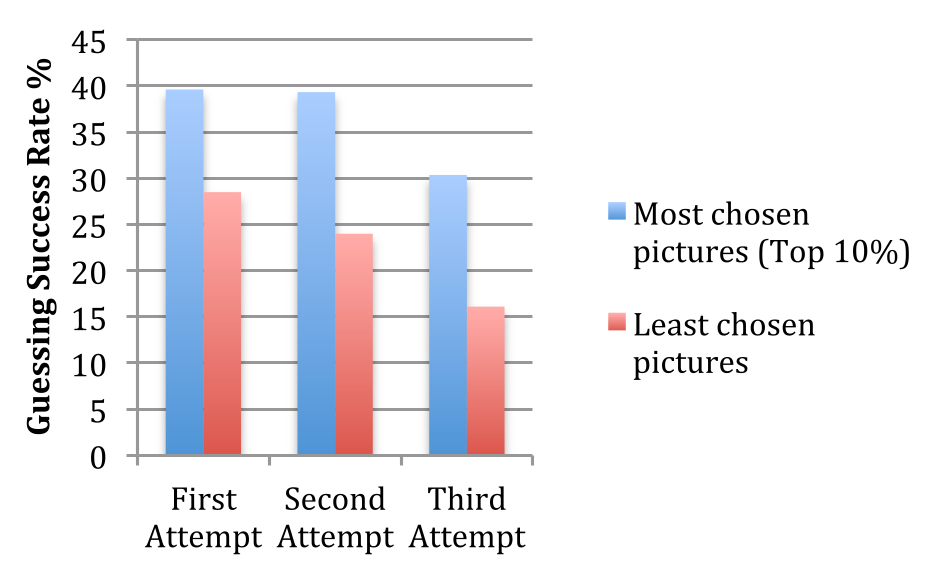 Figure 2: The success rate for most-frequently chosen vs. least-frequently chosen pictures.
Depth Insight: Why Does This Happen?
The study reveals that most attackers focus on Interests (56.3%). In a world where we "Like" and "Follow" our interests publicly, we are essentially publishing the building blocks of our graphical passwords.
- Collective Guessing: Attackers guess religious images for Saudi users or alcohol-related images for UK users because they are culturally pervasive.
- Individual Guessing: Attackers use Instagram to see that a victim likes "Manchester United," then look for football-related images in the challenge set.
Critical Analysis & Conclusion
Takeaway
Culturally familiar graphical passwords are a triple threat: they are predictable due to cultural tropes, discoverable via social media, and concentrated around a few "popular" images.
Limitations
The study used a relatively small sample of 17 victims. Furthermore, the decoys were random; if the decoys had all been from the same culture, the guessing success rate might have dropped significantly (the "Familiar Decoy" hypothesis).
Future Outlook
To save the "Cultural Graphical Password" concept, we must implement Security Guidelines during registration—warning users not to pick "the obvious" (e.g., the Eiffel Tower for a French user). More importantly, the system should generate homogenous challenge sets where every decoy is as culturally relevant as the target, effectively hiding the needle in a stack of identical needles.