
The Big Data Revolution in Educational Data Mining: From Passive Tracking to Active Intervention
Research on Educational Data Mining Based on Big Data
This paper provides a comprehensive review of Educational Data Mining (EDM) in the big data era, focusing on personalized learning, student behavior analysis, and dropout prediction. It introduces an experimental comparison of various machine learning models, demonstrating that Multi-Layer Perceptron (MLP) achieves SOTA-level performance (Accuracy 0.873) in predicting student attrition.
TL;DR
Educational Data Mining (EDM) is undergoing a paradigm shift. Moving away from static questionnaires, modern EDM leverages deep learning and big data to predict student dropouts and personalize learning paths. This paper reviews the current landscape and demonstrates that neural networks, specifically Multi-Layer Perceptrons (MLP), now outperform traditional statistical models in identifying "at-risk" students with over 87% accuracy.
Background & Motivation
Education has entered the "Big Data Era." With the explosion of MOOCs (Massive Open Online Courses) and intelligent learning platforms, we are no longer starved for data; we are drowning in it. Traditional EDM methods—which relied on manual surveys—are incapable of processing the "4Vs" (Volume, Velocity, Variety, Veracity) of modern educational logs.
The core motivation of this research is to solve the high dropout rate in online education and the lack of personalized guidance. By analyzing fine-grained behavior (watching videos, wiki browsing, forum participation), can we intervene before a student quits?
Methodology: The Shift to Deep Learning
The paper distinguishes between traditional algorithms and the new "Big Data" approach:
- Personalized Recommendation: While Collaborative Filtering is the standard, it suffers from "Cold Start" (new users) and "Data Sparsity." The authors highlight LSTM (Long Short-Term Memory) and Deep Belief Networks (DBN) as superior alternatives that model the evolution of a user's interests over time.
- Behavior Mining: Moving beyond simple frequency counts, the research discusses the use of Social Network Analysis (SNA) to measure collaborative knowledge sharing and Association Rules (like Fui-DK) to find hidden correlations between courses and performance.
- Dropout Prediction: The paper details a 3-step pipeline: Data Preprocessing, Model Training/Tuning (using cross-validation), and Effect Evaluation (Precision, Recall, F1).
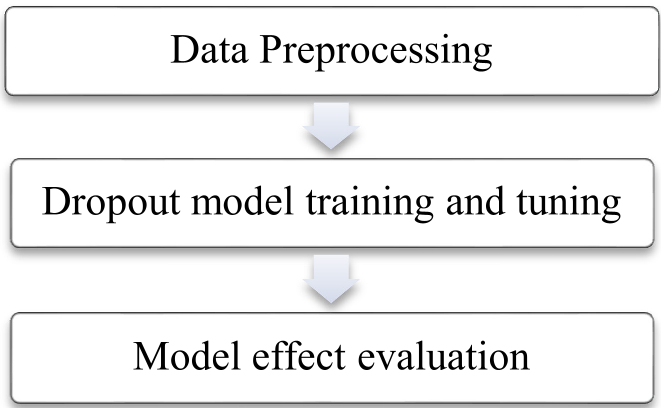 The generalized process for dropout prediction involves rigorous feature selection and cost-sensitive learning to handle unbalanced datasets.
Experiments and Comparative Analysis
The authors conducted an experiment using the KDD Cup 2015 dataset, which contains over 120,000 activity logs from the XuetangX platform. They compared traditional classifiers with deep learning models.
Performance Comparison:
| Model | Accuracy | Recall | F1-Score |
|---|---|---|---|
| Logistic Regression (LR) | 0.821 | 0.833 | 0.827 |
| Decision Tree (DT) | 0.798 | 0.815 | 0.806 |
| Support Vector Machine (SVM) | 0.661 | 0.712 | 0.686 |
| MLP (Neural Network) | 0.873 | 0.892 | 0.882 |
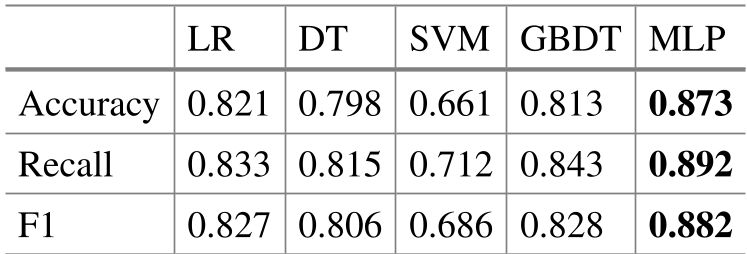
Insight: SVM performed poorly because it is fundamentally unsuited for large-scale sample mining. In contrast, MLP showed superior performance, confirming that neural networks are better at fitting the non-linear complexities of educational big data.
Critical Analysis & Future Outlook
While the results are promising, the authors identify several critical "bottlenecks" in current EDM research:
- Low Interpretability: Deep learning models are often "black boxes." Teachers need to know why a student is flagged for dropout to provide meaningful intervention.
- The "Cold Start" Problem: Predictive accuracy remains low for new students with no historical data.
- Teacher-Centric Mining: Current research is heavily skewed toward student behavior. The role of teacher behavior and instructional design in student success remains under-researched.
Conclusion
This paper serves as both a roadmap and a benchmark for the next generation of educational technology. The integration of Deep Learning into the classroom is no longer a theoretical exercise but a practical necessity to achieve large-scale personalized education. The next frontier? Making these models interpretable and including "Teacher-in-the-loop" data.