
Recommendation Systems in Higher Education: Bridging the Gap from Prediction to Retention Mitigation
An Overview on the Use of Educational Data Mining for Constructing Recommendation Systems to Mitigate Retention in Higher Education
This paper presents a Systematic Literature Review (SLR) on Educational Data Mining (EDM) and Recommendation Systems (RS) aimed at mitigating student retention in higher education. By analyzing 31 selected studies, the authors identify machine learning methods—predominantly Decision Trees, Random Forests, and Matrix Factorization—used to predict academic performance and guide course selection.
TL;DR
This study provides a comprehensive Systematic Literature Review (SLR) of 31 papers at the intersection of Educational Data Mining (EDM) and Recommendation Systems (RS). It highlights that while we are excellent at predicting when a student might fail, the field is still in its infancy regarding recommending specific, proactive pathways to prevent retention.
Background: The STEM Retention Crisis
Student retention—the delay in program completion—is a critical bottleneck in higher education, especially within STEM fields. Retention often precedes total dropout, resulting in wasted institutional resources and lost career potential. The authors position EDM not just as a statistical tool, but as the engine for Decision Support Systems that can steer students toward success.
Problem & Motivation: Why Prediction Isn't Enough
Most existing literature treats "student performance prediction" as an end goal. However, knowing a student is at risk of failing "Calculus II" is only half the battle. The challenge lies in the Inductive Bias of these systems: they often ignore the contextual factors (family income, sponsor status, etc.) and the "what next?" factor. The authors argue that the real value lies in integrating these predictions into a Recommendation System that assists in course enrollment.
Methodology: The Landscape of EDM
The review categorizes the technical approaches into three distinct tiers:
1. Supervised Learning (The Predictors)
Algorithms like Decision Trees are favored for their interpretability—allowing administrators to see why a student is flagged. More complex models like Gradient Boosting and Bayesian Networks are used when accuracy in high-fail subjects (Physics, Programming) is paramount.
2. Unsupervised Learning (The Profile Builders)
Clustering (e.g., R-KM algorithm) is used to segment students into profiles. This helps in understanding the "hidden" characteristics of students who might stay in the program vs. those who might abandon it.
3. Recommendation Mechanisms (The Action Takers)
This is the most specialized category. Techniques include:
- Collaborative Filtering: Suggesting courses based on what similar successful students took.
- Matrix Factorization: Capturing latent factors between student capabilities and course difficulty.
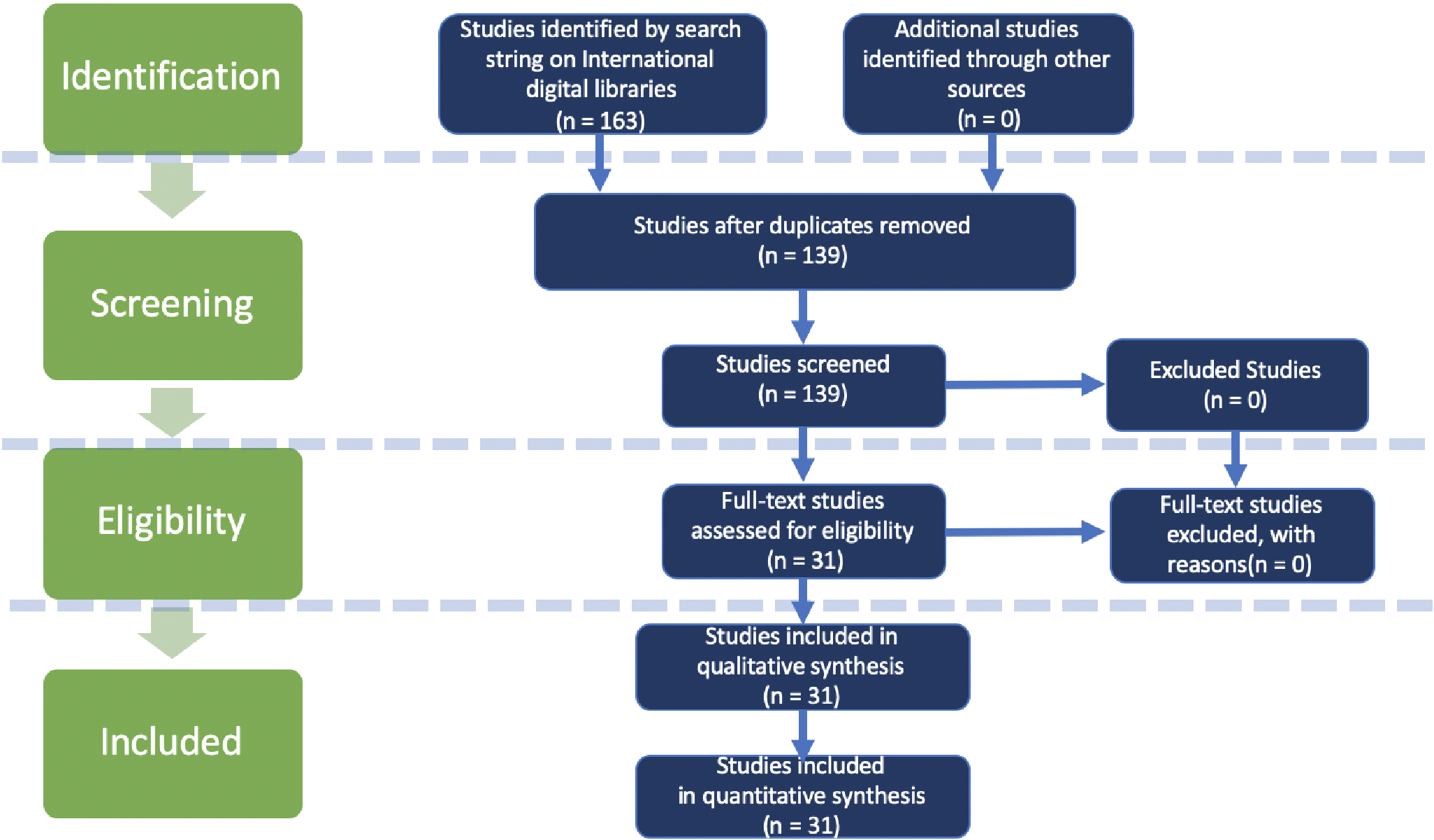 The selection process followed the PRISMA guidelines, refining 163 initial results down to 31 high-impact studies.
Key Experimental Insights
The review highlights a definitive hierarchy in algorithm performance. For instance, in classification tasks, Random Forest consistently outperformed single decision trees and K-Nearest Neighbors in predicting first-year success.
Another significant finding is the importance of "Non-Academic" features. Factors such as parents' educational qualification and family income were identified by experts as "very influential" in predicting student outcomes, yet they are often under-utilized in automated EDM models.
 The objective distribution reveals that 'Performance Prediction' dominates the field, while 'New RS' implementation remains a sparse research area.
Critical Analysis & Conclusion
Takeaway
The core contribution of this work is the identification of a Recommendation Gap. We have the data and the predictive power, but we lack the frameworks to translate these into personalized course advisors.
Limitations
A notable gap in the analyzed papers is the exclusion of Distance Learning (DL) data. While the authors excluded DL to focus on face-to-face interactions, the unique digital footprints left in Virtual Learning Environments (VLEs)—like forum participation and login frequency—could significantly enhance the RS models for traditional universities as well.
Future Outlook
The next frontier in EDM lies in Directed Acyclic Graphs (DAGs) to map academic paths and "Additive Latent Effect" models that account for the individual professor's influence on a student's grade. As the field matures, we expect to see "Intelligent Academic Advisors" that don't just predict grades, but curate entire degree paths tailored to a student's socio-economic and academic profile.