
Decoding the DNA of Learning: A Data-Driven Analysis of EDM Trends
Educational data mining: A survey and a data mining-based analysis of recent works
This paper provides a comprehensive survey and data-driven analysis of Educational Data Mining (EDM) research published between 2010 and early 2013. It analyzes 240 works to establish a systematic profile of EDM approaches, categorizing them into six core functional areas and identifying prevalent patterns in the methods and tools used across the field.
TL;DR
This seminal review by Alejandro Peña-Ayala doesn't just list EDM papers—it mines them. By analyzing 240 research works from 2010 to 2013, the author uncovers the "Standard Model" of educational data mining, revealing that the field is heavily tilted toward predictive modeling of student performance using a core set of probabilistic and machine learning algorithms.
Contextualizing the EDM "Teenage" years
While Data Mining has long served industry, its application to education is relatively recent. Peña-Ayala argues that the period between 2000 and 2010 represents the childhood of the field, while the 2010-2013 era marks its "adolescence"—a time of rapid expansion, specialization, and the emergence of dedicated conferences and journals. The core challenge addressed here is the lack of a formal "profile" that connects educational needs to specific technical mechanisms.
The Anatomy of an EDM Approach
The paper's most significant contribution is the categorization of EDM into six functional pillars:
- Student Modeling: Shaping the learner's digital twin (cognition, affect, skills).
- Student Behavior Modeling: Tracking real-time actions like "gaming the system" or "help-seeking."
- Student Performance Modeling: Predicting grades and success/failure.
- Assessment: Refining the accuracy and difficulty of evaluation.
- Student Support & Feedback: Recommender systems and automatic hint generation.
- Curriculum & Sequencing: Optimizing the path through learning materials.
Methodology: Preaching by Example
Instead of a traditional narrative review, the author uses a Knowledge Discovery in Databases (KDD) workflow to analyze the literature.
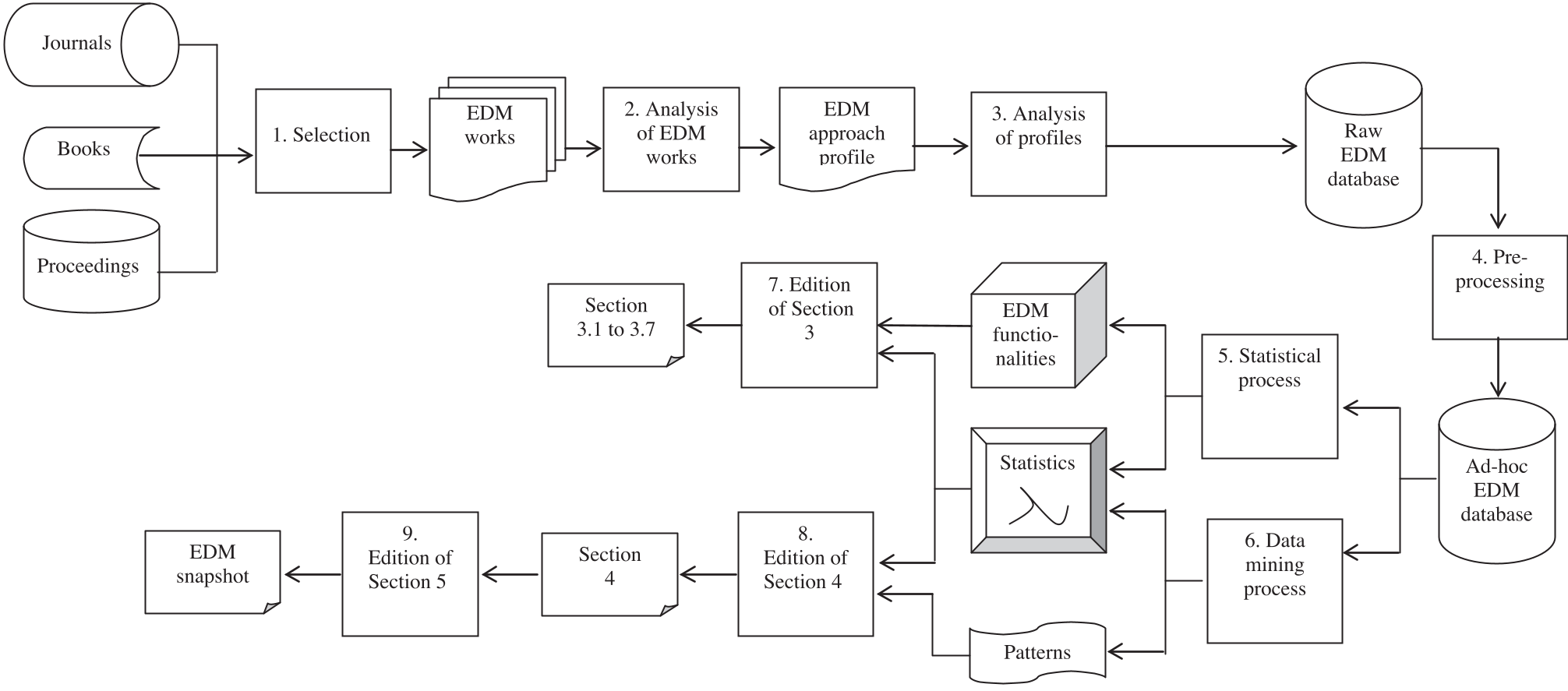 Figure 1: The 9-task KDD workflow used to mine 240 research papers.
This rigorous approach identified that the "Standard Menu" of EDM relies on a few "staple ingredients":
- Disciplines: Probability (37%), Machine Learning (33%), and Statistics (17%).
- Tasks: Classification (42%) and Clustering (27%) are the dominant engines.
- Algorithms: K-means for grouping and EM/J48 for prediction.
Key Patterns Discovered
Through clustering, the author discovered two distinct patterns that define the field:
The Predictive Pattern (The "Forecaster")
Used primarily for Student Behavior Modeling and Assessment. These models rely on the Probability discipline and favor Bayesian Networks and Decision Trees. They thrive in environments like ITS (Intelligent Tutoring Systems) where data is structured and fine-grained.
The Descriptive Pattern (The "Observer")
Typically applied to Curriculum Design and Teacher Support. These models leverage Machine Learning and Statistics, utilizing Association Rules and Clustering (K-means). They are more common in LMS (Learning Management Systems) like Moodle, where the goal is to discover hidden relationships in navigation and resource usage.
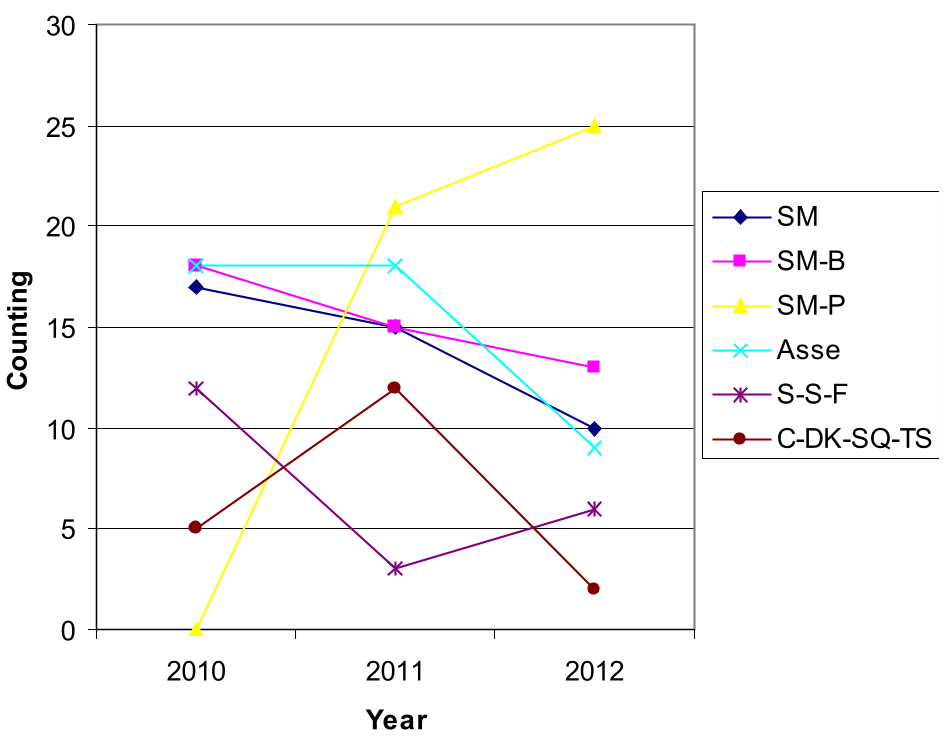 Figure 3: Performance of different EDM functionalities over the 2010-2012 period.
Critical Insight: The SWOT Analysis
The review concludes with a brutally honest SWOT analysis:
- Strength: A robust cross-disciplinary foundation.
- Weakness: Over-reliance on "Student Modeling" while ignoring curriculum and teaching support; research is often "users of tools" rather than "creators of new algorithms."
- Opportunity: The massive growth of Mobile/U-learning provides new types of data (spatial, semantic, social).
- Threat: A lack of standard terminology and the risk of being ignored by the broader DM community.
Conclusion: Toward a Hot Summer Season
As we move further into the era of Big Data, this survey serves as a fundamental coordinate system. While EDM was in its "spring time" in 2013, the patterns identified—specifically the dominance of BKT (Bayesian Knowledge Tracing) and the reliance on classification—set the stage for the Deep Learning revolution that followed in the late 2010s. For anyone entering the field, this paper defines the core syllabus of what has been done and where the "white space" for innovation lies.