
Mapping the Evolution of Learning Science: A Systematic Review of EDM (2006-2013)
Educational Data Mining: A Systematic Review of the Published Literature 2006-2013
This paper provides a systematic review of the Educational Data Mining (EDM) field between 2006 and 2013. Using a forward-chaining methodology based on the seminal 2007 survey by Romero and Ventura, the authors categorize 281 highly-cited papers into specific application domains, publication types, and educational tasks.
TL;DR
This research provides a comprehensive map of the Educational Data Mining (EDM) landscape during its foundational years of growth. By analyzing 281 significant papers using a forward-chaining method, the authors identify the shifting priorities of the field—from early theoretical explorations to high-impact applications like performance prediction and personalized learning.
Context: Why Systematic Reviews Matter for EDM
Education today generates a massive digital footprint through log files, discussion forums, and interactive exercises. EDM emerged to transform this "raw data" into "golden knowledge." However, as the field peaked after the establishment of the International EDM Society in 2008, the academic community needed a clear taxonomy to understand where research effort was being spent and where gaps remained.
Methodology: The Chaining Approach
Rather than a random keyword search, the authors utilized a forward-chaining technique. They started with the 2007 seminal survey by Romero and Ventura as a "foundation stone" and traced every significant paper that cited it. This allowed them to capture the direct genealogy of the field's evolution.
Core Classification Framework
The researchers categorized the literature across three dimensions:
- Quantitative Metrics: Publication year, venue (Journal vs. Conference), and top contributors.
- Application Domains: Where the mining happens (e.g., Educational Games, Mobile Learning).
- Technical Tasks: What the mining achieves (e.g., Student Modeling, Social Network Analysis).
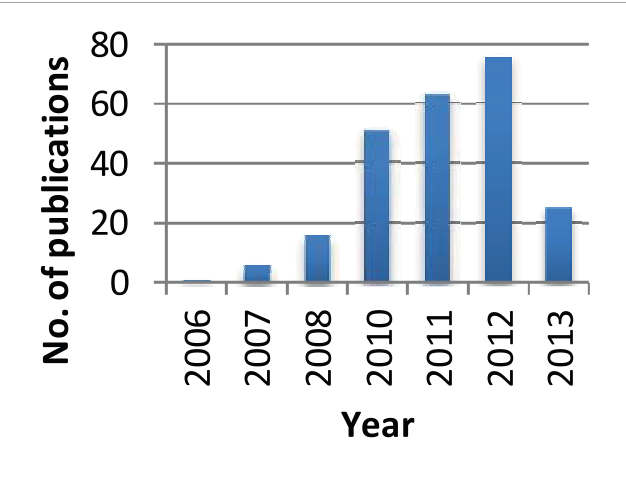 The chart on the left illustrates the rapid acceleration of EDM research following the inaugural EDM conference in 2008.
Key Insights: What the Data Tells Us
1. The Heavy Hitters of Research
The study identifies "Scientific Research into Learning" and "Learning Objects" as the most saturated domains, comprising over 60% of the literature. This indicates a strong academic focus on the mechanics of learning rather than the delivery methods (like Games or Mobile learning), which remained surprisingly under-researched (only 2% each).
2. The Dominance of Prediction
When looking at technical tasks, Predicting Student Performance (41 articles) stands as the primary goal. This involves estimating unknown values such as test scores or potential dropouts—a critical utility for proactive institutional intervention.
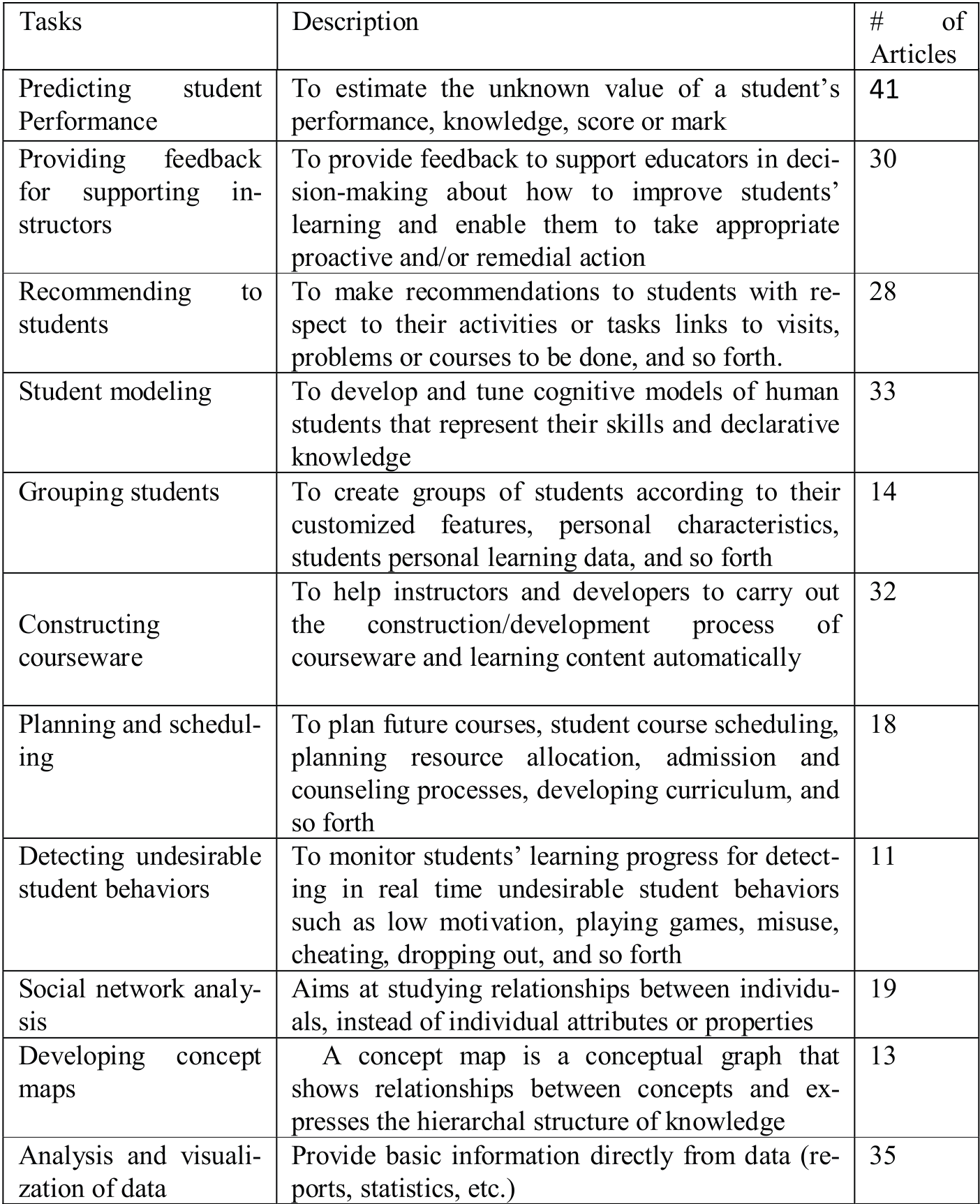 A breakdown of the 11 key tasks in EDM, showing the high concentration of work in prediction, modeling, and visualization.
Critical Analysis & Future Outlook
While the period from 2006-2013 established EDM as a "concrete and solid science," the authors point out a persistent Usability Gap.
- The Problem: Most EDM tools developed in this era were standalone prototypes created by researchers for researchers.
- The Future: To achieve real-world impact, these algorithms must be "embedded automatically" into Learning Management Systems (LMS). The goal is to move beyond academic papers and into the hands of educators through intuitive, attractive dashboards.
Limitations
As a retrospective, this study is limited by its focus on English-language publications and its reliance on the Romero and Ventura citation chain. However, as a historical snapshot, it highlights the essential transition from simple data reporting to complex predictive modeling in education.
Conclusion
This review serves as a vital anchor for anyone entering the field of learning analytics. It demonstrates that while we have become experts at predicting student outcomes, the next frontier lies in deployment—making these insights actionable for the average teacher in a real-time classroom setting.