
Virtual Social Scaffolding: Visualizing Group Dynamics for Children with Autism
Designing an Educational Game Facilitating Children’s Understanding of the Development of Social Relationships Using IVAs with Social Group Dynamics
The paper introduces a Virtual Learning Environment (VLE) designed to help children, specifically those with Autism Spectrum Disorder (ASD), understand and explore complex social dynamics. By utilizing Intelligent Virtual Agents (IVAs) that model social group dynamics, the system visualizes emerging social structures in simulated everyday scenarios like school playgrounds.
TL;DR
Socializing isn't just about talking; it’s a complex "dance" of spatial distance and group positioning. This paper presents a Virtual Learning Environment (VLE) that uses Intelligent Virtual Agents (IVAs) to model these subtle social physics. By simulating playground and canteen scenarios, the system helps children with autism visualize and navigate the invisible structures of peer relationships.
Background: The Invisible Walls of Social Interaction
In social settings, humans follow unspoken rules regarding personal space (Proxemics) and how we stand in circles or groups (F-formations). For neurotypical individuals, these are "unconscious reactions." However, for children on the autism spectrum, these invisible walls can be impenetrable barriers to communication.
The authors identify a critical gap: existing educational tools often focus on 1-on-1 interactions but fail to capture the dynamic "Social Lattice"—the way relationships shift when multiple people interact in a shared space.
Methodology: Modeling the "Social Physics"
The core innovation lies in the integration of classic sociological theories into the AI architecture of autonomous agents:
- Proxemics (Hall, 1966): Defining the "bubbles" of personal, social, and public space.
- F-formation (Kendon, 1977): Modeling how people orient their bodies to create shared spaces of interaction (e.g., how three people form a triangle to include or exclude others).
Agent-Based Social Structure
By embedding these rules, the agents in the VLE don't just stand still; they "negotiate" space. As the child user moves through the virtual playground, the agents shift their orientations, reflecting the emergence of social bonds and group boundaries.
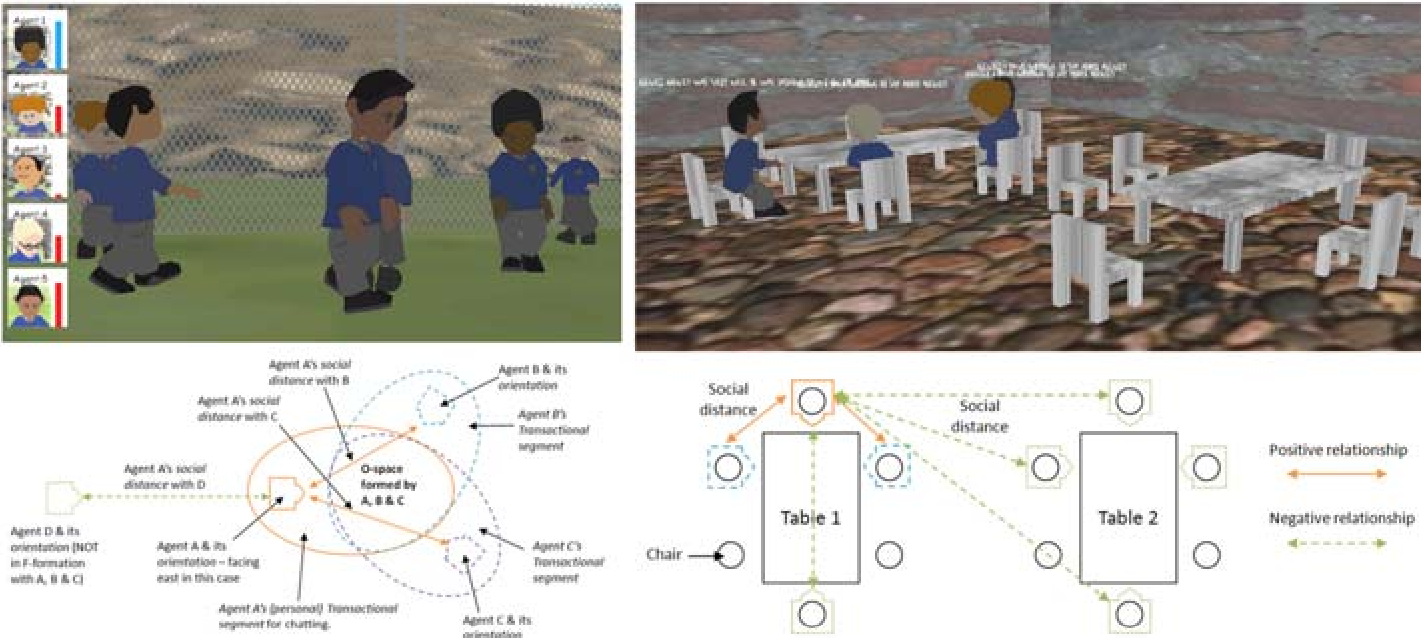 Figure 1: A visualization of the virtual playground where agents interact according to social group dynamics.
Insights from the Playground
The authors emphasize that the goal isn't just to mimic human movement, but to provide a visual feedback loop. When a child approaches a group of agents, the agents’ reaction—either opening the circle to welcome the user or maintaining a closed formation—serves as a safe, repeatable laboratory for the child to experiment with social "steering."
Key Contribution over SOTA:
Unlike static social stories, this system is dynamic and emergent. It doesn't follow a fixed script; the "social structure" is a real-time output of the underlying proxemic algorithms. This allows children to observe the consequences of their spatial choices in real-time.
Critical Analysis & Future Outlook
The paper establishes a robust theoretical foundation for "Social IVAs," yet several questions remain:
- Scalability: How do these social rules hold up in larger crowds?
- Transferability: Can the lessons learned in a simplified VE transition to the messy, unpredictable environment of a real school canteen?
Future Outlook: As VR and AR technology becomes more accessible, integrating these "Social Physics" models into head-mounted displays could provide real-time social "HUDs" (Heads-Up Displays) for neurodivergent individuals, helping to bridge the gap between virtual practice and real-world application.
Conclusion
Ho and Dautenhahn remind us that social intelligence is as much about geometry as it is about linguistics. By making the "hidden dimension" of human interaction visible through IVAs, they provide a powerful tool for social empowerment.