
Digital Footprints of Academic Mobility: Decoding Russian Migration to China via Social Media
Educational migration from Russia to China: social network data
This study analyzes educational migration from Russia to China by mining "digital footprints" from the social networking site VK (Vkontakte). Using conditional inference trees, the authors identify key geographic and institutional factors that predict student outflows, achieving a high model fit of R² = 0.86.
TL;DR
By mining data from VK (Vkontakte), Russia's largest social network, researchers have successfully modeled the educational migration flow of Russian students to China. The study finds that while the distance to the Chinese border matters, the "competing pull" of major Russian metropolitan hubs is the primary factor. However, where domestic attraction is weak, institutional support like Confucius Institutes and university web presence act as critical catalysts for migration.
The Shift in the Global Educational Map
For decades, China was the primary exporter of students to Western universities. Today, the tide is turning. China is positioning itself as a regional educational powerhouse, attracting thousands of students from neighboring Russia. But why do some Russian cities send more students to Beijing or Shanghai than others?
Traditional methods rely on census data, which is often outdated or lacks the resolution of individual city origins. This paper pivots to "Digital Footprints", utilizing the transparent nature of social media profiles to track real-time educational trajectories.
Methodology: Tree-Based Insights
The authors collected 8,131 migration trajectories from VK users who graduated school in Russia and enrolled in Chinese universities. They employed Conditional Inference Trees, a non-parametric method that avoids the biases of traditional regression when dealing with highly correlated spatial data.
The model categorized predictors into three zones:
- Push Factors: Local economic and ecological conditions.
- Pull Factors: Proximity to the Chinese border and local Chinese cultural institutions.
- Competing Pull: Proximity to Russia’s own educational and economic centers (Moscow, St. Petersburg, etc.).
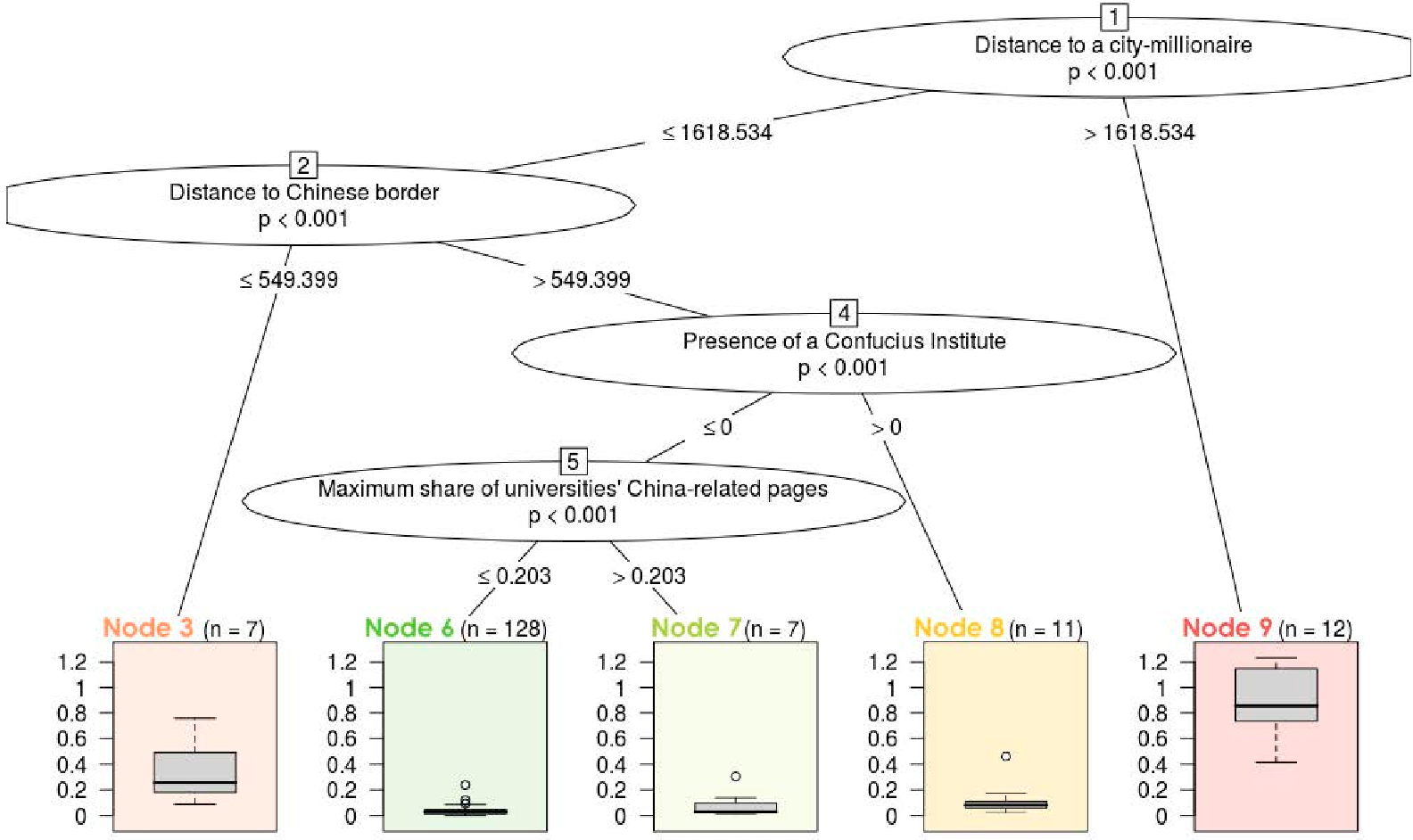 Figure 1: The resulting inference tree demonstrates how geographical distance and institutional presence bifurcate migration patterns.
Key Findings: Hubs vs. Borders
The results provide a fascinating look at the "gravity" of educational centers:
- The Power of Russian Hubs: The most significant split in the data is the distance to Russian cities with populations over 1 million. If a student is near a major Russian hub, they are statistically less likely to migrate to China, as the local "pull" is too strong.
- The Border Effect: For cities near the Chinese border (within 550km), migration is high due to cultural and economic integration.
- Institutional Bridges: In regions far from both Russian hubs and the Chinese border, institutional presence is the "deal-breaker." The existence of a Confucius Institute or a university website with high China-related content significantly increases the per-capita migration rate (as seen in nodes 7 and 8 of the tree).
Critical Analysis & Future Outlook
This work demonstrates the high predictive power (R² = .86) of social network data in sociology. The use of "Web presence" as a variable—the share of pages mentioning China on local university websites—is a particularly clever proxy for institutional focus.
Limitations: The study focuses on 2016 data. Since then, geopolitical shifts and the "Belt and Road Initiative" have likely intensified these flows. Furthermore, VK data represents a specific demographic (younger, tech-savvy), which might not capture students who don't use the platform.
Conclusion: The takeaway for policymakers is clear: institutional support and cultural branding (online and offline) are just as important as geography. For researchers, this paper serves as a blueprint for using social media mining to forecast international human capital flows.
 Figure 2: The geographical spread of the study highlights the vast distance-based factors in Russian educational migration.