
Mapping the Pulse of EdTech: A Social Network Revolution in Academic Analysis
Analysis and Research on Educational Technology Trends Based on High Quality Online Course
This paper presents a visual analysis of educational technology trends using Social Network Analysis (SNA) and the Gephi visualization platform. By processing keywords from 1,200 specialized articles, the author constructs "Knowledge Maps" to reveal the structural evolution and knowledge flow in the online course education domain.
TL;DR
How do we make sense of thousands of research papers published every year? This study moves beyond simple reading by treating the field of Online Course Education as a complex, living social network. By leveraging mathematical metrics like Eigenvector Centrality and Network Density, the author maps out the hidden architecture of educational technology, revealing which trends actually drive the industry and where the "knowledge gaps" reside.
Motivation: Moving Beyond the Human Bottleneck
In the digital era, the volume of educational research is expanding at a rate that traditional qualitative analysis cannot match. We often suffer from "siloed knowledge," where rural education experts and information technology developers might be working on similar problems without a unified framework. The author's intuition is that keywords are not just labels—they are the DNA of a research field. By analyzing how these keywords connect, we can visualize the "gravity" of certain ideas and identify "structural holes" where the next big innovation might occur.
Methodology: The Geometry of Knowledge
The core of this work lies in transforming text into a Weighted Undirected Graph. Unlike standard word clouds, this approach considers the quality of the connection by using funding levels as a weight multiplier.
1. Architectural Mapping
The researcher used Gephi (often called the "Photoshop of data visualization") to process 7,210 keyword pairs. The map doesn't just show what’s popular; it shows the topography of influence.
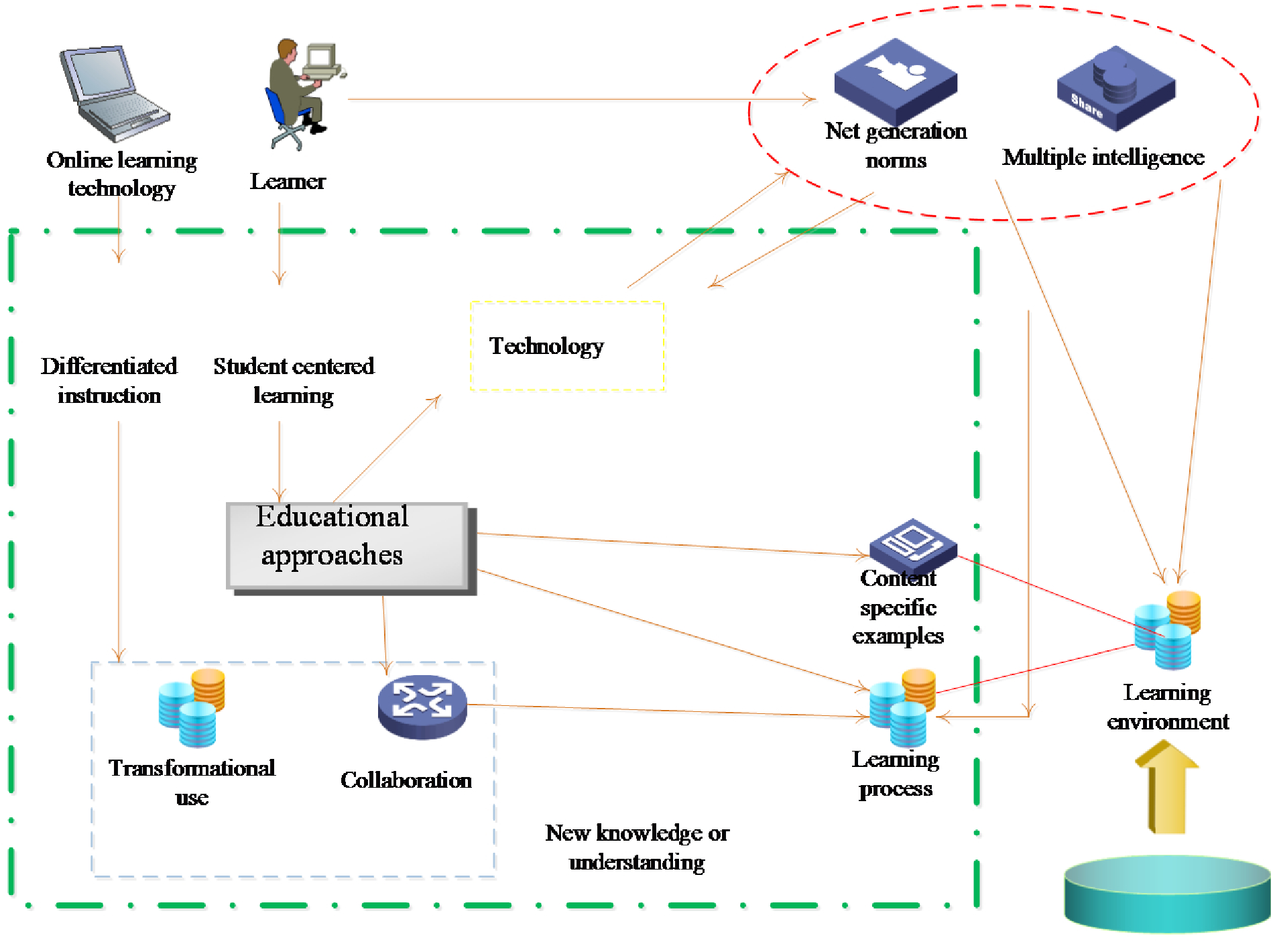 Figure: The research structure reveals how core educational concepts branch into specialized sub-fields.
2. The Math of Influence: Eigenvector Centrality
A key insight provided is that frequency (Degree) ≠ Importance. High-frequency words like "Information Technology" may appear often, but their "Eigenvector Centrality" might be low if they aren't connected to other influential nodes.
The author uses the formula for Graph Density: By calculating this for the 2019 dataset, the research found a density of 0.0231, proving that EdTech is currently a "sparse" field—highly specialized and decentralized, rather than tightly unified around a single dogma.
Experiments & Key Findings: The 2019 Snapshot
The analysis of the 2019 knowledge map (Figure 1 and 2 in the paper) revealed a significant divide.
- The Homogeneity Paradox: While "Modern Online Course Education" and "Rural Cadre Education" seem related, mathematical clustering showed they are heterogeneous. They exist in different "sub-groups," suggesting a lack of knowledge flow between urban and rural ed-tech research.
- The Hubs: As expected, "Online Course Education" remains the sun in this solar system, but "Content Analysis" and "Learning Resources" are the "structural bridges" that connect disparate research clusters.
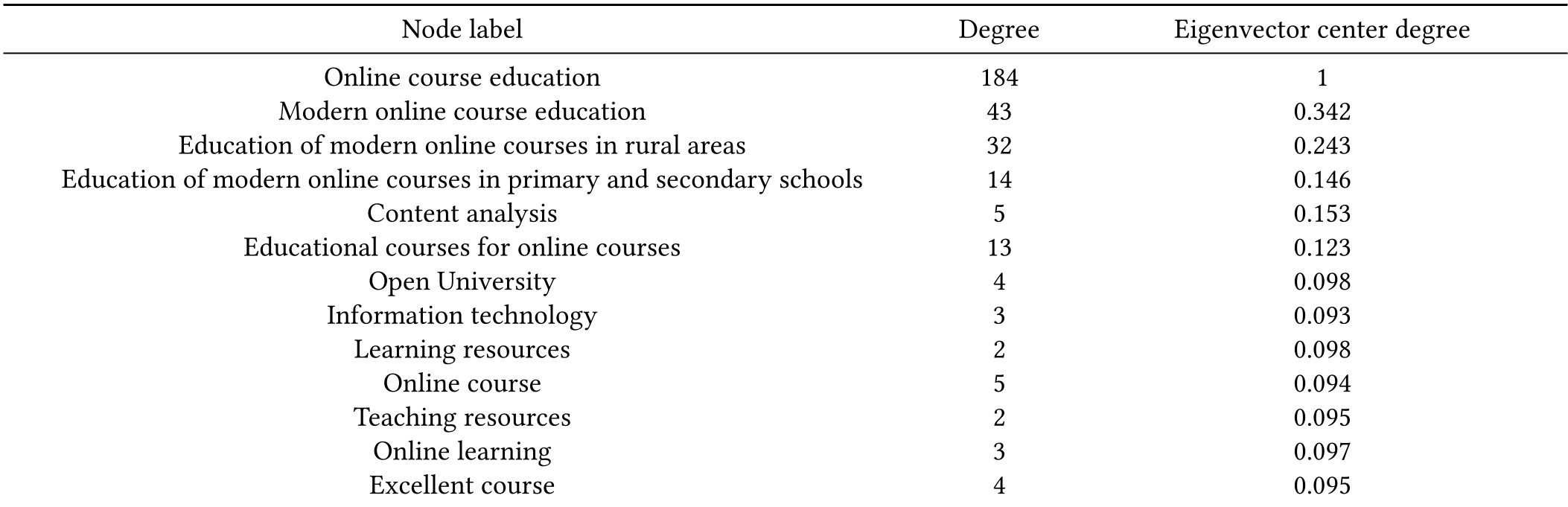 Table 1: Comparison of Node Degree vs. Eigenvector Centrality—showing that "Learning Resources" carries significant structural weight despite lower frequency.
Critical Insight & Future Outlook
The primary takeaway is the identification of Structural Holes. In network theory, a structural hole is a gap between two clusters. For entrepreneurs and PhDs, these holes are "gold mines"—they represent opportunities to connect two previously unrelated fields (e.g., applying advanced "Content Analysis" to "Rural Online Education").
Limitations: The paper correctly points out that keyword usage is often inconsistent ("synonym noise"). While the author used semantic cleaning, the field desperately needs a standardized Educational Vocabulary Library to improve the precision of these digital maps.
In conclusion, the study proves that Social Network Analysis is no longer just for sociologists; it is a vital tool for any technologist or policymaker looking to navigate the increasingly complex web of modern education.