
Deciphering Silent Emotions: How Hybrid Heuristics Reveal Neural Patterns in Deaf Subjects
EEG-Based Emotion Recognition of Deaf Subjects by Integrated Genetic Firefly Algorithm
This paper introduces a specialized EEG emotion recognition framework for deaf subjects, utilizing a novel Integrated Genetic Firefly Algorithm (IGFA) for feature selection and classifier optimization. The method achieves a state-of-the-art average classification accuracy of 96.1% across positive, neutral, and negative emotions while significantly reducing feature dimensionality.
TL;DR
Recognizing emotions in deaf individuals via EEG presents unique challenges, as their neural pathways often adapt to a lack of auditory input. This study proposes the Integrated Genetic Firefly Algorithm (IGFA), a hybrid optimization technique that achieves a remarkable 96.1% accuracy in emotion classification while stripping away 95.9% of redundant data. The results reveal that for deaf subjects, the occipital and parietal lobes play a surprisingly active role in emotional processing.
Background: Beyond the Hearing Norm
Standard Affective Computing research heavily relies on datasets from hearing participants. However, the brain is highly plastic; in the absence of sound, the cortex reorganizes itself. This study sought to map these unique "neural signatures" by establishing a dedicated dataset of 15 deaf subjects and developing a machine learning pipeline capable of pinpointing the most discriminative physiological features among thousands of candidates.
The Problem: The Curse of Dimensionality and Local Optima
While fusing various features (21 types across 5 frequency bands and 62 channels) provides a rich view of brain activity, it results in a massive 6510-dimensional feature vector. Traditional "Wrapper" methods like basic Firefly Algorithms (FA) often get stuck in local optima (premature convergence), retaining far too many irrelevant features and slowing down real-time BCI applications.
Methodology: The IGFA Architecture
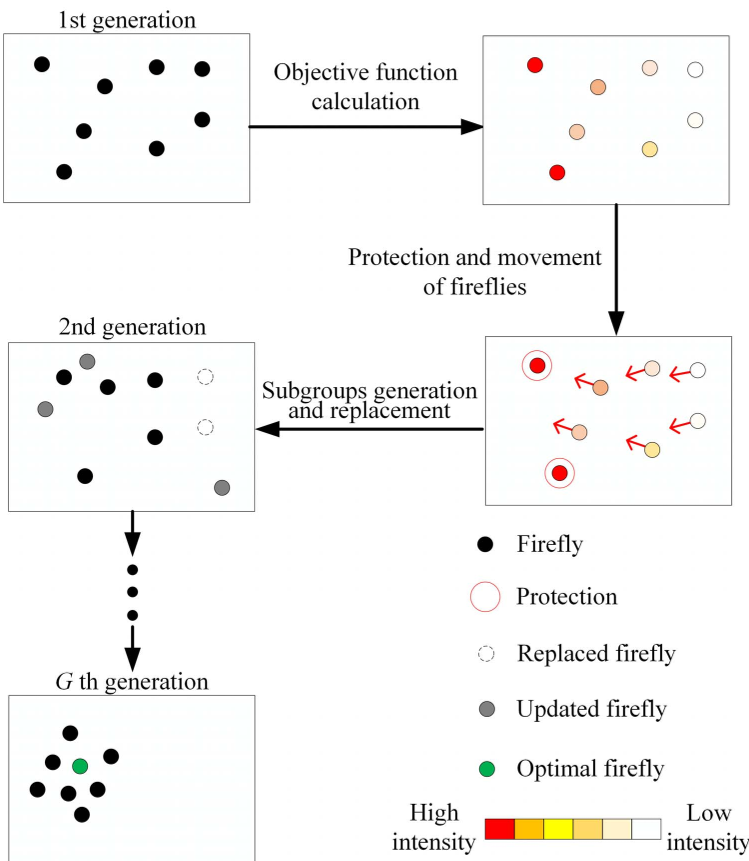
The authors' core contribution is the Integrated Genetic Firefly Algorithm (IGFA). It treats feature selection as a multi-objective search for the "brightest firefly."
1. Hybrid Encoding & Initialization
Each "firefly" represents a potential solution, encoded with a binary part (for feature selection) and an integer part (to select the optimal classifier, such as SVM-Linear, KNN, or DT).
2. Strategic "Brightening" (Evolution)
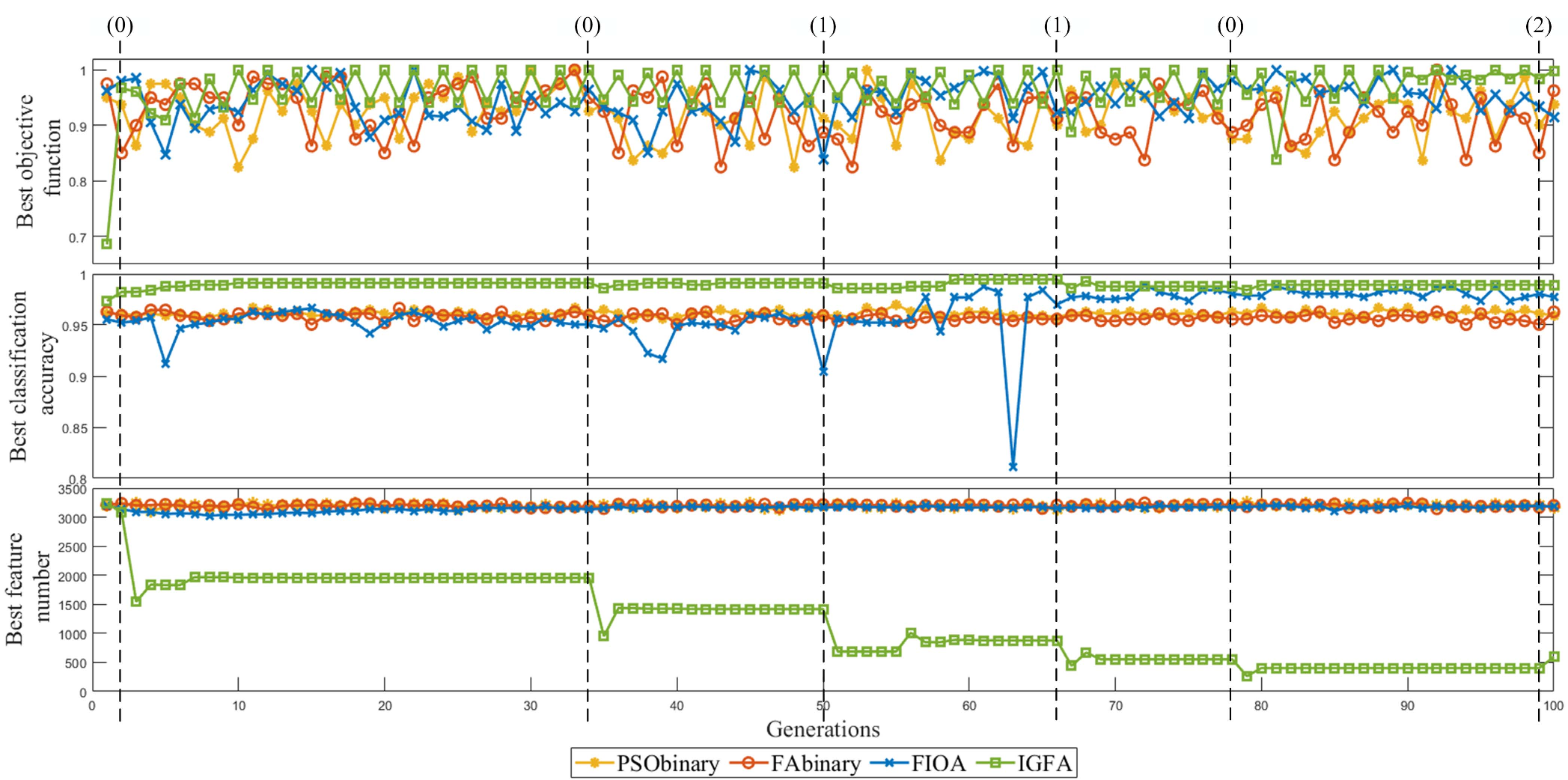
- Variable Weight Objective: Unlike static weights, IGFA dynamically shifts focus between classification accuracy and feature reduction. In the final generations, it prioritizes accuracy to ensure no critical emotional information is lost.
- Population Protection: The top 5% of solutions are immune to random movement, ensuring that the "best-so-far" solution is never accidentally degraded.
- Subgroup Generation (The GA Twist): To escape local minima, the algorithm generates new subgroups based on the elite fireflies, forcing the search into more efficient, lower-dimensional areas of the feature space.
Experimental Results: Precision and Efficiency
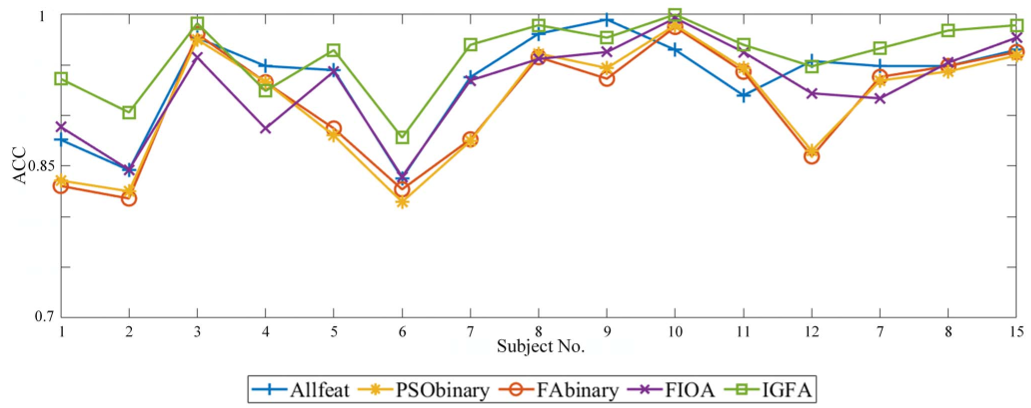
The IGFA was pitted against standard PSO, traditional FA, and the previously state-of-the-art FIOA.
- Accuracy: IGFA reached 96.1%, outperforming FIOA (93.0%).
- Dimensionality Reduction: This is where the paper shines. While other methods barely reduced the feature set by 50% (~3200 features), IGFA successfully compressed the input to just 264 features on average.
- Classifier Insight: Interestingly, SVM-Linear consistently yielded the best results, suggesting that the collected EEG signals for deaf subjects are linearly separable when the feature set is correctly optimized.
Deep Insight: A Different Brain Map
The most profound finding lies in the topographic maps. In hearing individuals, emotion is predominantly linked to the frontal and temporal lobes. Deaf subjects share these markers, but they also show significant activity in the occipital (visual) and parietal (sensory integration) lobes.
Why? The authors hypothesize that because deaf individuals rely more heavily on visual cues for emotional context, their brains have recruited visual processing centers to assist in emotional decoding—a classic example of cortical cross-modal plasticity.
Conclusion and Future Outlook
This work demonstrates that "one size fits all" models in BCI are likely insufficient. By using IGFA, researchers can prune unnecessary EEG channels, paving the way for lightweight, wearable emotion-recognition headsets specifically designed for the deaf community. Future work will likely look at applying these hybrid heuristic methods to multi-modal data (EEG + Facial Expressions) to further enhance robustness.
Takeaway: Effective feature selection isn't just about math; it's about understanding the underlying neurobiology. IGFA provides the surgical precision needed to find the needle in the neural haystack.