
Hierarchical Subnetwork Nodes: A Bio-Inspired Leap in EEG Emotion Recognition
EEG-Based Emotion Recognition Using Hierarchical Network With Subnetwork Nodes
2017-03-22
Summary
Problem
Method
Results
Takeaways
Abstract
This paper introduces a Hierarchical Network with Subnetwork Nodes for EEG-based emotion recognition, classifying states into positive, neutral, and negative. By replacing traditional hidden nodes with flexible subnetwork modules and utilizing non-iterative learning, the method achieves SOTA performance across single and multimodal datasets.
## TL;DR
Researchers have developed a novel hierarchical neural network that mimics the mammal cortex's heterogeneous neural activity to recognize human emotions. By replacing individual hidden neurons with complex **subnetwork nodes** and utilizing high-speed non-iterative learning (Moore-Penrose inverse), the model achieves over **91% accuracy**, significantly outperforming traditional Deep Belief Networks (DBN) and SVMs in both speed and precision.
## Problem & Motivation: The "Messy" Reality of Brain Waves
Human emotion recognition via Electroencephalography (EEG) is notoriously difficult. Unlike images or speech, EEG signals are:
- **Non-stationary**: They change unpredictably over time.
- **Temporal Asymmetry**: Patterns don't repeat linearly.
- **Low Signal-to-Noise Ratio (SNR)**: Real emotional cues are often buried under muscle artifacts and electrical noise.
Current Deep Learning (DL) methods struggle because they rely on **Backpropagation**, which is slow and prone to local minima. Furthermore, standard neural architectures assume "homogeneous" nodes, whereas biological evidence from the prefrontal cortex suggests that **heterogeneous, disordered neural activity (mixed selectivity)** is actually the key to complex cognition.
## Methodology: The Architecture of Local Experts
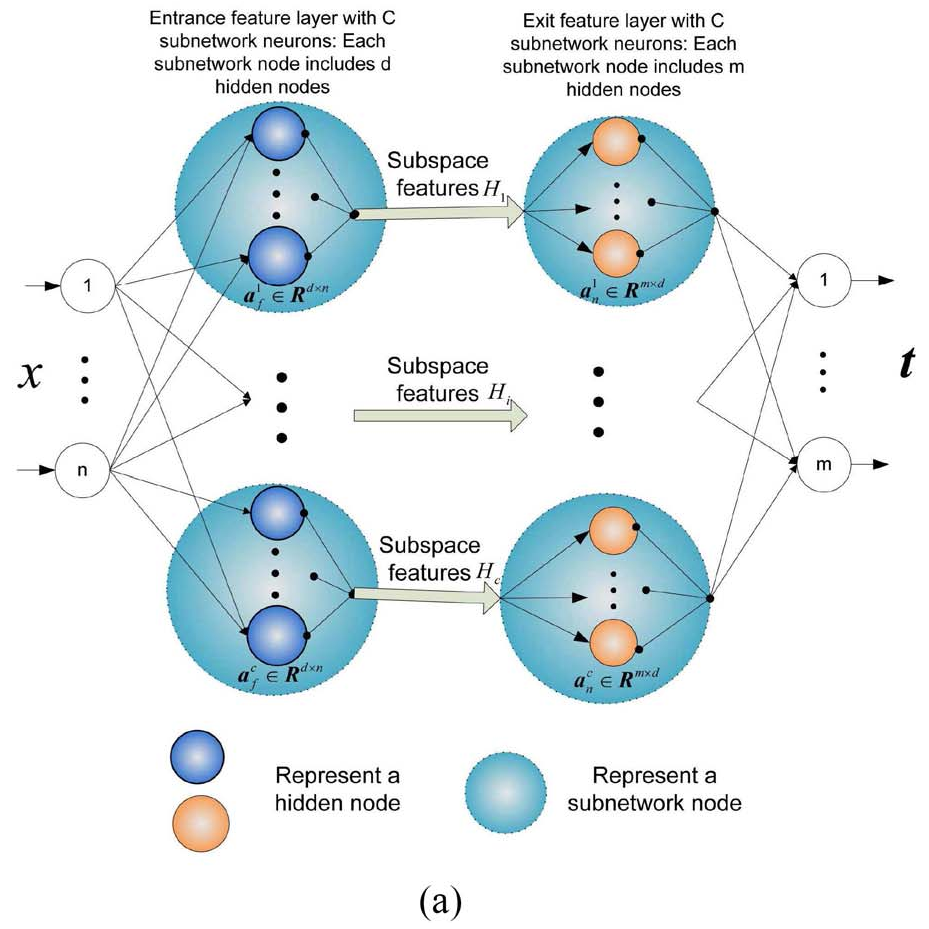
The core innovation of this paper is the **Subnetwork Node**. Instead of a single neuron representing a feature, a subnetwork node—consisting of hundreds of hidden nodes—acts as a local, independent feature representation layer.
### 1. The Hierarchical Structure
The network is divided into two primary parts:
- **Part I (Local Feature Extraction)**: Two-layer networks with subnetwork nodes extract "subspace features."
- **Part II (Pattern Learning)**: These features are fused and passed to a top-level classifier.
### 2. Why it’s Faster: Non-Iterative Learning
The authors bypass the "gradient descent" trap. By using the **Moore-Penrose generalized inverse** for weight calculation, the network can determine optimal parameters in a single step (or very few steps), drastically reducing computational workload compared to traditional DL.
### 3. Multimodal Fusion
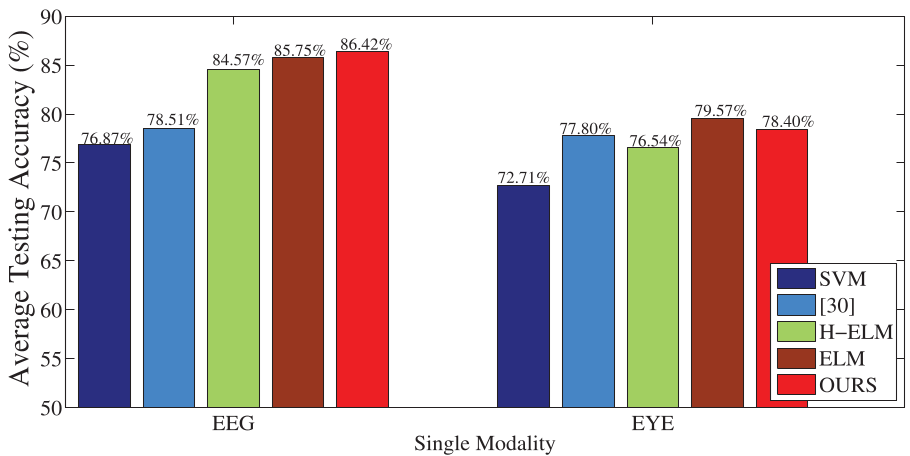
The architecture naturally scales. By employing **Early Fusion** or **Maxpooling**, the model can combine EEG data with Eye-movement features (pupil diameter, blink duration, etc.), recreating the multi-sensory integration of the human brain.
## Experiments & Results: Crushing the Baselines
The model was tested on two major datasets (including the high-standard **SEED** dataset).
- **Subject Dependent Test**: The model reached **93.26%** accuracy using Differential Entropy (DE) features, surpassing DBN (86.08%) and SVM (83.99%).
- **The Ultimate Stress Test**: In a "one classifier for all" challenge (changed times, persons, and stimulations), the proposed method maintained strong performance while traditional ELMs and SVMs saw significant drops. The accuracy boost in these tough scenarios reached up to **14%**.
### The Importance of Differential Entropy (DE)
The study confirms that DE features—which distinguish between low and high-frequency energy—remain the most effective input for EEG-based emotion recognition across all tested frequency bands.
## Critical Analysis & Conclusion
### Takeaway
The shift from "deep and narrow" (many simple layers) to **"hierarchical and wide" (modular subnetwork layers)** is a winning strategy for physiological signals. The biological intuition—that neurons must work in heterogeneous groups to manage high-dimensional cognitive tasks—is mathematically validated here.
### Limitations
While the non-iterative learning is fast, it requires the activation functions to be **invertible**. This limits the choice of non-linearities compared to standard backprop models. Additionally, the memory footprint increases as subnetwork nodes grow to include "hundreds" of internal nodes.
### Future Outlook
This framework paves the way for real-time BCI (Brain-Computer Interface) applications, where training must be instantaneous and robust enough to handle the hardware noise of consumer-grade EEG headsets.
---
**Editor's Note**: This work effectively bridges the gap between neurophysiological theory and practical machine learning, proving that "structured disorder" in neural design is often better than uniform architecture.