
Elevating EEG Emotion Recognition: The Power of SVM-RFE in High-Dimensional Neural Data
EEG-Based Emotion Recognition Using a Wrapper-Based Feature Selection Method
This paper presents a robust EEG-based emotion recognition framework utilizing Recursive Feature Elimination (RFE) as a wrapper-based feature selection method. Tested on the DEAP dataset, the approach achieves state-of-the-art results across valence, arousal, dominance, and liking scales using a combination of spectral, oscillation, and entropy features.
Executive Summary
TL;DR: This study addresses the complexity of decoding human emotions from brainwaves by introducing a refined feature selection pipeline. By utilizing Recursive Feature Elimination (RFE), the authors successfully distilled 786 EEG-derived features down to the most impactful 196, achieving a breakthrough accuracy of ~80% on the DEAP dataset—surpassing previous benchmarks by nearly 10%.
Context: Within the landscape of Affective Computing, this work acts as a significant "Refinement and Optimization" study. It demonstrates that before jumping to complex Deep Learning architectures, traditional machine learning coupled with sophisticated wrapper-based feature selection can still set new SOTA records.
The "Curse of Dimensionality" in EEG
Brain signals are notoriously noisy and high-dimensional. When we decompose 32 electrodes into 5 frequency bands (Delta, Theta, Alpha, Beta, Gamma) and add spatial asymmetry features (comparing the left and right hemispheres), the feature space explodes.
The problem with prior research is two-fold:
- Redundancy: Many EEG features are highly correlated, leading to "noise" that confuses classifiers.
- Overfitting: With too many features and limited trials, models simply memorize the noise rather than learning the underlying emotional patterns.
Methodology: Pruning the Neural Noise
The core innovation is the application of Recursive Feature Elimination (RFE) with a linear Support Vector Machine (SVM) backbone.
1. Feature Extraction Trinity
The authors didn't just look at power; they used three distinct types of features:
- Spectral Power: Logarithms of power in major rhythms.
- Oscillation & Entropy: Capturing the complexity and randomness of the signal via Shannon entropy.
- Hemispheric Asymmetry: Measuring the difference between symmetrical electrode pairs, a known biological marker for emotional valence.
2. The RFE Wrapper Mechanism
Unlike "filter" methods (like Pearson correlation) which look at features in isolation, RFE is a wrapper. It evaluates feature sets by their actual performance in a model.
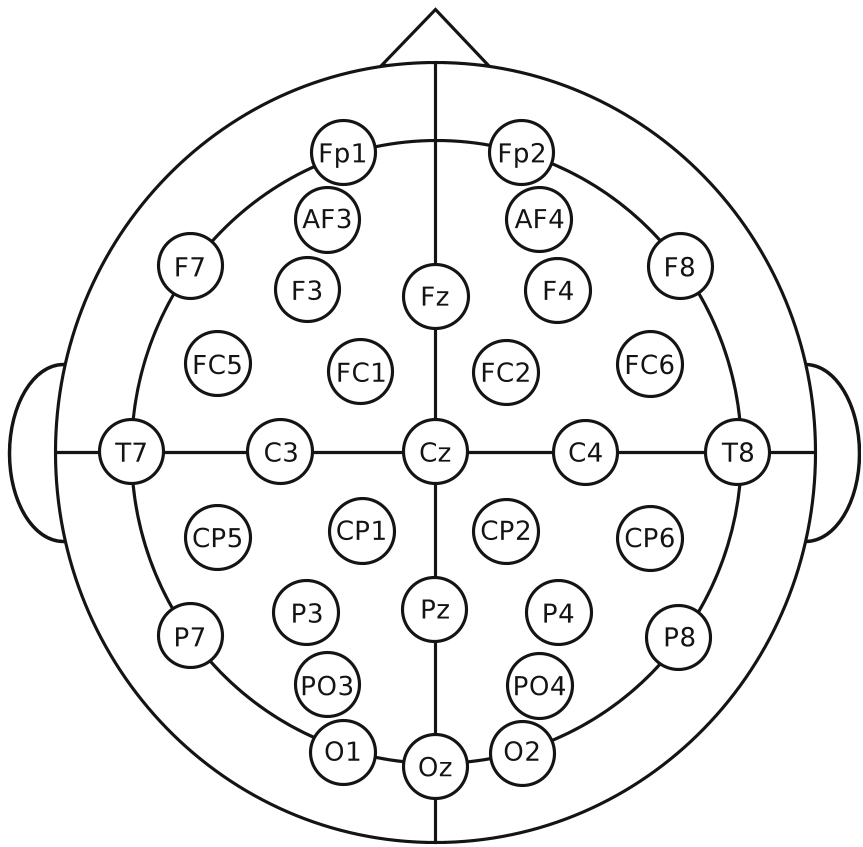
Figure 1: The signal decomposition process and mapping into feature vectors.
The RFE algorithm works by:
- Training a linear SVM on the full set (786 features).
- Calculating the weight magnitude for each feature.
- Trashing the least important feature.
- Repeating until only the "elite" 25% of features remain.
Experimental Results: A New Benchmark
The results were conclusive. Linear SVMs and Linear Discriminant Analysis (LDA) thrived on the filtered feature sets, suggesting that RFE effectively found a subspace where emotions are linearly separable.
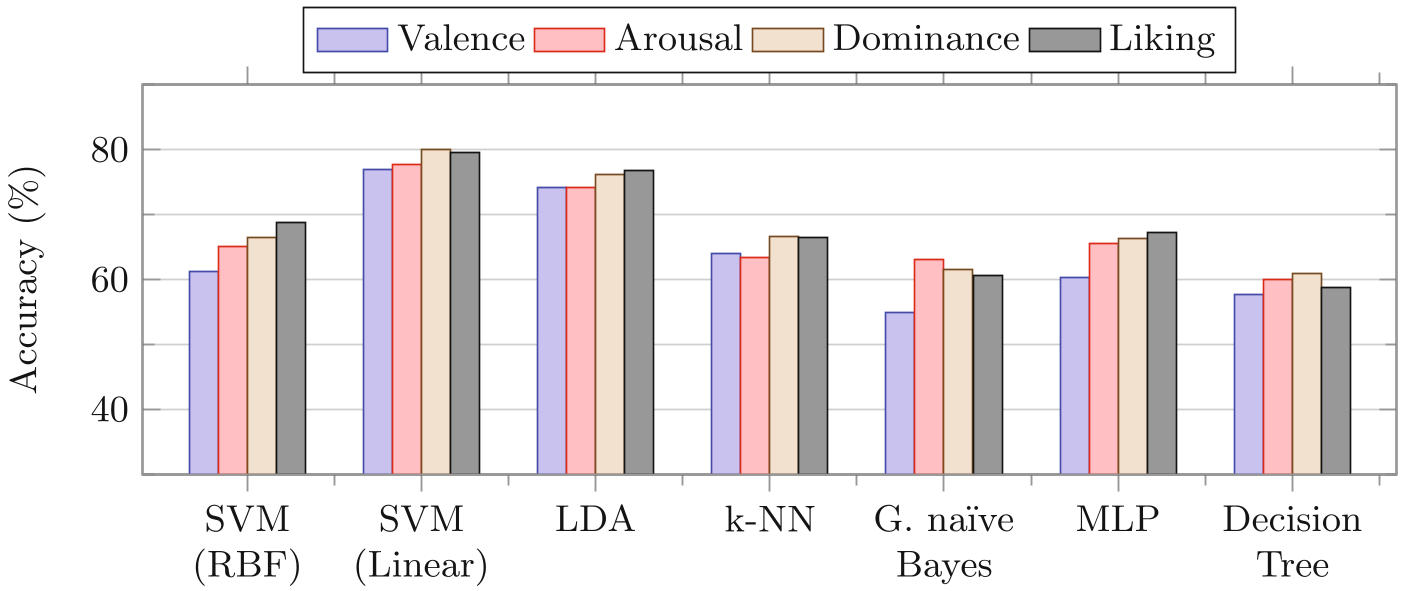 Figure 2: Accuracy of different classifiers. Note the dominance of Linear SVM.
Competitive Analysis
When compared to the original DEAP paper and subsequent studies (Daimi & Saha, Chen et al.), the improvements are striking:
- Valence: 76.84% (vs. previous best of 67.89%)
- Arousal: 77.66% (vs. previous best of 69.09%)
- Dominance: 79.99% (vs. previous best of 69.10%)
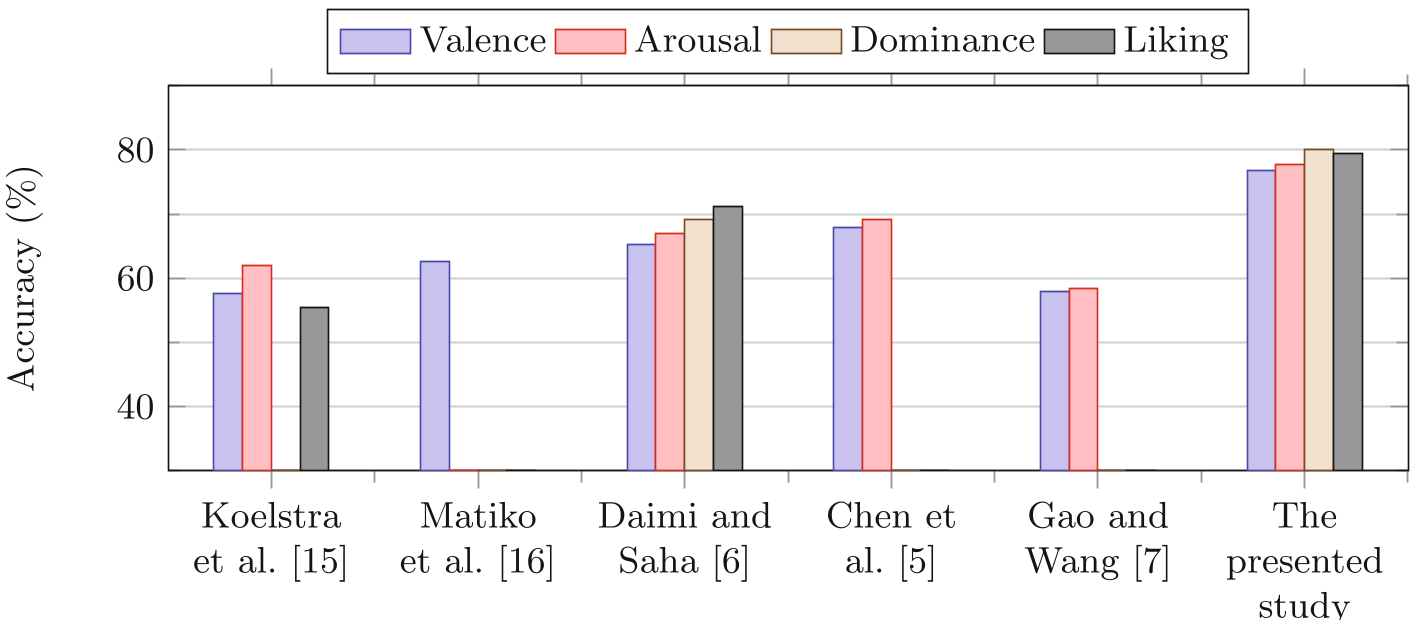 Figure 3: This study (far right) consistently outperforms previous methods across all emotional dimensions.
Critical Insight & Conclusion
The success of this method proves that Inductive Bias matters. By forcing the model to select features that support a linear boundary, the authors avoided the pitfalls of non-linear kernels (like RBF) which often overfit on small physiological datasets like DEAP.
Takeaways:
- Efficiency: Reducing feature count by 75% makes real-time emotion monitoring much more feasible.
- Robustness: High F1-scores (~75%) indicate the model isn't just gaming the majority class; it truly understands the emotional spectrum.
Limitations: While the performance is excellent, RFE is computationally expensive during the training phase because it requires retraining the model for every feature removed. For future work, exploring "step-wise" pruning or Gating Mechanisms in Neural Networks might provide similar benefits with less overhead.
Future Outlook: Deep Learning (CNN/GCN) is the current trend, but this paper serves as a reminder that rigorous feature engineering and selection are often the most reliable paths to SOTA performance in biological signal processing.