
Beyond Single Classifiers: Boosting Brain-Machine Interface Accuracy with Stacked Ensembling
EEG Brainwave Emotion Detection Using Stacked Ensembling Method
This paper presents a robust emotion classification framework using an EEG-based Brain-Machine Interface (BMI). By employing a Stacked Ensembling method that combines eight heterogeneous base models (including SVM, XGBoost, and Deep Neural Networks) into a meta-learner, the authors achieved a SOTA accuracy of 97.0% in classifying positive, neutral, and negative emotional states.
TL;DR
EEG-based emotion detection is a cornerstone of modern Human-Machine Interaction (HMI). This paper introduces a Stacked Ensembling framework that synthesizes the predictions of eight diverse machine learning models. By moving beyond a single-classifier approach, the researchers achieved a remarkable 97.0% accuracy on the mental state classification task, outperforming traditional SOTA baselines.
Academic Context: This work transitions emotion detection from simple heuristic or single-model classification (e.g., SVM/KNN) to a meta-learning ensemble paradigm, establishing a new performance ceiling for the standard EEG brainwave dataset.
The Problem: The Complexity of Brainwaves
Emotion classification via EEG is notoriously difficult due to the "noise" in brain oscillation bands (Delta, Theta, Alpha, Beta, Gamma). Prior works by Koelstra (2010) and Soleymani (2012) struggled with accuracies ranging from 52% to 76%. The core challenge lies in the Valence-Arousal model; physiological signals are high-dimensional and subject-dependent, meaning a single algorithm like a Support Vector Machine often lacks the representational capacity to generalize across all emotional intensities.
Methodology: The Power of Stacking
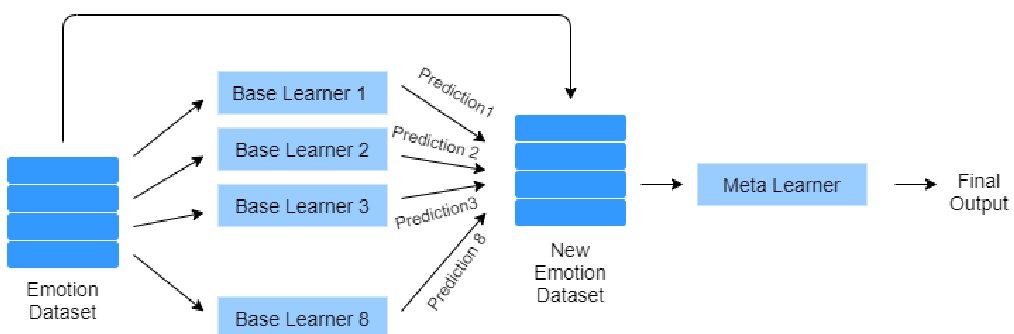
The authors' "Secret Sauce" is not a single new algorithm, but a sophisticated hierarchical architecture called Stacked Generalization.
1. Preprocessing and PCA
To handle the high dimensionality, the study uses Principal Component Analysis (PCA). By distilling the signal into the 150 most significant features, they avoid the "curse of dimensionality" while retaining enough data to prevent information loss.
2. The Base Layer (The Experts)
Eight models were trained independently:
- Classical Models: SVM, Logistic Regression, KNN.
- Ensemble Tree Models: Random Forest, XGBoost, LightGBM.
- Deep Learners: Two distinct Neural Networks (NN1 and NN2) with differing depths to ensure "diversity" in error types.
3. The Meta-Learner (The Judge)
The output labels and probabilities from these eight models are fed into a Meta Neural Network. This higher-level model learns which base model to trust for specific data patterns.
Experimental Results & Insights
The results confirm that the "collective intelligence" of the stack outperforms any individual expert.
- Accuracy Boost: SVM, the strongest base model, achieved 96.06%. The Stacked Model pushed this to 97.0%.
- Stability: The Stacked model showed lower training loss and higher stability during the convergence phase compared to individual Deep Neural Networks.
- Misclassification Reduction: As shown in the confusion matrices, the meta-model significantly reduced the confusion between "Positive" and "Negative" states, which is critical for real-world BMI applications like sensitive robotics.
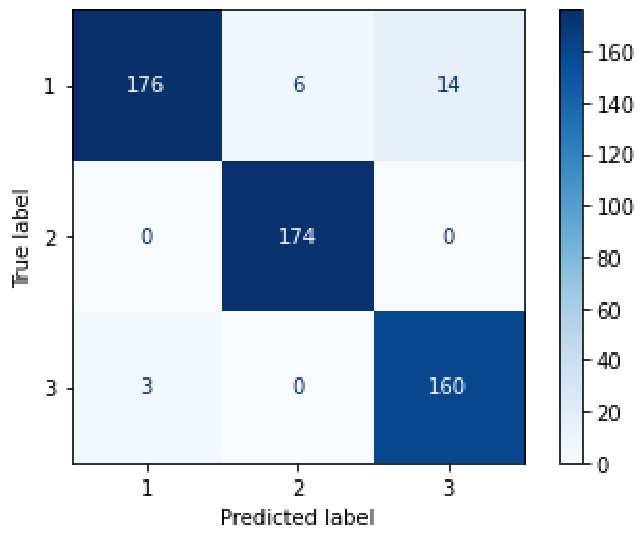 Fig: Training Loss comparison showing the Stacked Model's superior convergence (the blue line).
Critical Analysis & Future Outlook
This work demonstrates that for complex physiological data, Diversity > Complexity. By combining tree-based logic with gradient descent-based neural networks and geometric SVMs, the authors created a "safety net" where the weaknesses of one model are covered by the strengths of others.
Limitations: The study currently classifies three states (Positive, Negative, Neutral). However, the Valence-Arousal model contains 8 distinct emotional quadrants (e.g., "Calm" vs "Sad"). Expanding the label space will be the true test of this ensemble's robustness.
Future Prospects: The next frontier is "Deep Stacking"—using multiple layers of meta-learners. Additionally, applying this to real-time robotic feedback loops could revolutionize how assistive robots interact with users in clinical settings.
Conclusion
The transition to Stacked Ensembling marks a shift in BMI research from "algorithm hunting" to "architectural synthesis." Achieving 97% accuracy brings us one step closer to seamless, high-fidelity human-machine emotional synchronization.