
CWGAN: Breaking the Data Scarcity Barrier in EEG Emotion Recognition
EEG Data Augmentation for Emotion Recognition Using a Conditional Wasserstein GAN
This paper introduces a Conditional Wasserstein Generative Adversarial Network (CWGAN) with gradient penalty for EEG data augmentation in emotion recognition. By generating realistic Differential Entropy (DE) features, the method achieves significant SOTA improvements on the SEED and DEAP datasets.
TL;DR
The lack of large-scale labeled datasets is the "Achilles' heel" of Affective Brain-Computer Interfaces (aBCI). This paper presents a Conditional Wasserstein GAN (CWGAN) framework designed to synthesize high-quality Differential Entropy (DE) features. By augmenting real EEG data with synthetic samples, the authors achieved up to a 20.13% accuracy boost in emotion classification, proving that generative models can effectively "fill the gaps" in neural data manifolds.
The "Small Data" Problem in Affective Computing
Deep learning thrives on data, but EEG research lives in a state of perpetual "starvation." Collecting high-quality brain signals requires expensive equipment and intensive human participation, leading to datasets that are often too small for robust model training.
Prior attempts to solve this via data augmentation used geometric transforms (like rotation) borrowed from Computer Vision. However, EEG signals aren't images; a "rotated" brainwave doesn't necessarily represent a valid neural state. The authors recognized that to truly augment EEG data, we must learn the latent distribution of the features themselves.
Methodology: Feature-Level Generative Modeling
Instead of generating raw, noisy time-series signals, the authors focused on Differential Entropy (DE) features—a high-level representation proven to be highly correlated with emotional states.
1. The CWGAN-GP Architecture
Traditional GANs are notoriously unstable (mode collapse). To solve this, the authors used:
- Wasserstein Distance: Uses Earth-Mover distance to provide smoother gradients even when distributions don't overlap.
- Gradient Penalty (GP): Enforces the Lipschitz constraint to ensure training stability.
- Conditioning: By feeding emotion labels (Positive, Neutral, Negative) into both the Generator and Discriminator, the model learns to produce class-specific samples.
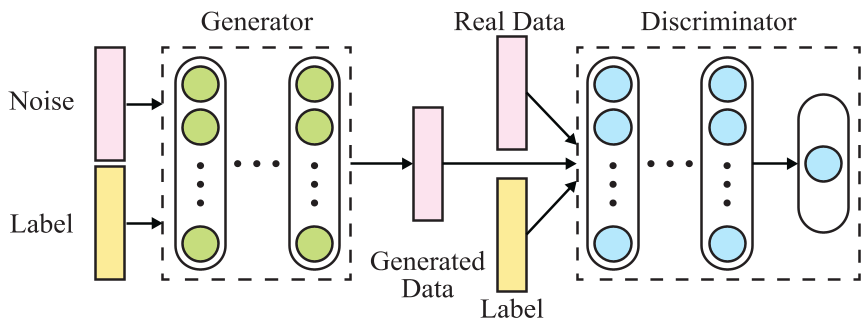
2. Quality Control: The Triple Indicator
How do you know if a 310-dimensional synthetic EEG feature is "good"? Since humans can't visualize DE features, the paper employs:
- Discriminator Loss: Converging to zero indicates the synthetic data is indistinguishable from the real.
- Maximum Mean Discrepancy (MMD): A statistical test to measure the distance between two distributions.
- t-SNE Visualization: Mapping high-dimensional data to 2D to ensure clusters overlap correctly.
Experimental Results & Insights
The method was tested on the SEED and DEAP datasets using an SVM classifier.
- Effect of Augmentation: The best performance was generally found when the dataset size was doubled (1x real + 1x generated). Beyond this, accuracy remains high but stabilizes, suggesting a point of diminishing returns in manifold density.
- Accuracy Jumps: The most dramatic improvement was seen in DEAP-Valence (from 53.76% to 73.89%), a task that is notoriously difficult due to the low signal-to-noise ratio in valence elicitation.
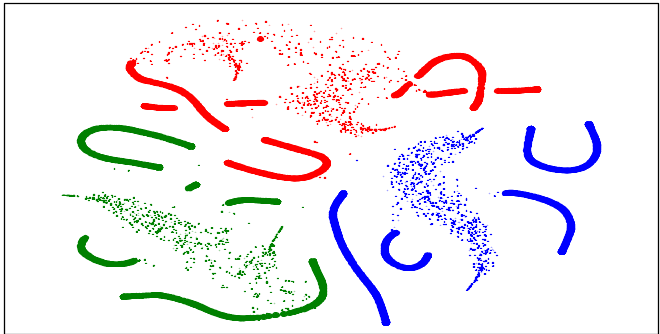 Figure: The t-SNE plot shows how synthetic points (thin dots) fill the sparse regions between real samples (crosses), creating a more continuous and separable manifold for the classifier.
Critical Analysis
Why does this work?
Real EEG data is "sparse." In a high-dimensional feature space, there are large "empty" regions between class clusters. CWGAN acts as an interpolator that learns the underlying geometry of these clusters. By "supplementing the data manifold," it helps the SVM find a hyperplane that generalizes better to unseen data.
Limitations
While highly effective for DE features, the paper does not explore the generation of raw temporal signals, which would be necessary for end-to-end deep learning models (like CNN-LSTMs). Additionally, the quality of generated data is highly dependent on the quality of the small initial seed set.
Conclusion
This work signals a shift from simple "signal distortion" to "distribution learning" in BCI. Successfully boosting SEED accuracy to nearly 87% and drastically improving DEAP results demonstrates that generative AI is not just for creating art—it is a vital tool for scientific discovery in data-constrained domains.