
EEST: Bridging the Gap Between Vague Queries and Real-Time Insights on Twitter
EEST: Entity-Driven Exploratory Search for Twitter
EEST (Entity-Driven Exploratory Search for Twitter) is a novel search engine framework that enhances social media exploration by integrating multi-source entity extraction from Google News, Twitter, Freebase, and News Embeddings. It bridges the gap between vague user queries and specific information needs through a two-phase graph-based exploration and tweet summarization process.
TL;DR
EEST (Entity-Driven Exploratory Search for Twitter) is an advanced search framework designed to transform vague keyword searches into structured, entity-based explorations. By merging real-time data from Google News and Twitter with historical knowledge from Freebase, it provides users with a relational graph of topics and a noise-free summary of the social media conversation.
Background & Motivation
When users search on Twitter, they often start with a broad concept (e.g., "Obama") without a specific goal. Traditional search engines return a chronological firehose of data, which is often redundant or irrelevant.
The authors identify a critical gap: existing expansion methods usually rely on a single source (like DBpedia). This is insufficient because:
- Real-time events (News) move faster than static knowledge bases.
- Semantic relationships (Embeddings) capture associations that formal ontologies might miss.
EEST was built to solve this by acting as a "Multi-source Entity Navigator."
Methodology: The Two-Phase Intelligence
The core of EEST is divided into two distinct logical phases that move from "Expansion" to "Refinement."
Phase I: Multi-Source Entity Extraction
Instead of just looking at the query, EEST treats the query as a seed to gather entities from four distinct environments:
- Google News & Twitter: For high-velocity, real-time "Person, Location, Organization" detection.
- Freebase: For grounding the query in established human knowledge.
- News Embeddings: Using Word2Vec-style cosine similarity to find semantically related terms that might not share a direct link in a database.
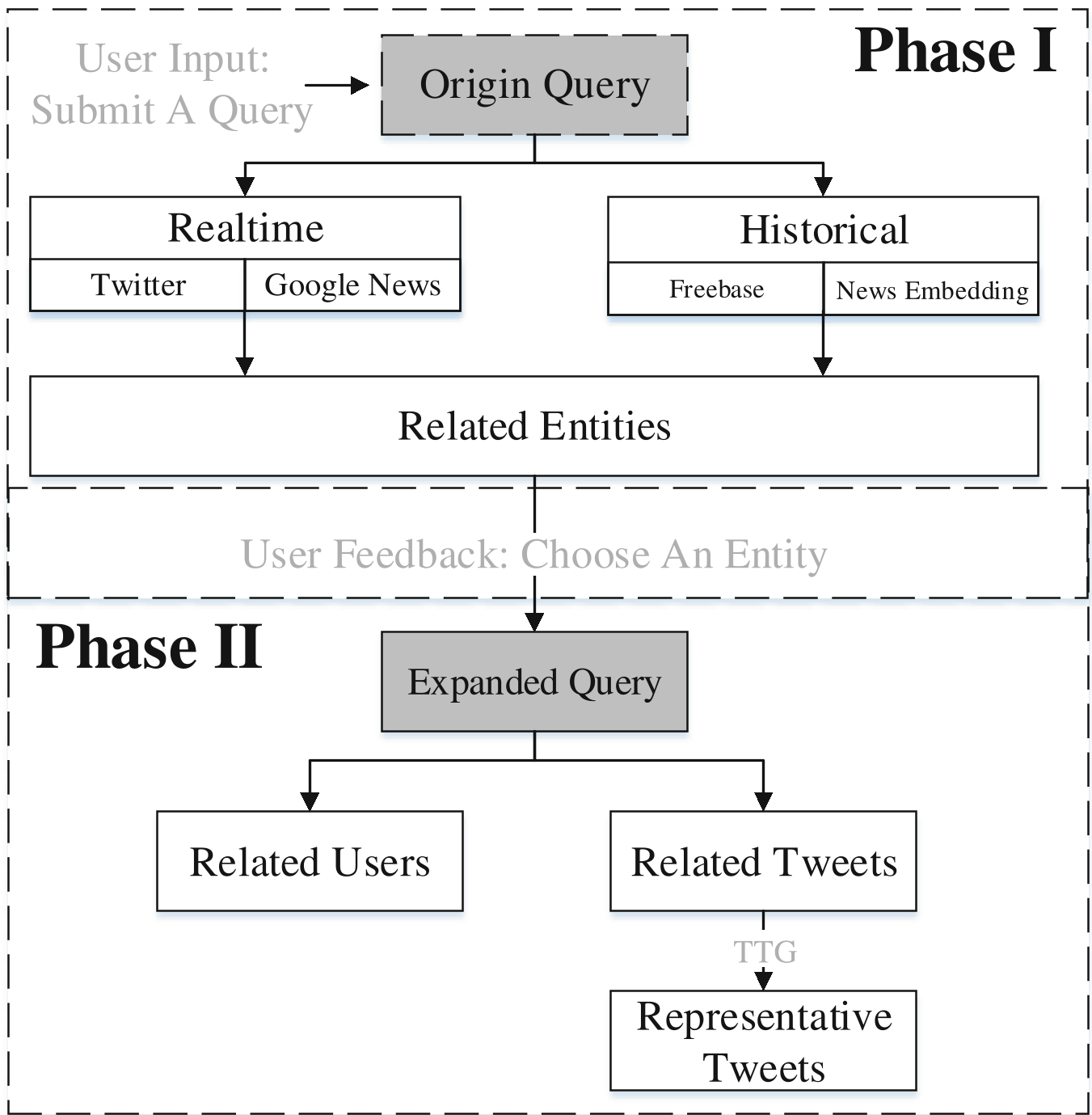
Phase II: Result Presentation & Summarization
Once a user selects an entity from the graph (e.g., clicking "Iraq" after searching "Obama"), the system generates an ExpandedQuery. To prevent "Information Overload," EEST employs Tweet Timeline Generation (TTG) via a Star Clustering algorithm. This organizes thousands of tweets into a few representative clusters, effectively acting as an automated editor for the user.
Experiments & Visual Demonstration
The paper showcases the system's efficacy through a real-world scenario. A search for "Obama" reveals a complex web of connections.
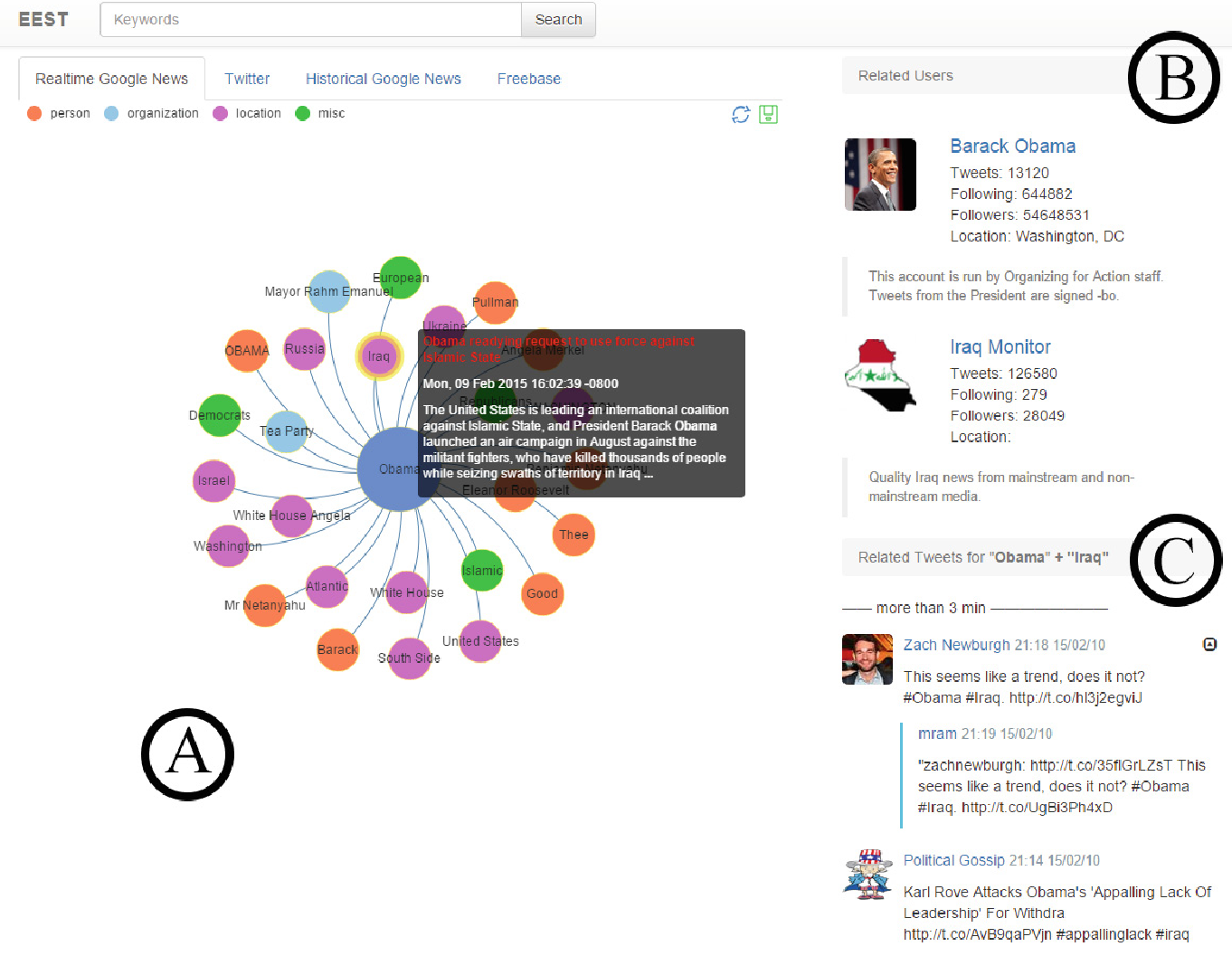
- Module A (Related Entities): Displays a graph where "White House" and "Iraq" are linked to "Obama" based on current news flows.
- Module B (Related Users): Identifies key influencers (e.g., "Iraq Monitor") specifically relevant to the intersection of the two entities.
- Module C (Related Tweets): Provides the filtered, non-redundant stream of information.
Critical Analysis & Conclusion
Takeaway
The genius of EEST lies in its hybrid temporal approach. By identifying that a user's search intent is a mix of "What just happened?" (Real-time) and "What is this?" (Historical), the system provides a more holistic view than a standard search bar ever could.
Limitations
- Computational Latency: Extracting entities from four sources and running NER in real-time can be resource-intensive.
- Data Silos: Since the paper's publication, API restrictions (especially on Twitter) have made this type of multi-source cross-referencing more challenging for open research.
Future Prospect
In the era of Generative AI, the logic of EEST could be evolved into RAG (Retrieval-Augmented Generation) systems. Instead of just showing a graph, an LLM could use these multi-source entities to synthesize a comprehensive report for the user.