
EEUPL: Solving the Multi-Platform Identity Puzzle with Scalable Graph Clustering
EEUPL: Towards effective and efficient user profile linkage across multiple social platforms
The paper introduces EEUPL, an effective and efficient framework for linking user profiles across multiple social networks. It proposes a graph-based clustering approach using an average-link strategy and leverages Apache Spark to achieve SOTA performance and scalability on large-scale datasets.
TL;DR
Linking a single user across Twitter, Instagram, and Foursquare is a complex "Who's Who" problem. Traditional methods fail when users have multiple accounts on one site or only use a few of the platforms. EEUPL (Effective and Efficient User Profile Linkage) introduces a distributed graph-clustering framework that effectively handles account duplicates and scales to millions of users using Apache Spark, outperforming existing pairwise matching approaches.
Problem: The "Platform Uncertainty" Trap
Most current research treats User Profile Linkage (UPL) as a simple 1-to-1 matching game between two platforms. However, reality is messier:
- Platform Uncertainty: A user might be on Twitter and Instagram but not Foursquare. Simple pairwise integration creates "incorrect linkage chains" that drift away from the true identity.
- Intra-Platform Duplication: Reports show up to 11% of Facebook accounts are duplicates. If a model assumes "one person = one account per platform," it will inevitably fail.
- The N-Platform Explosion: The computational cost grows quadratically () as you add more platforms and users.
EEUPL targets these gaps by moving beyond pairwise logic to a comprehensive Similarity Graph approach.
Methodology: Graph-Based Resolution
The EEUPL workflow is divided into two major phases: effectiveness (the "what") and efficiency (the "how").
1. Similarity Graph Generation
To avoid the comparison nightmare, the authors use MinHashLSH (Locality Sensitive Hashing) to block candidate pairs. A pre-trained Logistic Regression classifier then evaluates these pairs to assign a "match probability." These probabilities become weights in a massive undirected graph where nodes are profiles and edges signify identity overlap.
2. Average-Link Clustering
This is the "secret sauce" of the paper. Instead of rigid constraints, EEUPL uses an average-link strategy to partition the graph:
- Splitting: It removes "weak edges" where weights aren't the local maximum.
- Merging: It uses cluster representatives and an inverted index to find and merge highly similar clusters that were originally separated.
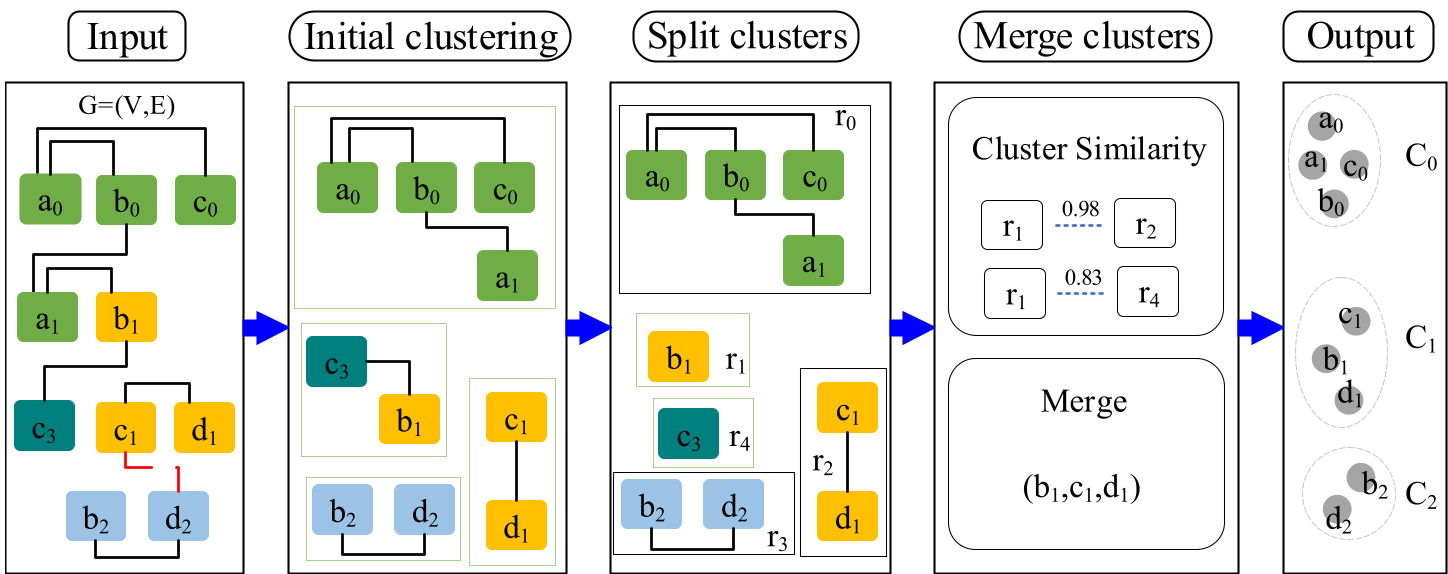 Figure: The process of evolving initial components into refined, source-consistent user clusters.
Experiments: Real-World Performance
The researchers tested EEUPL on two massive datasets: GTI (Google+, Twitter, Instagram) and NCV (North Carolina Voters, 5 million profiles).
Quantifiable Superiority
In the GTI dataset (with induced 11% duplicates), EEUPL achieved:
- F1-Score: 0.7371, significantly higher than pairwise methods like OPL and CNL.
- Ablation Study: Removing the splitting/merging steps (EEUPL_N) caused a 13-15% drop in performance, proving that the clustering refinement is critical.
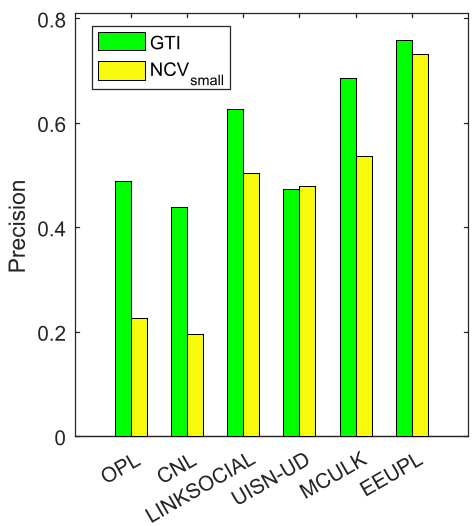 Figure: Comparison of Recall, Precision, and F1-score across different methodologies.
Scaling with Spark
Efficiency is not just about speed; it's about capacity. By deploying EEUPL on Apache Spark, the system processed millions of profiles efficiently. Increasing CPU cores from 15 to 120 resulted in a marked reduction in processing time, though the authors note that 100% linear speedup is hard to achieve due to certain non-parallelizable clustering steps.
Critical Analysis & Future Outlook
EEUPL succeeds because it treats identity as a clustering problem rather than a matching problem. Its ability to handle duplicate accounts within a single platform makes it far more robust for production environments than its predecessors.
Limitations: The model currently relies heavily on profile attributes (username, name, bio). If a user uses completely different personas (e.g., a "professional" LinkedIn and a "highly anonymous" Reddit), profile linkage alone will struggle.
Future Work: The next frontier is incorporating Social Graph Structure (who follows whom) and UGC (User Generated Content) patterns to link accounts even when the names and bios have zero overlap.
Takeaway: For tech leaders in Ad-Tech or Recommendation Systems, EEUPL provides a blueprint for building "Single View of Customer" (360-degree) profiles across fragmented social ecosystems.