
The Demanding Lord: Solving the Mystery of the Optimal History Window
The Effect of History on Modeling Systems' Performance: The Problem of the Demanding Lord
The paper introduces an analytical framework named "The Problem of the Demanding Lord" to model the relationship between sliding window size and the performance of incremental learning systems. It proposes an algorithm-agnostic Signal-to-Noise Ratio (SNR) approach to estimate average prediction performance during abrupt concept drift.
TL;DR
How much history should an AI remember? Too much, and old, irrelevant data (noise) poisons its current decisions. Too little, and it lacks the sample size (signal) to learn. This paper introduces a universal mathematical model to find the "sweet spot" of the sliding window size, effectively predicting a learner's performance before you even run the experiments.
Background: The Hidden Cost of Memory
In recommendation systems and information filtering, user interests are not static—they drift. The standard industry response is to use a Sliding Window. However, choosing the size () of this window is usually treated as a "black art" of hyperparameter tuning.
The authors frame this as The Problem of the Demanding Lord: A servant (the system) must serve meals (predictions) to a lord (the user) whose tastes shift abruptly. The goal is to maximize the lord's satisfaction by knowing exactly how many recent feedback instances to consider.
The Core Insight: Learners as Signal-to-Noise Responders
The fundamental breakthrough of this work is the Concept Transfer Function (CTF). Instead of focusing on how a specific algorithm (like SVM or Naive Bayes) works, it treats the algorithm as a black box that responds to a Signal-to-Noise Ratio ().
The Formalism
The authors define:
- Signal (): Valid data points following the current concept.
- Noise (): Outdated data points from before the last concept shift.
- Ratio (): .
They suggest that nearly all supervised learners follow a Sigmoid-like response to this ratio:
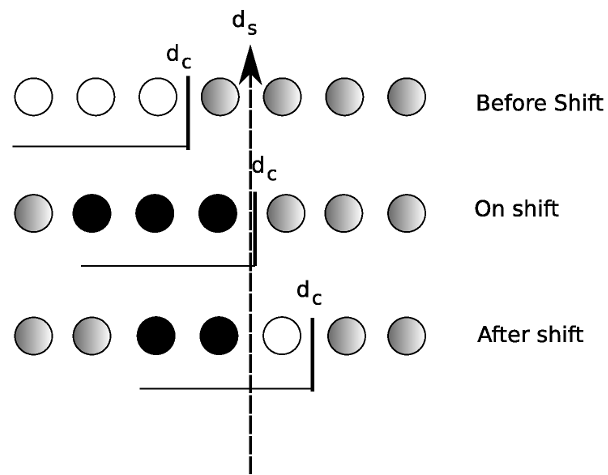 Figure 1: Visualization of valid signal (white) vs. noise (black) as the window slides past a concept shift.
Methodology: Parameters and Optimization
The paper uses a Genetic Algorithm (GA) to search for the parameters () of the sigmoid.
- CTF Estimation: It maps the signal-to-noise ratio to the observed accuracy.
- Performance Aggregation: By calculating the expected value of over a period of (the interval between shifts), the formula provides the average expected performance of the system for any given window size .
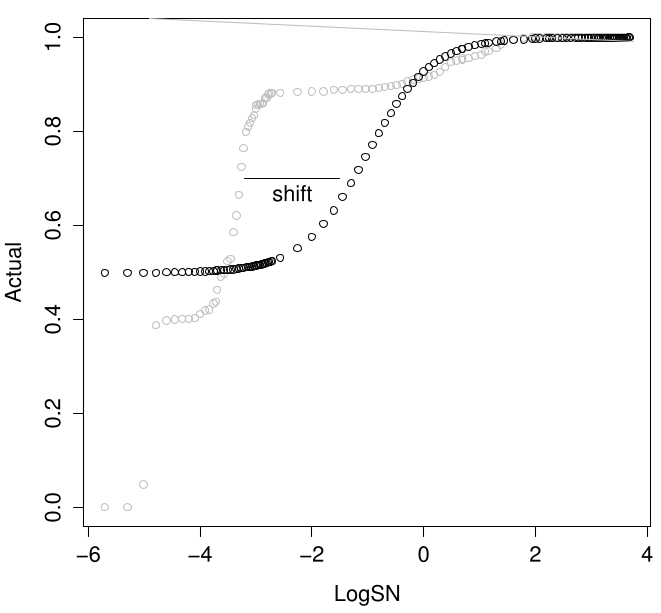 Figure 2: The Sigmoid response of different learners. Performance plateaus as the Signal-to-Noise ratio increases.
Experimental Results
The authors tested their theory on the classic STAGGER dataset and a real-world Business Climate (IFO) dataset. Key findings include:
- High Collinearity: The Pearson correlation between the estimated performance and real performance was consistently high (often above 0.90), proving the sigmoid model is a robust reflection of reality.
- Fast Convergence: The error between predicted and actual performance drops below 5% very quickly, even when concept shifts are random rather than strictly periodic.
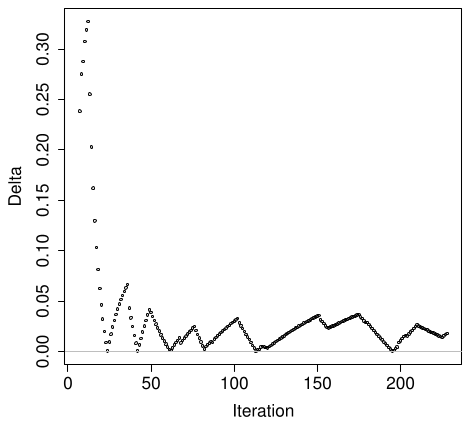 Figure 3: Convergence of the estimation error (Delta) over time for both synthetic and real-world datasets.
Critical Insight & Takeaways
The "Demanding Lord" problem highlights a critical Inductive Bias: More data is not always better.
Key Takeaways for Practitioners:
- Algorithm Agnosticism: Whether you use Naive Bayes or a complex Decision Tree, the performance curve against the history window follows the same sigmoid logic.
- Proactive Optimization: Once you estimate the shift period () and the sigmoid parameters of your algorithm, you can mathematically solve for the optimal without running expensive grid searches.
- Limitations: The model assumes "Abrupt Shifts." In scenarios where concepts change very slowly and gradually, the "Noise" is harder to distinguish from the "Signal," potentially requiring a more complex CTF.
This study provides the first systematic steps toward a "Physics of Learning Performance," moving us away from trial-and-error and toward truly adaptive AI systems.