
Beyond "Following": Unleashing the Power of Implicit Social Networks in Scholarly Recommendations
Effect of Different Implicit Social Networks on Recommending Research Papers
This paper proposes and evaluates three types of Implicit Social Networks (ISNs)—Readership, Co-readership, and Tag-based—integrated into collaborative filtering for research paper recommendations. Using CiteULike data, the study identifies that combining implicit behavioral signals with social recommender algorithms significantly improves recommendation accuracy and coverage compared to traditional collaborative filtering (CF).
TL;DR
Researchers struggle with the overwhelming volume of new scientific papers. While social recommenders help, they usually rely on explicit "friend" or "follow" links, which most users never create. This paper introduces Implicit Social Networks (ISNs) derived from bookmarking behavior, proving that "who you read" and "how you tag" are better and more scalable predictors of interest than explicit social graphs, increasing recommendation coverage from 18% to over 87%.
The "Cold-Start" and "Sparsity" Bottleneck
Collaborative Filtering (CF) is the backbone of modern recommendation, yet it fails when data is sparse. In academic platforms like CiteULike or Mendeley, users are often "lurkers"—they consume content but rarely link to others. Prior work relied on explicit connections, but the authors found that only 18% of users actually use these features. The central challenge addressed here is: How can we build a robust social recommender when the social graph itself is missing?
Methodology: Engineering Implicit Connections
The authors propose shifting from explicit declarations to implicit behaviors. They define three distinct ISNs:
- Readership ISN: Links a user to the author of a bookmarked paper. It assumes a "latent following" where the reader finds the author's expertise relevant.
- Co-readership ISN: Links users who consume papers by the same authors. This leverages the "wisdom of the crowd" by identifying niche communities of interest even if the users don't know each other.
- Tag-based ISN: Uses NLP (Porter Stemmer) to process user-generated tags. If two users use the same specialized terminology, they are implicitly connected.
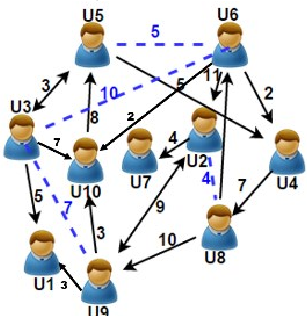
The study then tested these networks across three algorithmic frameworks: Social Recommender (purely social peers), Combined Recommender (social + CF neighbors), and Amplified Recommender (weighting CF by social signals).
Experimental Results: The Accuracy-Coverage Trade-off
The evaluation used 5-fold cross-validation on a large CiteULike dataset (13,189 users).
Precision vs. Recall
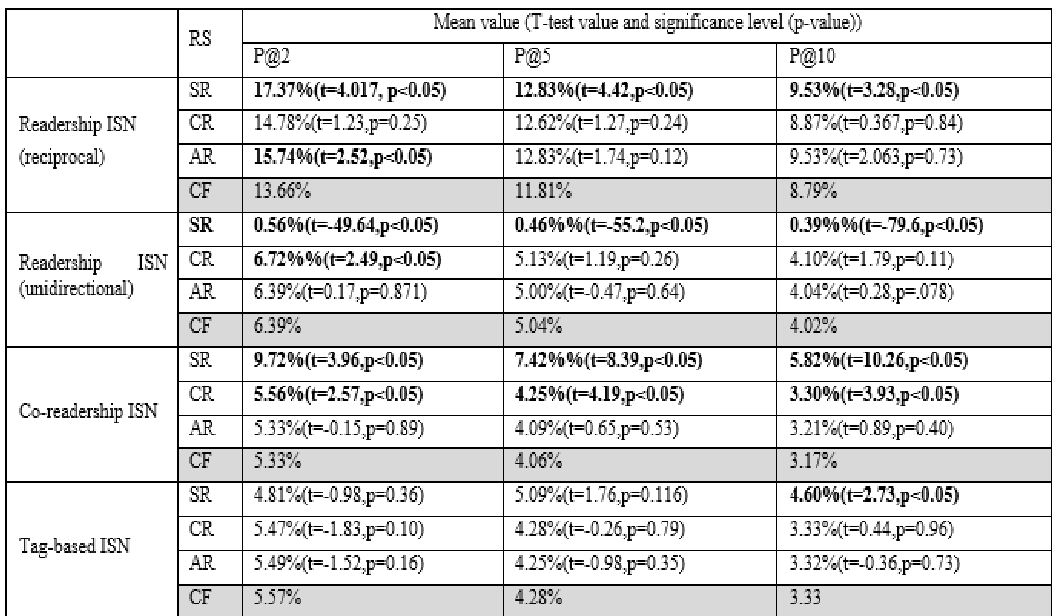
The Readership ISN (Reciprocal)—where two authors have bookmarked each other’s work—showed the highest precision (reaching over 17% for P@2). This suggests that mutual citation/bookmarking is an extremely strong signal of shared research direction. However, this is rare, leading to low coverage.
The Winner: Co-readership
For general platform utility, the Co-readership ISN was the standout. As shown in the table below, it consistently outperformed standard CF across P@2, P@5, and P@10 while providing a massive 87.25% user coverage.
Critical Insight & Conclusion
This paper's value lies in its pragmatic approach to the Inductive Bias of recommendation systems. By recognizing that research interest is effectively encoded in the "author-reader" relationship, the authors bypass the need for a manual social graph.
Key Takeaways:
- Implicit > Explicit: Behavioral signals (bookmarks) are more abundant and often more accurate than social declarations.
- Algorithm Strategy: The "Social Recommender" algorithm, which prioritizes social peers over anonymous CF neighbors, generally wins on precision when the underlying network quality is high.
- The Future: Modern discovery tools should stop asking users to "follow" each other and instead focus on mapping the latent co-readership graphs to drive serendipity.
Limitations: The study is based on unary ratings (presence in a library) rather than explicit Likert scales, and the tag-based ISN's performance was dampened by a lack of descriptive metadata per user (avg. 3.8 tags). Future iterations combining these implicit graphs with deep learning embeddings could likely bridge the gap between niche precision and global coverage.