
Dissecting the Value of Healthcare IT: A 26-Year Longitudinal Perspective
The Effect of Information Technology Investments in Healthcare: A Longitudinal Study of its Lag, Duration, and Economic Value
This longitudinal study analyzes the impact of four types of Healthcare IT (HIT) investments—PMIT, TSIT, CIT, and AIT—on hospital productivity and costs over 26 years. Using an Almon polynomial-distributed-lag model, it establishes that different IT categories yield varied lags and durations of economic effect, with Communications IT (CIT) providing the highest marginal economic value.
TL;DR
Not all IT investments are created equal. This landmark study reveals that while Communications IT (CIT) and Transactional IT (TSIT) provide immediate and massive boosts to hospital labor productivity, Patient Management IT (PMIT) often increases short-term costs. The research underscores that the "IT Productivity Paradox" can be solved by accounting for specific implementation lags and functional categories.
The Productivity Paradox in Healthcare
For decades, economists have wrestled with the "Productivity Paradox"—the observation that massive investments in computing power haven't always translated into measurable productivity gains. In healthcare, this is particularly acute:
- High Adjustment Costs: Replacing paper records leads to significant "learning friction" and operational disruption.
- Lagged Effects: The benefits of a system may not show up for years until it is fully integrated with external partners.
- Measurement Error: Treating all IT as a single "IT Budget" bucket hides the fact that back-office systems might be driving efficiency while front-end systems drive quality.
Methodology: Opening the "Black Box"
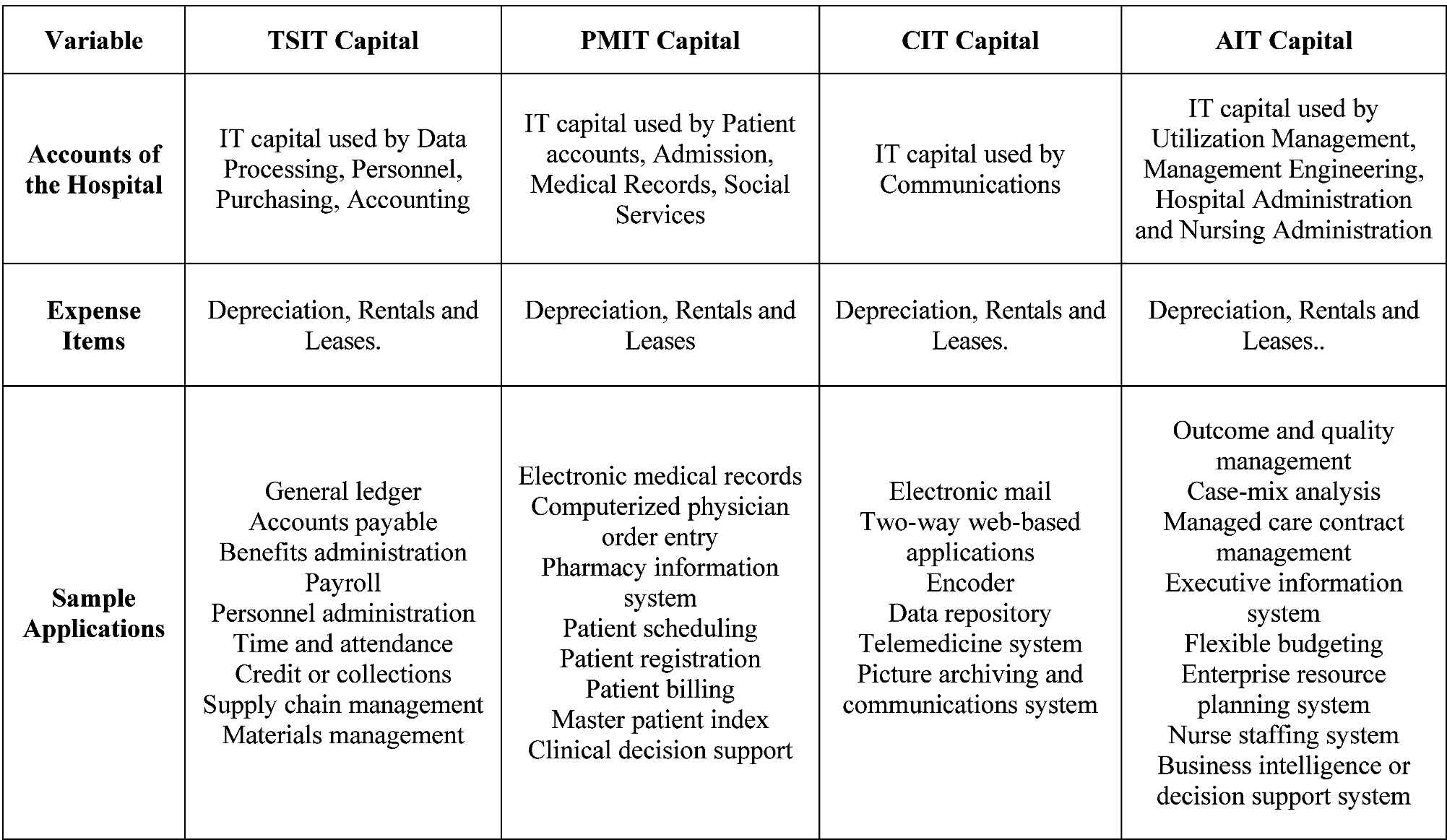
The researchers broke down HIT into four functional pillars to see which one actually moves the needle:
- PMIT (Patient Management): EMRs, clinical decision support, and pharmacy systems.
- TSIT (Transactional Support): Accounting, HR systems, and supply chain management.
- CIT (Communications): Networks, paging, and data repositories.
- AIT (Administrative IT): Executive decision support and "what-if" analysis tools.
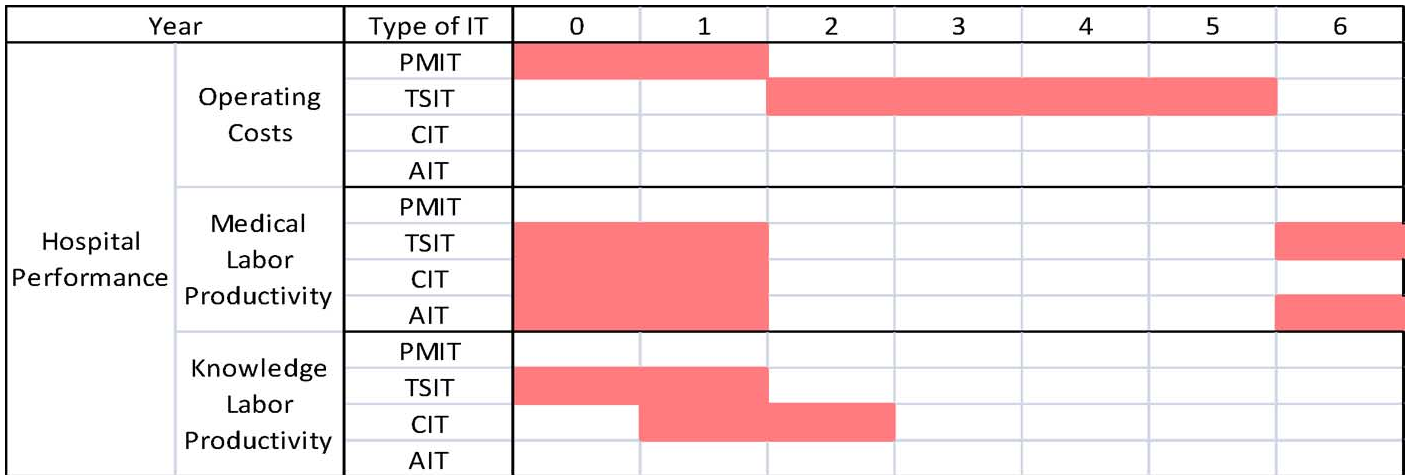
Using 26 years of data from Washington State hospitals, they applied a distributed lag model to track how an investment in Year 0 impacts performance through Year 6.
Key Findings: The "Hidden Gems" of IT
The study produced several counter-intuitive results that challenge current policy focuses:
1. The Communication Multiplier
Communications IT (CIT) emerged as the champion of economic value. Because it facilitates coordination across all other units (reducing wait times and streamlining scheduling), it has an immediate and high-impact effect on both medical and administrative labor productivity.
2. The Patient Management "Cost Trap"
Surprisingly, PMIT was associated with an increase in operating costs in the short term. The authors argue this is due to the intense resources required for system integration and user training. Furthermore, hospitals often reassign the "time saved" by PMIT to focus on patient quality rather than cutting staff, masking productivity gains in financial data.
3. The Durability of Transactional Systems
TSIT (Back-office systems) provided the most consistent value. It was the only category found to have a durable effect on lowering operating costs, starting about 2 years after implementation.
Deep Insight: Relational IT Resources
The study found a curious "rebound" effect where AIT and TSIT showed renewed productivity impacts in the 6th year. This supports the Relational Resource View: it takes years for a hospital's systems to sync perfectly with external suppliers' and insurers' systems. Once this "Digital Ecosystem" matures, a second wave of productivity is unleashed.
Critical Analysis & Conclusion
This research suggests that policy-makers' obsession with EMRs (PMIT) might be misplaced if the primary goal is cost containment.
- Strategic takeaway: Hospital CEOs should look at "back-end" infrastructure (TSIT and CIT) to find the fastest ROI.
- Limitations: The study focuses on financial measures. It does not account for clinical outcomes (mortality rates, patient satisfaction), where PMIT likely shines.
In the healthcare IT landscape, the "long game" is mandatory. ROI isn't a snapshot; it's a multi-year trajectory defined by learning curves and ecosystem maturity.