
The Physics of Popularity: How Social Cascades and Geography Drive Business Success on Yelp
Effect of Information Propagation on Business Popularity: A Case Study on Yelp
This paper investigates how information propagation, driven by social connections and geographical proximity, determines business popularity on Yelp. It proposes a region-specific popularity labeling framework and leverages social cascade structures to predict success and recommend optimal locations for new businesses.
TL;DR
Why do some neighborhood bistros thrive while others vanish? This study moves beyond simple check-in counts to reveal that business popularity is a byproduct of information diffusion. By modeling the interplay between social "friendship" links and the geographical origins of visitors, the researchers built an AI model capable of predicting business success with 89% accuracy and recommending optimal locations for new ventures.
Context: Beyond the "One Metric" Trap
In the world of Location-Based Social Networks (LBSNs), popularity is often treated as a static number. However, the authors argue that "popularity" is contextual. In one region, a high star rating defines success; in another, it might be the raw volume of visits. This paper introduces a Region-Specific Popularity Metric using an entropy-based approach to determine which signal (Visit Count, Star Rating, or Elite Count) most effectively distinguishes the "winners" from the "losers" in a specific neighborhood.
The Core Engine: Information Propagation
The researchers identified two primary modalities that act as vehicles for business success:
1. The Social Effect (The "Why")
Success is contagious. By analyzing temporal windows of visits, the paper shows that popular businesses exhibit a high Social Effect index (). This isn't just about having many visitors; it's about visitors being influenced by their friends who visited previously.
- The Cascade Structure: The authors represent this influence as a directed graph. Popular businesses show a "dense" cascade—a complete graph of influence—while unpopular ones remain fragmented.
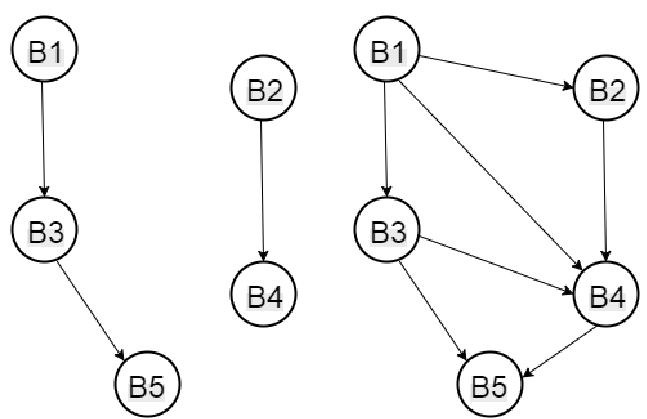 Above: Popular businesses (g) show high clustering in social influence vs. unpopular ones (f).
2. Geographical Proximity (The "Where")
Not all customers are the same. The study identifies two distinct city profiles:
- Local Dominated Cities: Where popularity is driven by residents (e.g., Charlotte).
- Foreign Dominated Cities: Where success depends on "tourist" or non-local visitors (e.g., Las Vegas 'Nightlife').
The research highlights that the correlation between local visit density and popularity is strong in residential zones but flips in high-tourism categories like 'Nightlife'.
Methodology: The Multilayer Framework
To capture these dynamics, the authors used a multilayer graph representing visitors, business units, and the temporal links between them.
 Above: The stark difference in clustering coefficients between popular and unpopular businesses.
Experiments and Beating the Baseline
The authors tested their insights by building two models:
- Popularity Predictor: Using SVM, they achieved 89.0% accuracy, significantly higher than the Potential Customer Estimator (PCE) baseline which only reached 80%.
- Region Recommender: For an owner looking to open a new 'Nightlife' spot, the model suggests regions where existing information diffusion patterns match the "popular" profile. This model hit 78% accuracy for top-5 recommendations.
| Model | Accuracy | F-Score |
|---|---|---|
| SVM (Proposed) | 0.89 | 0.90 |
| PCE (Baseline) | 0.80 | 0.82 |
| Our Recommender | 0.78 | 0.73 |
Critical Insight & Practical Value
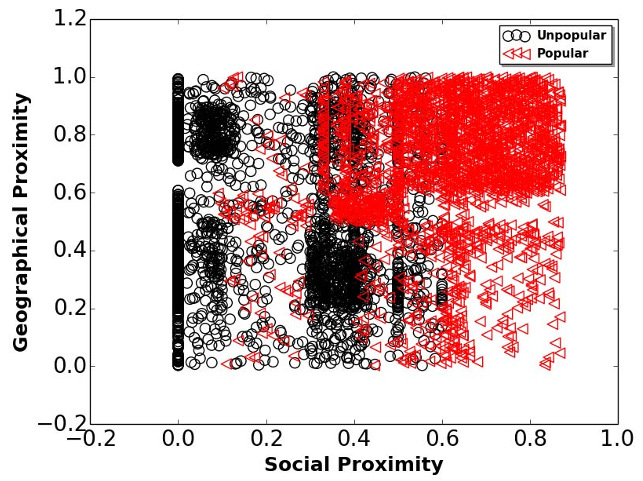
The real takeaway here is the Social-Geographical Plane. Most popular businesses occupy a high-social-effect/high-local-proximity quadrant in residential cities, but shift toward a high-social-effect/low-local-proximity quadrant in tourist hubs.
Limitations: The study relies on Yelp data (2005-2014), which might not capture the immediate "viral" nature of modern TikTok-driven business spikes. However, the fundamental math of social cascades remains a robust framework for urban planning and retail strategy.
Conclusion
This work transforms how we view urban commerce. Instead of just "Location, Location, Location," the new mantra might be "Cascade, Cascade, Cascade." By understanding the social and geographical dna of a city, we can predict not just where people go, but which businesses have the structural support to become community pillars.