
Socializing P2P: How Sub-Communities Mimic Human Logic to Optimize Networks
The Effect of Sub Communities in a Community-Based Peer-to-Peer Model Based on Social Networks
This paper proposes a semi-structured Peer-to-Peer (P2P) model inspired by social network dynamics, specifically investigating the impact of sub-communities on network efficiency. Using an ontology-based approach and super-peers, the model organizes peers into communities and clusters them around "hubs" to mimic real-world social structures.
TL;DR
This research transitions Peer-to-Peer (P2P) networking from abstract graph theory to social reality. By dividing the network into communities and further into "sub-communities" clustered around hubs, the model achieves a high clustering coefficient and short path lengths. The breakthrough? You don't need powerful "super-servers" anymore; a well-organized group of normal nodes can outperform them.
Problem & Motivation: The Gap Between Graphs and People
Most P2P systems are treated as random graphs. However, human interaction isn't random. It obeys two laws: Limited Interest (you only care about a few topics) and Spatial Locality (you interact more with those "near" you).
Early P2P models like Gnutella relied on flooding (inefficient), while DHTs (Distributed Hash Tables) are efficient but ignore the semantic "cliquishness" of how people actually share data. The authors noticed that in real social networks, "hubs" (popular individuals) exist, but they are rare. The goal was to build a system that utilizes these social "hubs" to create a "Small World" effect—where everyone is just a few hops away, but most connections remain local and efficient.
Methodology: The Architecture of Social Connectivity
The proposed model is semi-structured and relies on three pillars:
- Ontology-Based Grouping: Using a shared framework (like the ACM ontology) to ensure peers with similar interests find the same "Community."
- Super-Peers & Representatives: Super-peers act as global bridges, while "Representatives" manage the entry point for specific communities.
- Sub-Communities (The Hubs): Instead of every peer connecting to a representative, they connect to a "Hub"—a peer that is rich in content and geographically/logically close.
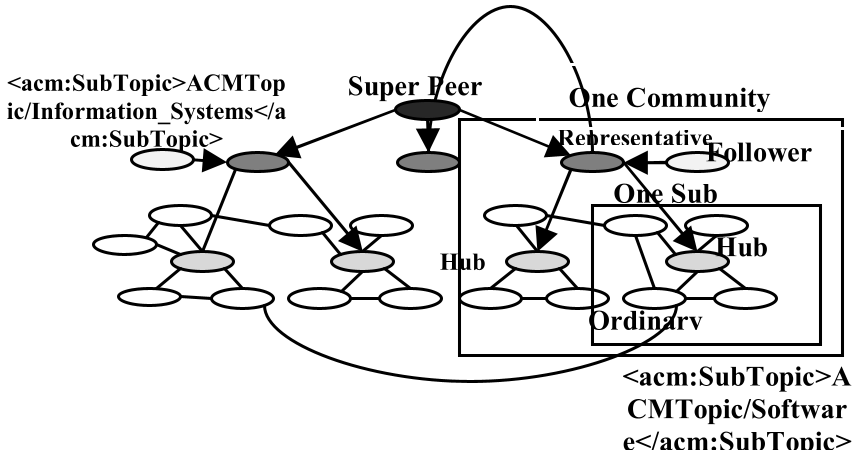 Figure 1: The hierarchy showing Super-Peers, Community Representatives, and Sub-community Hubs.
The genius of the sub-community approach is that it forces the network to obey Power Law Distribution. Nodes aren't just arbitrarily linked; they gravitate towards specialists, creating dense clusters that are then connected via "weak ties" (the bridges between hubs).
Experiments: Proving the "Small World" Effect
The authors simulated a 500-node environment to test two critical metrics:
- Clustering Coefficient (C): Measures how "cliquey" the neighborhood is.
- Characteristic Path Length (L): Measures the average number of hops between any two nodes.
Key Findings:
- Efficiency without Power: As shown in the table below, even with a low maximum connection limit (e.g., 10), increasing the number of hubs from 0 to 40 nearly quadrupled the Clustering Coefficient (0.096 to 0.39).
- Rapid Navigation: The path length dropped significantly. In a 40-hub setup, any piece of data was reachable within ~2-3 hops, fulfilling the "Small World" promise.
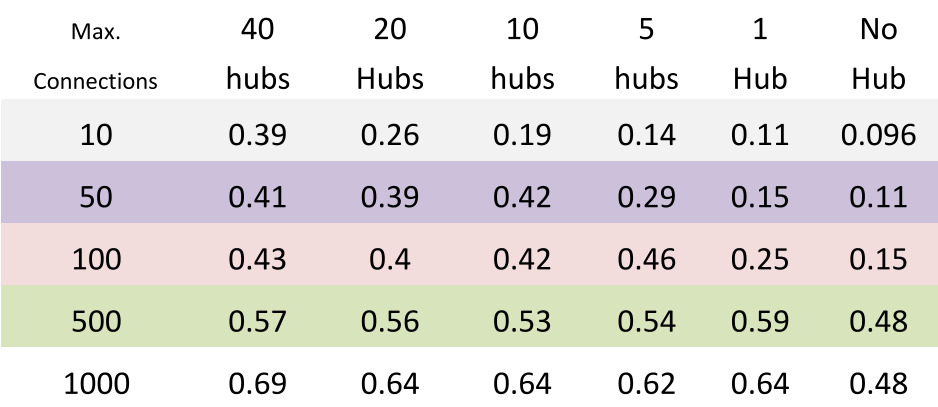 Table 1: Cluster coefficient increases as sub-communities (hubs) are introduced.
Critical Analysis & Conclusion
The primary takeaway is Resource Decoupling. By using sub-communities, the system reduces the "Index Size" that any single node must maintain. Instead of indexing every file, Super-Peers only need to index the Communities.
Limitations:
- Hub Volatility: The paper assumes hubs are somewhat stable. In a "high-churn" environment where nodes join and leave every minute, maintaining these sub-community clusters could incur high overhead.
- Ontology Rigidity: The model relies on a fixed ontology. If users' interests don't fit the pre-defined categories, the "Representative" nodes become bottlenecks.
Final Thought:
This work provides a blueprint for modern decentralized systems (like IPFS or Fediverse). It suggests that the future of the internet isn't in massive, centralized data centers, but in organized "digital neighborhoods" that mirror the way humanity has functioned for millennia.