
Establishing Ad Hoc Social Networks: Harnessing OLSR and Similarity Metrics
Effective Ad Hoc Social Networking on OLSR MANET Using Similarity of Interest Approach
The paper introduces a framework for establishing ad hoc social networks on OLSR-based MANETs using the Reserved field of HELLO messages to exchange user interests. It evaluates four similarity metrics—Cosine, Jaccard, Correlation, and Dice—integrating Delay Tolerant Network (DTN) mechanisms to improve discovery in intermittent connectivity. Combined with OLSR, Cosine Similarity emerged as the most effective metric for success in interest matching.
TL;DR
This research tackles the challenge of building infrastructure-less social networks by repurposing the OLSR (Optimized Link State Routing) protocol. By embedding interest profiles into standard HELLO messages and comparing four similarity metrics, the authors identify Cosine Similarity as the superior engine for "friend discovery." They also explore how Delay Tolerant Networking (DTN) can help bridge network gaps, albeit at a cost of increased message overhead.
Problem & Motivation
Most social interactions today are mediated by centralized servers (Facebook, X, etc.). But what happens when the grid goes down? In disaster recovery or remote exploration, we rely on Mobile Ad Hoc Networks (MANETs).
The core difficulty lies in Efficient Discovery:
- Computational Constraints: Mobile devices have limited battery; complex semantic matching is too "heavy."
- Dynamic Interests: User interests aren't static; they shift over time, following various distributions.
- Network Partitioning: Nodes move in and out of range, making it hard to find a match that isn't a direct neighbor.
The authors' insight was to use the existing signaling traffic of the routing protocol itself to carry "social" data, minimizing the need for additional heavy handshake procedures.
Methodology: The Core Mechanism
The system utilizes a 2D Interest Matrix covering categories like Sports, Movies, Shopping, and Food.
1. Interest Embedding
Instead of creating new packets, the algorithm hijacks the "Reserved" field in the OLSR HELLO message. This ensures backward compatibility with standard OLSR routers while enabling social awareness for supported nodes.
2. Hierarchical Matching
To save power, the computation follows a tiered approach:
- Step 1: Exchange basic category weights.
- Step 2: If the category similarity exceeds a Threshold (0.5), proceed to sub-category analysis.
- Step 3: Normalize weights and determine if a "Match" response should be sent.
3. Comparing the "Brains" of the System
The paper compares four mathematical ways to calculate how similar two people are:
- Cosine Similarity: Measures the cosine of the angle between two vectors.
- Jaccard Coefficient: Looks at the size of the intersection vs. the union.
- Correlation: Measures the linear relationship.
- Dice Coefficient: Similar to Jaccard but gives more weight to the intersection.
 Above: Example of the interest weights used for computation.
Experiments & Results
The authors used NS2 to simulate nodes moving at various speeds (1-30 m/s) with different Interest Changing Times (ICT).
Key Finding 1: Cosine Similarity Wins
Across all tests, Cosine Similarity outperformed the others. As node speed increases, the similarity index initially rises because nodes "meet" more people, increasing the probability of finding a match.
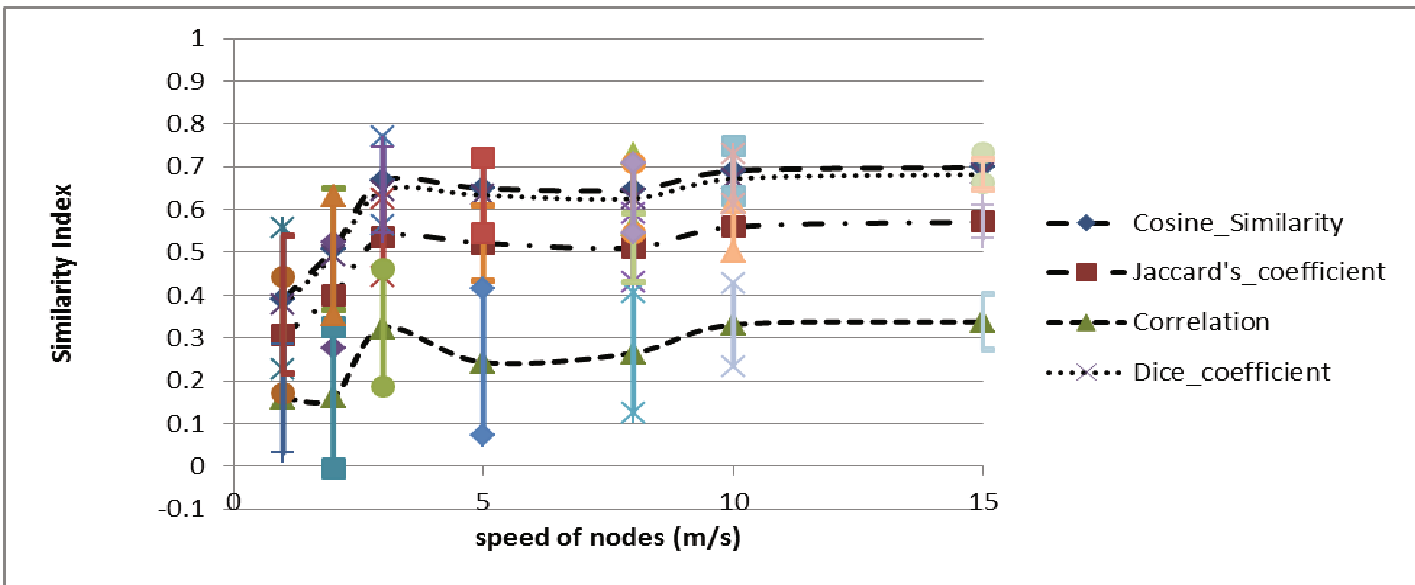 Figure: Cosine Similarity provides the highest index of matches as mobility increases.
Key Finding 2: The DTN Trade-off
Implementing DTN (Store-and-Forward) allowed nodes to find matches even if those nodes weren't currently in range. However, the Success Ratio—defined as matches found divided by messages sent—actually looks worse. Why? Because the protocol continues to blast HELLO messages every 2 seconds even after a match is found or discarded, creating massive overhead.
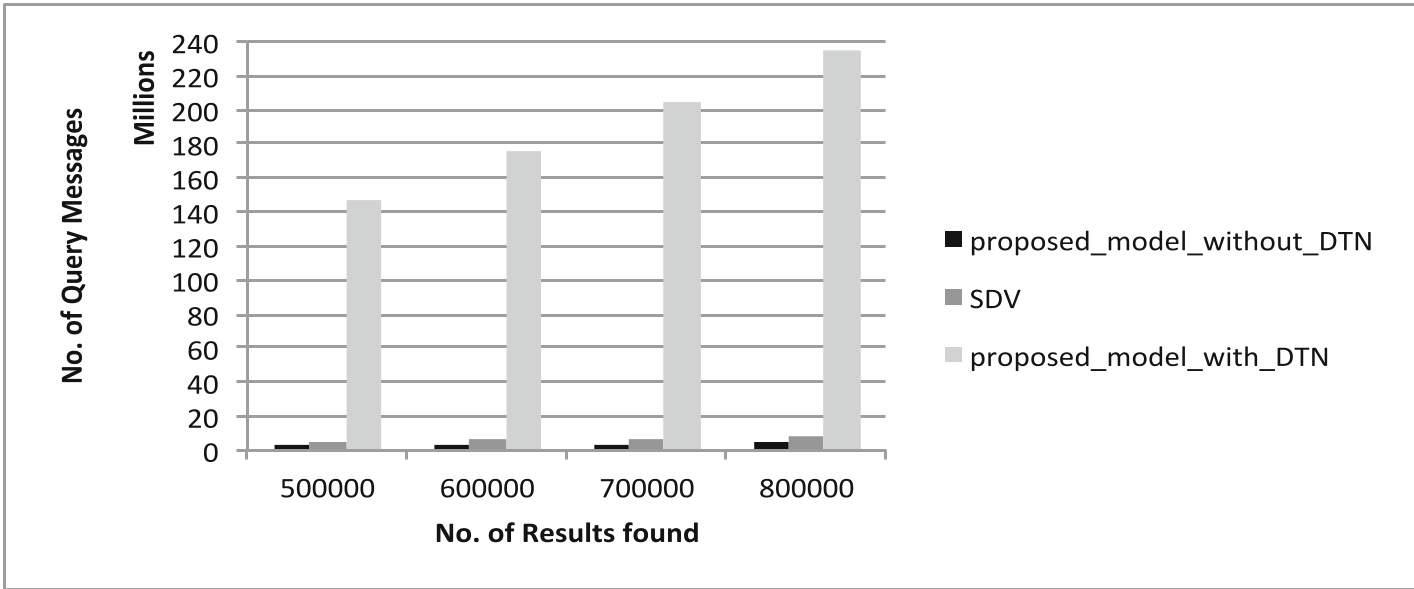 Figure: The proposed OLSR model (without DTN) maintains lower overhead than existing semantic-based methods (SDV).
Critical Analysis & Conclusion
Takeaway: If you are building an ad hoc social app, Cosine Similarity is your best bet for matching interest vectors efficiently. Leveraging the routing layer (OLSR) is a clever way to reduce the energy cost of "who is around me" queries.
Limitations:
- The Success Ratio metric used is heavily penalized by the "heartbeat" nature of OLSR. In a real-world app, one might back off the frequency of HELLO messages once social discovery is settled.
- The study assumes a Pause Time of 0, meaning nodes are in constant motion. Real social scenarios often involve "clustering" (people sitting together), which would change the dynamics of the DTN buffer.
Future Outlook: The next step for this tech is "Virtual Communication"—moving beyond finding a friend to actually maintaining a chat session over these intermittent, similarity-calculated links.