
Beyond the Pulse: Using Kurtosis and Duration to Decipher Political Twitter
Effective Clusterization of Political Tweets Using Kurtosis and Community Duration
The paper proposes a novel community clustering method for political "social listening" on Twitter, utilizing Kurtosis and Community Duration as key metrics. By applying the Ward method for hierarchical clustering, it successfully aggregates fine-grained graph communities into manageable clusters and achieves SOTA-like precision in filtering out noise or "insignificant" data.
TL;DR
Researchers have developed a more effective way to perform "Social Listening" by moving beyond simple keyword counts. By analyzing the statistical "peakiness" (Kurtosis) and the longevity (Duration) of twitter communities, they can automatically filter out irrelevant noise and group thousands of micro-discussions into meaningful political insights.
Background: The Granularity Trap
Social media listening is becoming a cornerstone of modern policy-making due to its spontaneity and real-time nature. However, when we use graph theory to group users (nodes) and their interactions (edges), we often end up with "community explosion"—thousands of tiny groups that are too granular to provide actionable intelligence.
The core challenge addressed here is twofold:
- How do we merge these micro-communities into meaningful clusters?
- How do we know which clusters are worth a human analyst's time and which are just digital static?
Methodology: The Physics of Discussion
The authors' insight is elegantly simple: Important political topics endure, while viral noise flashes and fades. They use two primary metrics to categorize communities:
1. Kurtosis (The Peak Factor)
In statistics, Kurtosis measures the "tailedness" of a distribution.
- High Kurtosis: A sharp spike in activity (intensive transmission over a short period).
- Low Kurtosis: A flatter, more distributed engagement pattern.
2. Community Duration
Using 4-hour "time buckets," the researchers measured how long a community stays active throughout an election cycle.
The Clustering Pipeline
The researchers visualized the semantic association of 1.4 million tweets using the Insight Digger (IDG) tool.
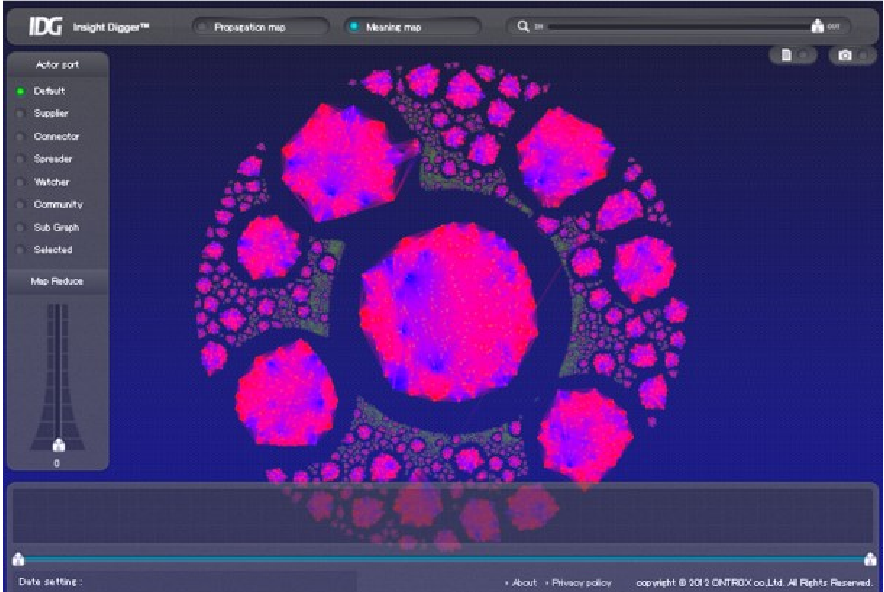 Fig 1: Semantic map showing the initial complex network of nodes (tweets) and edges (associations).
By applying the Ward Method—a hierarchical clustering algorithm—to the kurtosis and duration data, they were able to condense nearly 7,000 communities into 8 strategic clusters.
Experimental Results: Separating Signal from Noise
The evaluation focused on the 2012 Japanese National Election. By plotting the clusters on a scattergram (Kurtosis vs. Duration), the researchers discovered a "Goldilocks Zone" for political relevance.
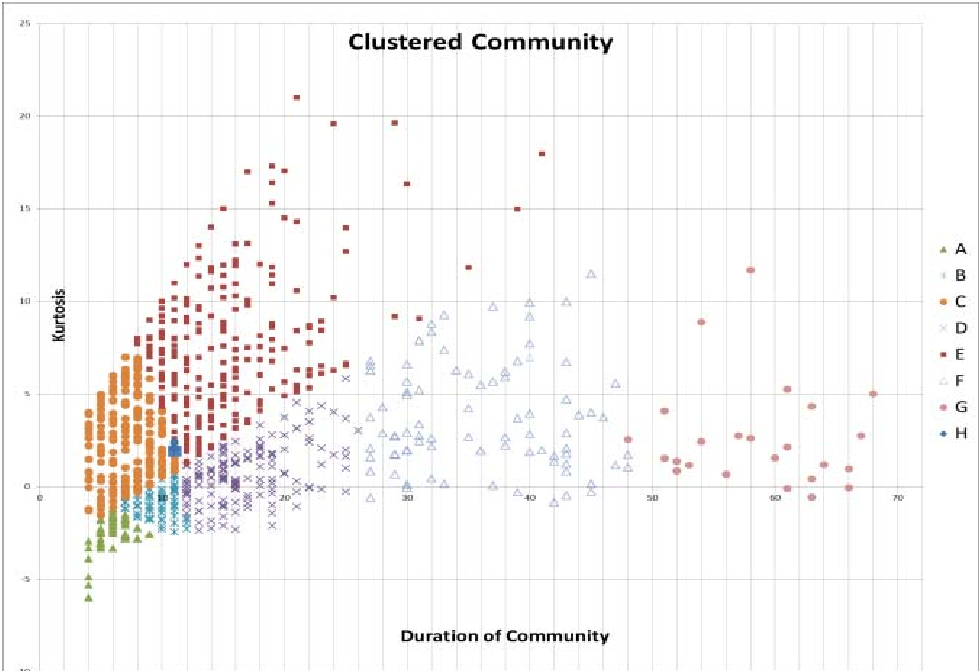 Fig 2: Scattergram of Kurtosis (Vertical) vs. Duration (Horizontal).
- The Noise Filter: Cluster H was identified as having low duration and varying kurtosis. Morphological analysis revealed that 85% of words in Cluster H were unrelated to politics, proving the method's ability to act as an automated "trash filter."
- The Policy Signal: Cluster G (Low Kurtosis, High Duration) was the only cluster containing significant "Diplomacy" related keywords, representing stable, long-term voter concerns rather than temporary election-day outrage.
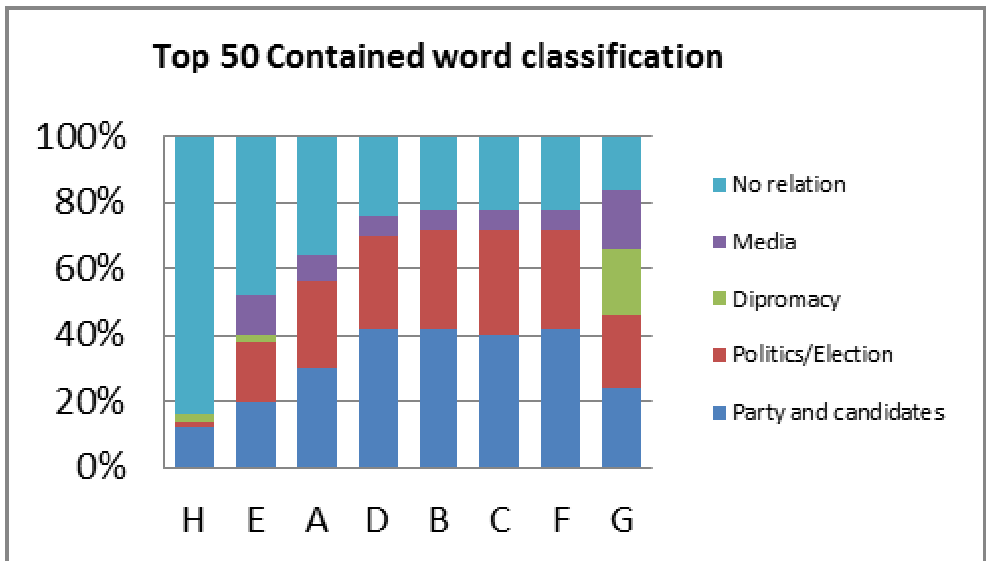 Fig 3: Categorization of the 50 most frequent words per cluster, validating that dynamic metrics correlate with content quality.
Critical Insight & Conclusion
The true value of this work lies in its Inductive Bias: the assumption that the temporal shape of a conversation reveals its intent. While many contemporary models focus on SOTA NLP (like Transformers) to understand what is being said, this method focuses on how it is being said over time.
Limitations & Future Work
The study relies on a 10% random sample for its primary analysis, which may miss some long-tail nuances. Future research could integrate these temporal metrics with LLM-based sentiment analysis to provide even deeper qualitative layers.
Takeaway: If you want to find the real heart of a political debate on social media, don't just look for the loudest voices—look for the ones that have been speaking the longest and steadiest.