
Location Influence Maximization: Turning Social Mobility into Geographical Spread
Effective and efficient location influence mining in location-based social networks
This paper introduces a novel framework for "Location Influence Maximization" in Location-Based Social Networks (LBSNs), identifying sets of influential locations that maximize geographical reach. The authors propose the "Influence Oracle" data structure, utilizing HyperLogLog sketches to efficiently solve the top-k location problem, outperforming state-of-the-art methods like IRS with up to 45% better influence spread.
TL;DR
While most "influence" research focuses on high-traffic social media accounts, this paper shifts the focus to the physical world. It defines Location Influence—the capacity of a physical venue to distribute information across a city via its visitors. By combining mobility patterns with social friendship data and leveraging efficient probabilistic data structures (HyperLogLog), the authors provide a scalable way to find the best spots for outdoor marketing.
Background & Motivation: Beyond Viral Tweets
In the world of Location-Based Social Networks (LBSNs) like Foursquare or Gowalla, we usually talk about "popular" places. But popularity is not the same as influence. A metro station might be popular, but if its visitors only go home afterward, its geographical reach is limited.
The authors argue for a shift toward Outdoor Marketing (OOH). If you give a promotional T-shirt to a visitor at Location A, and they subsequently visit Locations B, C, and D, Location A has exerted "geographical influence." The core challenge is: How do we find a set of 'k' locations that collectively expose information to the widest possible area?
Methodology: The "Bridging Visitor" and The Oracle
1. The Bridging Visitor
The heart of the paper is the Bridging Visitor (B).
- Direct Bridging: User visits location then within window .
- Friends-Based/Influenced: Extends by assuming friends of visitors are likely to follow suit, accounting for data sparsity in LBSN check-ins.
2. The Influence Oracle
To find the top-k locations, you need to calculate the combined influence of thousands of location pairs. This is computationally expensive. The authors propose an Influence Oracle, a data structure that maintains summaries of these transitions.
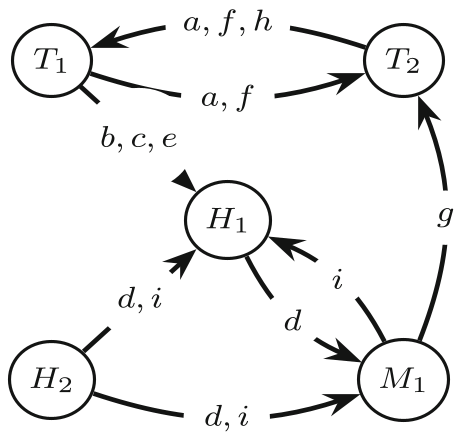 Fig 1: A running example showing how user movements (C) and friendships (R) define influence between locations like Tourist attractions (T) and Hotels (H).
3. Optimization via Sketches
Keeping exact lists of every visitor for every location pair would crash most servers. The authors utilize HyperLogLog (HLL) sketches—probabilistic data structures that estimate set cardinality using minimal memory. For the "Single-Influencer" case (where one carrier is enough to spread a message), they use Versioned HLL (vHLL) to process activities in reverse time, achieving massive speedups.
Experimental Proof: Mapping the Spread
The authors validated their models using real-world datasets (FourSquare, BrightKite, Gowalla). A key finding was the qualitative difference in geographical spread.
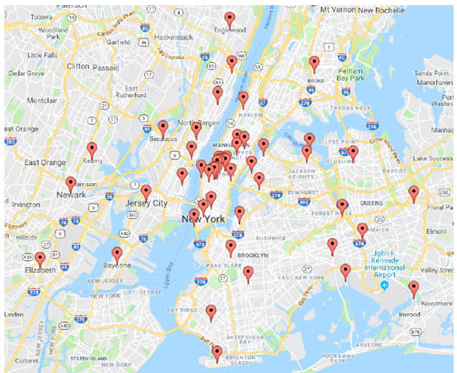 Fig 2: Comparison of influence spread in New York. The red dots (Proposed MIA model) show a much wider and denser geographical reach compared to traditional temporal path methods (IRS).
Key Quantitative Results:
- Effectiveness: Their MIA model (Influenced Friends) outperformed the best baseline (IRS-window) by up to 400% in terms of unique locations reached.
- Efficiency: The approximate HLL algorithms reduced memory requirements by 22x compared to exact calculations, making it feasible for massive metropolitan datasets.
Critical Insight: The "Friendship Assumption"
The paper confirms a crucial intuition through data: Friends move similarly. Their analysis (Fig 7 in the paper) shows that the Jaccard similarity of locations visited by friends is significantly higher than that of non-friends in the same city. By incorporating "potential" future visits from friends, the model overcomes the "sparse data" problem (where most users only check-in occasionally).
Conclusion and Future Outlook
This work formalizes the "physicality" of social networks. By treating visitors as vectors of influence, it provides a rigorous mathematical framework for urban planning and marketing.
Limitations: The model currently treats all "visits" as equal, regardless of the time spent at a location or the "quality" of the interaction. Future iterations might incorporate "dwell time" or group activities (visiting a place with friends) to further refine the influence probability.
Takeaway for Tech Leads: If you are building spatial-temporal recommendation engines or ad-tech platforms, shifting from "user-to-user" to "location-to-location" influence via HLL sketches is a highly scalable and effective path for capturing urban dynamics.