
TourMiner: Unlocking Popular Travel Patterns from Big Social Media Data
An Effective and Efficient Similarity-Matrix-Based Algorithm for Clustering Big Mobile Social Data
This paper introduces TourMiner, an efficient clustering algorithm designed to extract popular tourist tours from big mobile social data (Twitter). It leverages a similarity-matrix-based approach combined with GPU-accelerated geo-partitioning to process massive semantic trajectories.
TL;DR
TourMiner is an end-to-end framework designed to solve the "Where do tourists go?" question by mining geo-tagged tweets. By converting raw GPS pings into Semantic Trajectories and utilizing GPU acceleration alongside specialized memory-paging for similarity matrices, it achieves high-performance clustering on datasets that typically crash traditional algorithms.
Background & Motivation: Moving Beyond Raw Coordinates
In the era of Smart Cities, understanding urban mobility is vital. While we have millions of geo-tagged tweets, raw coordinates are "noisy." A user might tweet five times from a hotel or an airport, creating artificial density.
The authors identified two major gaps in prior work:
- Lack of Semantics: Most methods use pure Euclidean distance, ignoring that two points in the same ZIP code or POI (Point of Interest) are semantically linked regardless of the exact meter-distance.
- Scalability Walls: Clustering requires pairwise comparisons. For a set of trips, a similarity matrix grows at , which quickly exceeds standard RAM capacity.
Methodology: The TourMiner Workflow
The core of TourMiner lies in its three-phase approach:
1. Geo-Partitioning & Semantic Mapping
Raw tweets are grouped into "trips." These trips are then mapped to:
- Categorical IDs: Spatial units like NUTS (EU territorial units) or ZIP codes.
- Numerical IDs: Using Z-Order Curves (GeoHash) to map 2D coordinates into a 1D sequence while preserving spatial proximity.
2. The GPU-Accelerated Similarity Matrix
Instead of a simple "match or no match," TourMiner supports multiple similarity metrics (Jaccard, Dice, Cosine, and Fuzzy Inclusion). To handle the computational load, these calculations are offloaded to 4 parallel GPUs.
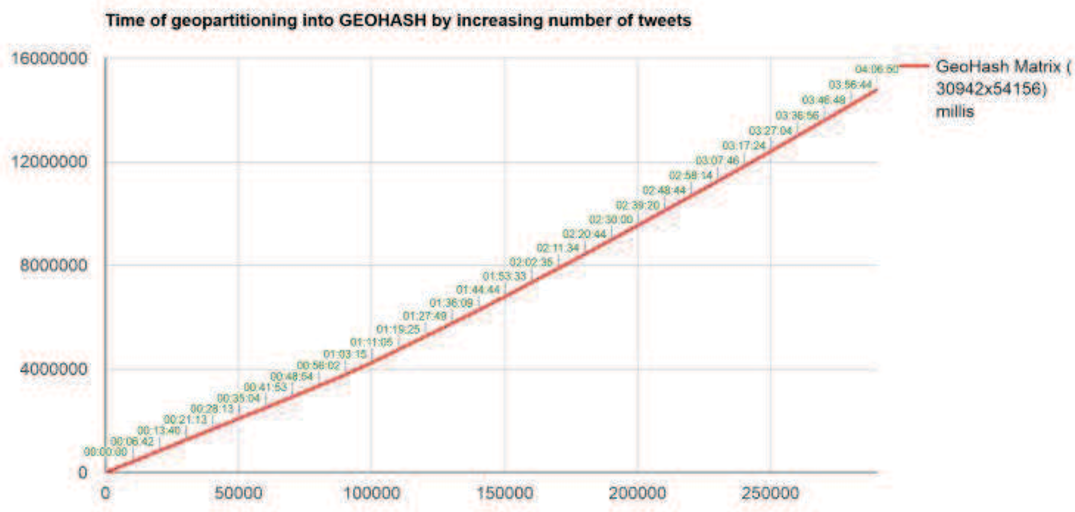 Figure: The impact of GeoHash-based partitioning on processing time.
3. Smart Memory Management
To handle the "Big" in Big Data, the authors used Sequential Indirect Memory Paging. The similarity matrix is mapped to a one-dimensional vector stored in a memory-mapped file on disk. This allows the algorithm to process matrices larger than physical RAM by randomly accessing "chunks" as needed.
Experiments: Performance Breakthroughs
The team tested two clustering flavors: DBSCAN (for flat, fast partitions) and Complete Link (for hierarchical depth).
Key Findings:
- Complexity Reduction: While hierarchical clustering is theoretically , the combination of symmetry optimizations and parallel pre-computations brought the empirical trend down to .
- Flexibility: The system handles both strict categorical matches and fuzzy numerical matches with ease.
- Scaling: As shown in the figures below, parallel optimization significantly flattens the execution time curve as tweet volume increases.
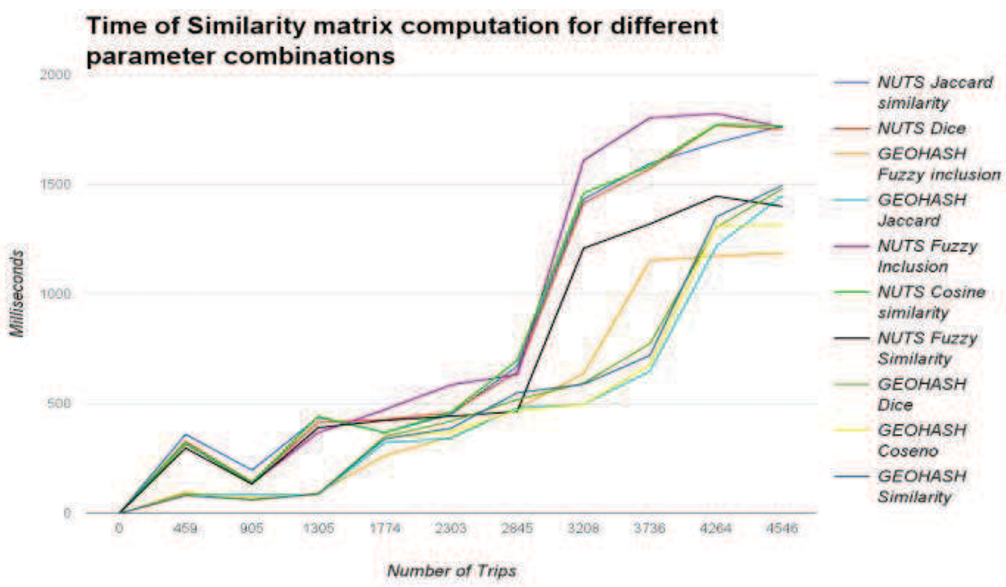 Figure: Trip Clustering Efficiency for Complete Link Clustering on NUTS-based trips.
Critical Insight & Conclusion
The real "magic" of TourMiner isn't just the clustering algorithm—it's the data representation. By removing redundant "pointwise" trips (e.g., multiple tweets from the same WiFi hotspot), the algorithm focuses on actual movement.
Takeaway: Future Big Data analytics should not just focus on "faster" algorithms but on "smarter" data structures like memory-mapped files and GPU-sensitive indexing. TourMiner serves as a robust blueprint for converting social noise into actionable urban intelligence.
Limitations: The current model relies heavily on the quality of external spatial layers (NUTS/ZIP). In regions with poor GIS data, the semantic mapping may lose granularity.