
Leveraging the "Social Curve": Can Facebook Replace Prohibitively Expensive Course Management Systems?
Effective Use of Facebook’s Social Learning Group as a Course Management System for Undergraduate Engineering Courses
This paper explores the feasibility of using "Facebook Social Learning Groups" (FSLG) as a free Course Management System (CMS) for undergraduate engineering courses. It identifies four functional pillars of a CMS and validates Facebook's effectiveness through a semester-long pilot study in Bangladesh.
TL;DR
In the Global South, the high cost of educational software creates a "digital divide" in classroom management. This paper investigates whether the Facebook Social Learning Group (FSLG)—a feature introduced in 2018—can serve as a robust, free Course Management System (CMS). While it excels at community building and material organization, it struggles with the privacy requirements of formal assessments.
The Problem: The High Cost of Learning Logsitics
For engineering departments in developing nations, implementing a SOTA (State-of-the-Art) CMS like Blackboard is often a financial impossibility. This forces a reliance on traditional methods or fragmented free tools. The authors argue that since students are already "living" on social media—94% of social media users in Bangladesh use Facebook—instructors should meet them on their own turf to reduce the "cognitive load" of managing multiple educational accounts.
Methodology: The Four Pillars of CMS
To judge Facebook's effectiveness, the authors first established a rubric of what a CMS must do. They categorized features into four "Functional Feature Categories":
- Communication: Bi-directional flow between instructor and students.
- Material Management: Organizing slides, manuals, and syllabi.
- Assessment: Handling submissions and quizzes.
- Progress Tracking: Monitoring student completion and grades.
The TPSC Model
The authors introduced the Task Post by Instructor, Submission Comments by Students (TPSC) model. By using timestamped comments for project updates and team formations, the instructor created a transparent, accountable audit trail for course activities.
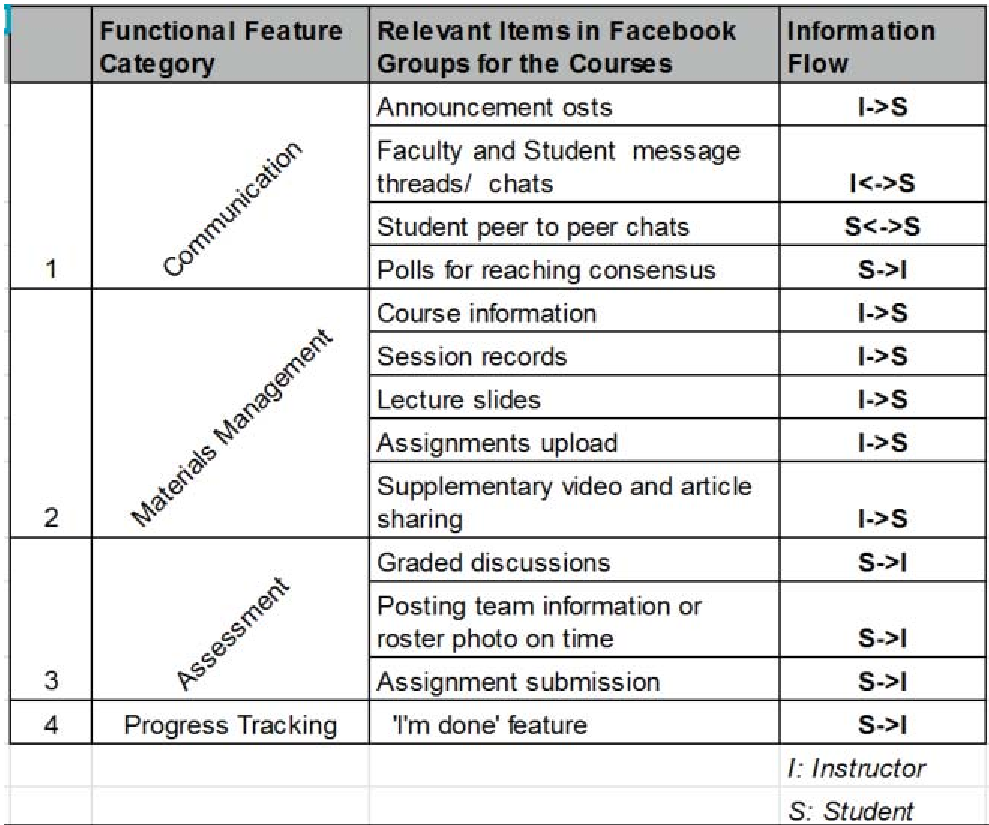 Figure 1: Mapping Facebook features to standard CMS functional categories.
Key Findings: Successes and Shortfalls
The pilot study across three engineering courses yielded several critical insights:
1. Superior Communication & Organization
The "Units" feature was a game-changer. By grouping materials into learning chapters, 90% of students found it easier to navigate than traditional email-based or fragmented file-sharing methods.
2. The Privacy Paradox in Assessment
While Facebook's "seen by" feature increased accountability, the platform failed in Assessment. Students were uncomfortable submitting assignments in public message threads where peers could see their work. Furthermore, Facebook comments do not support file uploads (PDFs/Docs), requiring clumsy workarounds like group chat attachments.
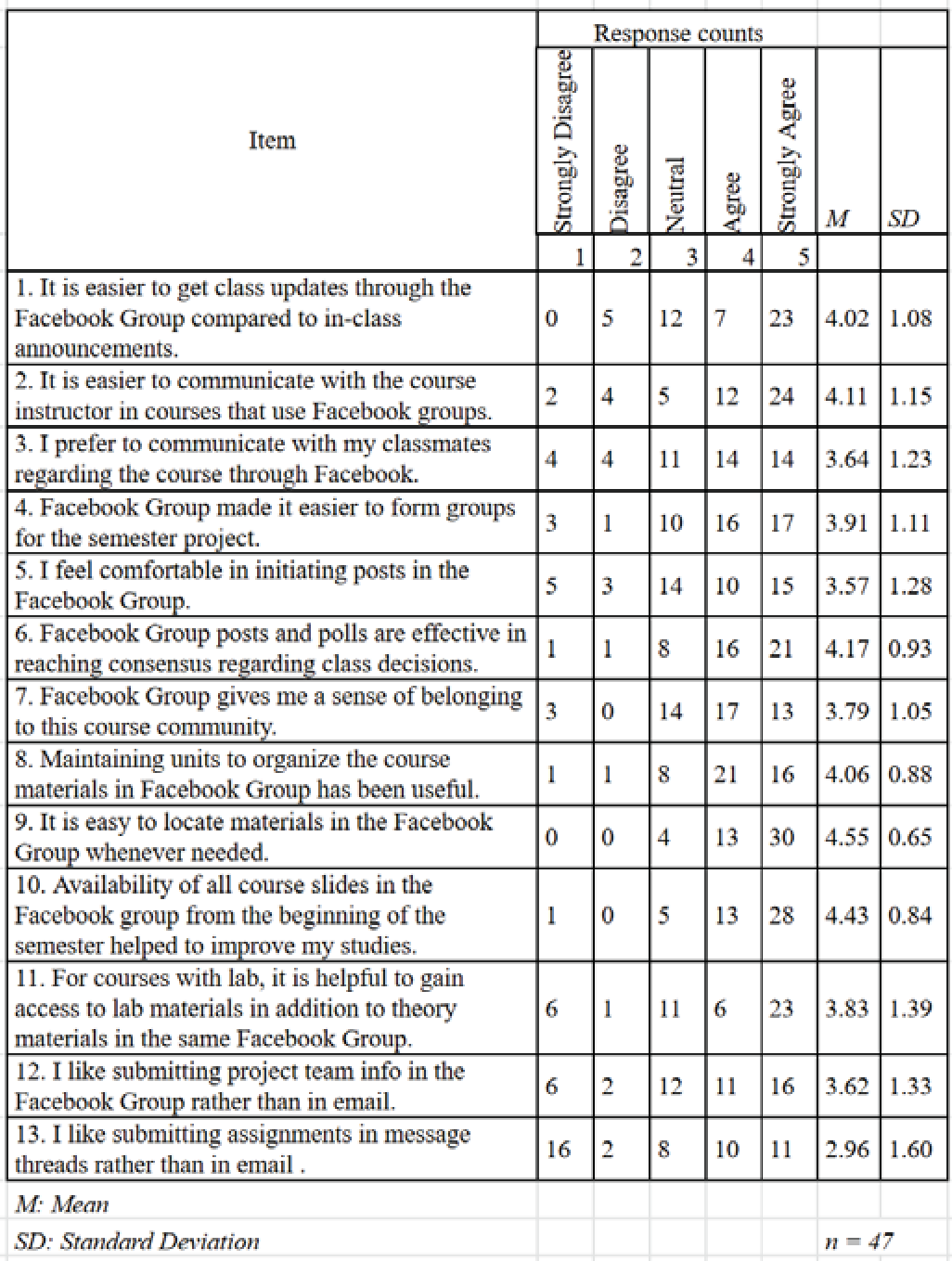 Table 1: Student perception data showing high scores for organization but low scores for assignment submission (Item 13).
Critical Analysis: Distraction vs. Access
The paper honestly addresses a major "Inductive Bias" in social media pedagogy: Distraction. 10% of students explicitly preferred Google Classroom because it lacked the "doom-scrolling" temptation of the Facebook News Feed.
However, the "Zero Facebook" initiative—which provides free data access to Facebook in certain regions—makes FSLG a uniquely egalitarian tool for students who cannot afford broad internet data plans.
Conclusion and Future Outlook
The study concludes that Facebook Social Learning Groups are an effective "gateway" CMS for hybrid courses, particularly in resource-limited environments.
Takeaways for Educators:
- Use FSLG for Communication and Material Distribution to capitalize on high student up-time.
- Avoid FSLG for High-Stakes Assessment or private grading due to privacy limitations.
- The "Social Learning Unit" feature is the most critical component for maintaining academic structure within a social environment.
Future research should look into integrating Facebook's communication strengths with more secure, specialized grade-tracking tools.