
EIMCT: Optimizing Opportunistic Networks through Socialization Nodes and Optimal Control
Effective information transmission based on socialization nodes in opportunistic networks
The paper introduces EIMCT (Effective Information Transmission based on Socialization Nodes), an optimized forwarding model for opportunistic networks. By leveraging socialization nodes and Pontryagin's Maximum Principle, it establishes a time-threshold-based strategy to maximize delivery ratios while minimizing energy consumption.
TL;DR
Information transmission in opportunistic networks often suffers from the "flooding paradox"—more copies improve delivery but kill the network through energy and buffer exhaustion. The EIMCT (Effective Information Transmission) algorithm solves this by treating mobile devices as "socialization nodes." By applying the Pontryagin Maximum Principle, it identifies an optimal stop-time threshold, ensuring high delivery ratios (up to 67%) with a fraction of the energy used by traditional methods.
Problem & Motivation
Most classical opportunistic routing protocols like Epidemic or Spray and Wait treat nodes as random particles. In reality, human-carried devices follow social patterns.
- Blind Flooding: Older methods waste bandwidth and energy by replicating messages to every neighbor.
- Resource Constraints: Mobile devices have limited cache and battery; once these are exhausted, the node becomes a "dead" link, decreasing total network reliability.
- Social Reality: Observations suggest that a node is more likely to meet "friends" or nodes within the same community, yet existing math models rarely bridge the gap between social ties and optimized control theory.
Methodology: The Core of EIMCT
The authors define the system based on two pillars: Social Characteristics and Optimal Control Theory.
1. The Socialization Model
Instead of assuming uniform encounter probabilities, EIMCT uses a negative exponential distribution for encounter intervals combined with a power-law distribution for social degrees (the number of "friends" a node has). This allows the model to calculate a more accurate state-space transition for information spreading.
2. Optimal Control via Pontryagin
The research defines a objective function to maximize the Delivery Ratio ( F(T) ) subject to an Energy Constraint ( C ). By constructing a Hamiltonian function, the authors prove a critical theorem: the optimal forwarding strategy follows a "binary" behavior.

- Phase 1 (t < h): The node forwards packets with maximum effort to capitalize on social encounters.
- Phase 2 (t > h): The node stops forwarding to conserve energy and buffer space, recognizing that the marginal gain of reaching the destination decreases over time.
Experiments & Results
The authors used the ONE (Opportunistic Network Environment) simulator with a real-world map of Helsinki to validate their approach against five baselines.
Performance Gains
- Delivery Ratio: EIMCT reached a 0.67 delivery ratio in long-running simulations, a ~60% improvement over the standard Spray and Wait (copy=10) protocol.
- Energy Efficiency: As shown in the comparative data, EIMCT consumes only ~100J, whereas Epidemic protocols skyrocket to 550J+ due to uncontrolled replication.
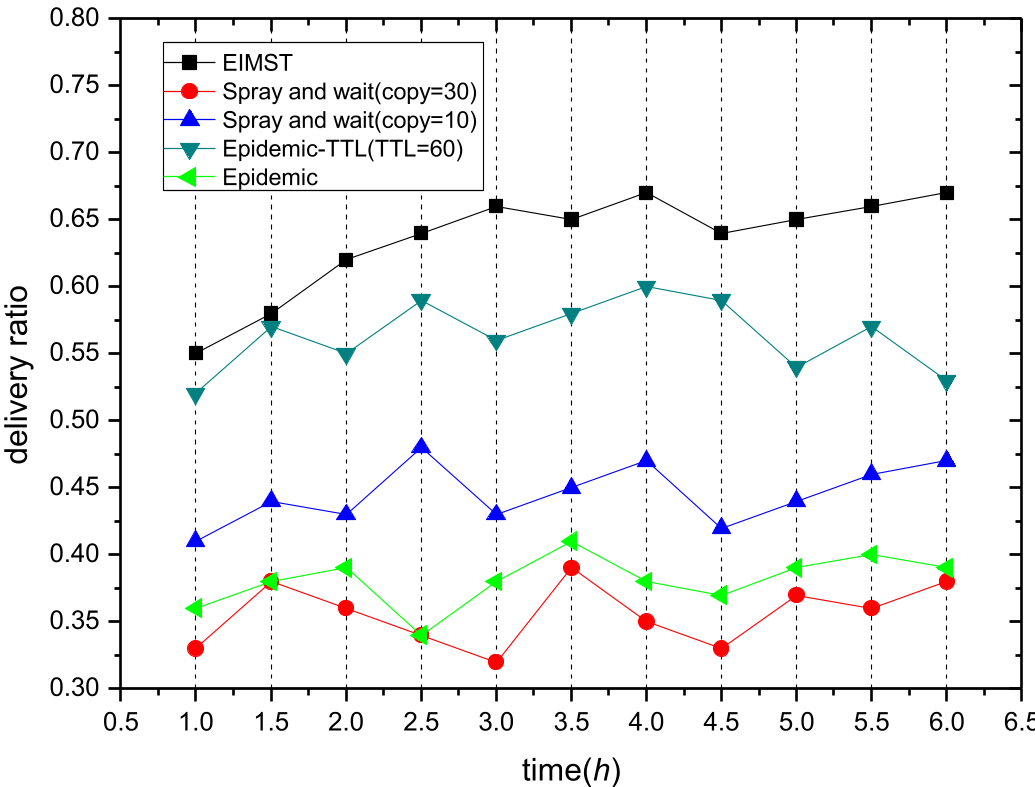 Fig 1: The simulation environment utilizes the complex street layout of Helsinki to ensure realistic mobility patterns.
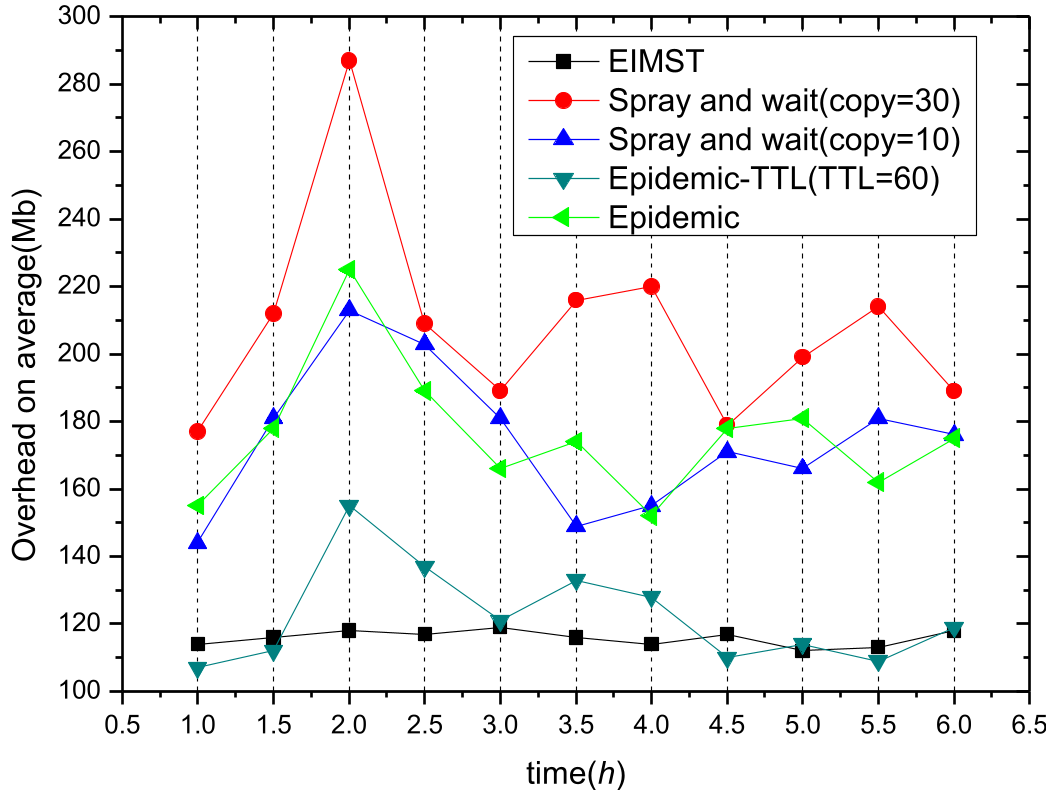 Fig 2: EIMCT (top curve) maintains a consistently higher delivery ratio as simulation time progresses compared to flooded and limited-copy alternatives.
Critical Analysis & Conclusion
Takeaway
The genius of EIMCT lies in its mathematical rigor. It doesn't just "guess" when to stop forwarding; it uses the Pontryagin Maximum Theorem to find the precise "stop-time" ( h ). By treating nodes as social entities, it aligns network topology with human behavior.
Limitations
- Homogeneity: The model assumes a somewhat static definition of "socialization." In high-mobility disaster scenarios, social ties may be less predictable.
- Threshold Complexity: Calculating the optimal ( h ) in real-time on low-power IoT devices might introduce computational overhead not fully explored in the paper.
Future Outlook
This work lays the foundation for "Green Networking" in the IoT era. Future iterations could involve Deep Reinforcement Learning to dynamically adjust the stop-time ( h ) as the network density changes in real-time.