
Maximum Causal Tree: Precision Intervention for Disability Employment
Recommending the Most Effective Intervention to Improve Employment for Job Seekers with Disability
This paper introduces the Maximum Causal Tree (MCT), a two-stage causality-based recommendation framework designed to improve employment for disabled job seekers. It uniquely identifies causal factors (e.g., motivation, education) and recommends both the most effective factor and its optimal intervention level to maximize individual employability.
TL;DR
In the realm of Disability Employment Services (DES), the million-dollar question isn't just "what job fits?" but "what skill should be upgraded to maximize employment chance?" This paper presents Maximum Causal Tree (MCT), a framework that moves beyond simple matching to counterfactual reasoning. By combining causal discovery with multi-objective tree-based optimization, MCT identifies not just which factor to change, but the exact level of intervention needed—revealing that sometimes, more education isn't always the answer.
The Motivation: Moving from Association to Causation
Most employment recommenders are built on associations: "People with degree X usually have job Y." However, for a disabled job seeker, this is insufficient. They need to know: "If I spend six months on a computer course, how much will my specific employment probability increase?"
The technical challenge is twofold:
- Continuous Factors: Most causal models work with binary treatments (e.g., drug vs. placebo). Skills like education or motivation are ordinal or continuous.
- Observational Data: Unlike clinical trials, we cannot randomize who gets an intervention. We must adjust for "back-door" confounding variables in historical data.
Methodology: The Two-Stage Causal Engine
Stage 1: Causal Discovery (The "Why")
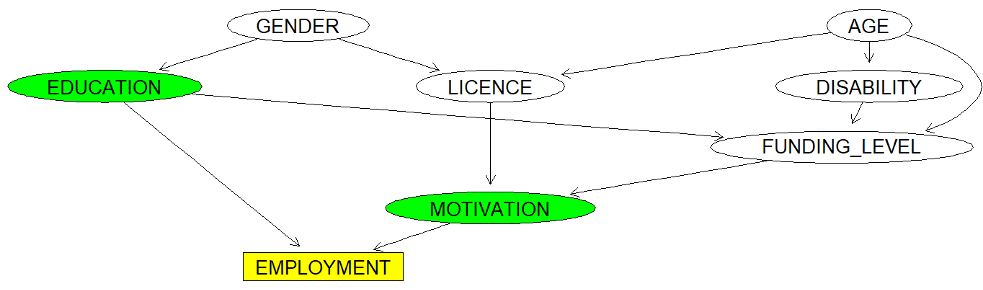
The authors first use the PC algorithm to construct a Directed Acyclic Graph (DAG). This ensures the system only recommends factors that actually cause employment, rather than those merely correlated with it. For instance, they discovered three primary causes: Motivation, Education, and Work Capacity.
Stage 2: The Maximum Causal Tree (MCT)
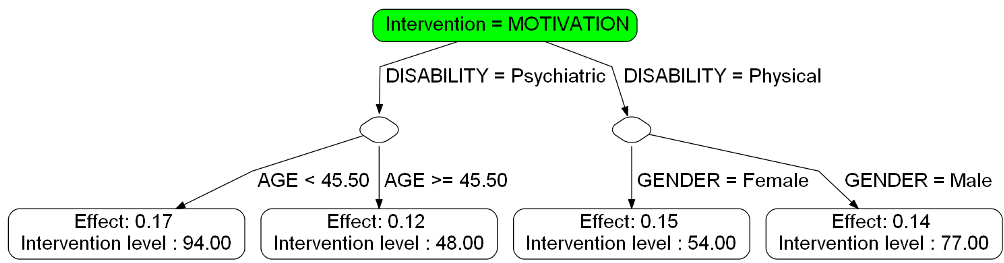
To find the personalized "sweet spot" for intervention, MCT splits the population into subgroups based on characteristics (Age, Disability Type, etc.). At each split, the model performs Multi-Objective Optimization using three criteria:
- Effect Fitness: Maximizing the accuracy of the predicted employability increase.
- Effect Diversity: Ensuring the tree finds subgroups that respond differently to interventions.
- Intervention Level Diversity: Identifying that different groups require different "doses" of a skill.
To handle the complexity of these three rewards, the authors use -dominance, a refinement of Pareto optimality that allows for practical trade-offs during tree growth.
Experimental Insights: Surprising Results
The researchers applied MCT to data from 4,697 Australian disabled job seekers.
1. The "Optimal" is not the "Highest"
One of the most profound findings is that the best intervention level is rarely the highest level. For motivation, reaching an "intermediate" stage might yield the same employment boost as "extreme" motivation, saving job seekers from burnout.
2. The Education Paradox
While education is generally positive, the MCT revealed that for older job seekers, further education can actually reduce employability—likely due to overqualification or age-related market biases.
Performance & Heterogeneity
MCT achieved a Kendall correlation of 1.00 in ranking job seekers by their actual employability increase, significantly outperforming standard Causal Trees (CT) and Fit-based Trees (FT). It successfully separated "high-responders" from others, allowing service providers to allocate scarce resources to those who would benefit most from specific upskilling.
Practical Takeaways
For the DES sector and AI researchers, this paper highlights:
- Interpretability is Actionable: Tree-based models provide clear "rules" that counselors can explain to job seekers.
- Precision Matters: Recommending the wrong intervention (like education for an older worker) isn't just unhelpful—it can be detrimental.
- Causality > Correlation: In social interventions, we must model the change in outcome, not just the outcome itself.
MCT serves as a blueprint for how AI can provide nuanced, human-centric guidance in complex social systems.