
Leadership as a Catalyst: Decoding BPM Success in Developing Nations
Effective Leadership in BPM Implementations: A Case Study of BPM in a Developing Country, Public Sector Context
This study investigates the role of effective leadership in Business Process Management (BPM) within the public sector of developing countries, specifically through an in-depth case study of the Dompe e-Hospital initiative in Sri Lanka. By synthesizing Complexity Leadership Theory (CLT) and Actor-Network Theory (ANT), the authors identify 36 specific leadership actions across four stages of network translation that drove a successful, sustainable digital transformation.
TL;DR
Business Process Management (BPM) often fails in the public sector of developing countries due to bureaucratic inertia and social complexity. This paper analyzes the Dompe e-Hospital in Sri Lanka, a rare success story, revealing that leadership isn't just a "style"—it is a series of precise actions across four phases of network building. By balancing Operational, Enabling, and Entrepreneurial leadership, the project turned a chaotic hospital into a national benchmark.
The "Why": Why Leadership is the Missing Link in BPM
In the context of developing nations, BPM projects face a staggering 85% failure rate. While technical issues are often blamed, the root cause is usually social and organizational. Traditional leadership models—often focused on "Command and Control"—fail to address the complex web of stakeholders (politicians, medical associations, apathetic staff).
The authors argue that leadership in BPM is not a static trait but a dynamic interaction. They ask: What exactly does a leader do to make an innovative process "stick" in a resistant culture?
Methodology: The Synthesis of ANT and CLT
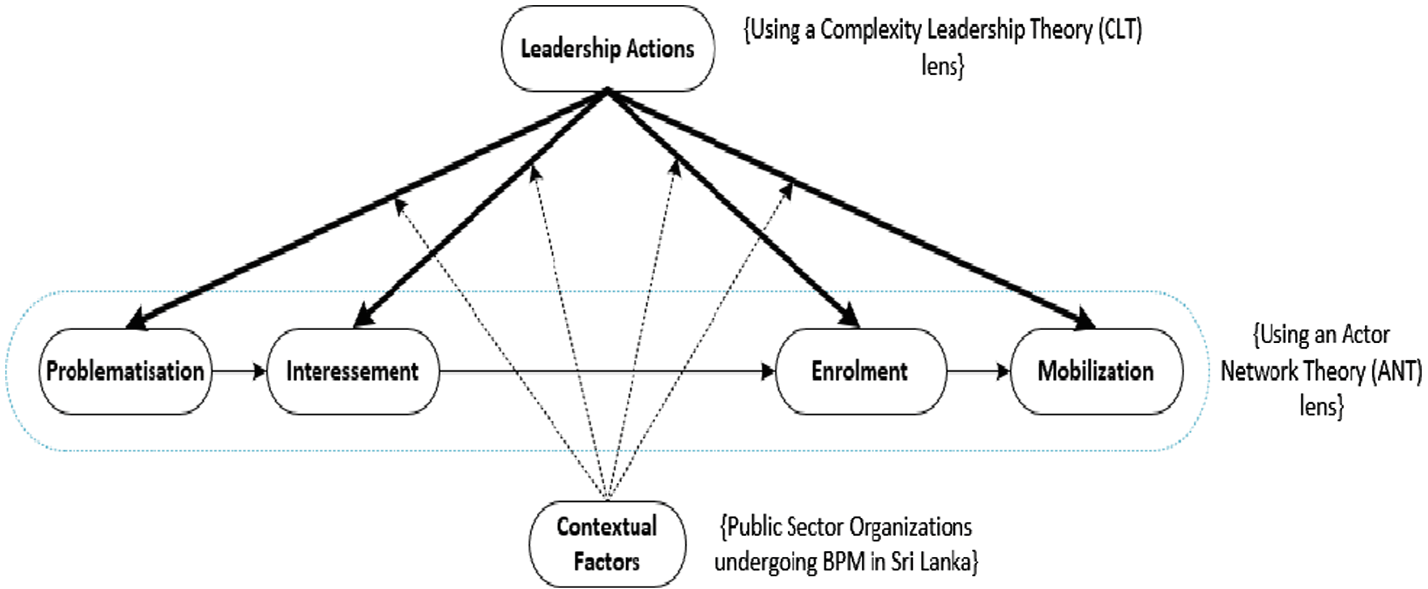
The researchers used a sophisticated lens to analyze the case:
- Actor-Network Theory (ANT): Views the BPM project as a network of humans and non-humans (software, standards). It tracks how a "focal actor" aligns everyone's interests.
- Complexity Leadership Theory (CLT): Breaks leadership into three types:
- Operational: Bureaucratic alignment and control.
- Entrepreneurial: Driving innovation and new ideas.
- Enabling: Creating the "Adaptive Space" where the other two can coexist without killing each other.
The Case Study: Dompe e-Hospital
Dompe District Hospital was once notorious for chaos and poor service. The transformation was led by three focal actors: a young Medical Officer (MO), an ICTA Program Manager, and a local Community Leader. Over several years, they moved from manual paperwork to a centralized digital healthcare management system.
The Four Phases of Transformation (ANT Translation)
1. Problematisation (The Vision)
The Medical Officer defined the problem in a way that resonated with staff.
- Action: Used "Visible Outcomes" (Operational) like physical layout changes to show immediate value.
- Action: Organized "Field Visits" (Enabling) to other hospitals to motivate staff through comparison.
2. Interessement (Gaining Commitment)
This was the most action-heavy phase (15 actions).
- Action: "Rewards and Recognition" (Operational) such as certifications and overtime payments.
- Action: "Exhibiting Trust" (Enabling) by delegating responsibilities based on skill rather than seniority.
3. Enrolment (The Turning Point)
The network became stable. Staff stopped fighting the system and started suggesting improvements.
- Action: "Process Innovations" (Entrepreneurial) where staff feedback led to the use of bar codes and auto-fill forms.
4. Mobilization (Universal Acceptance)
The new way of working became "irreversible."
- Action: The Medical Officer emerged as the "Legitimate Spokesperson" for the success.
Key Results and Insights
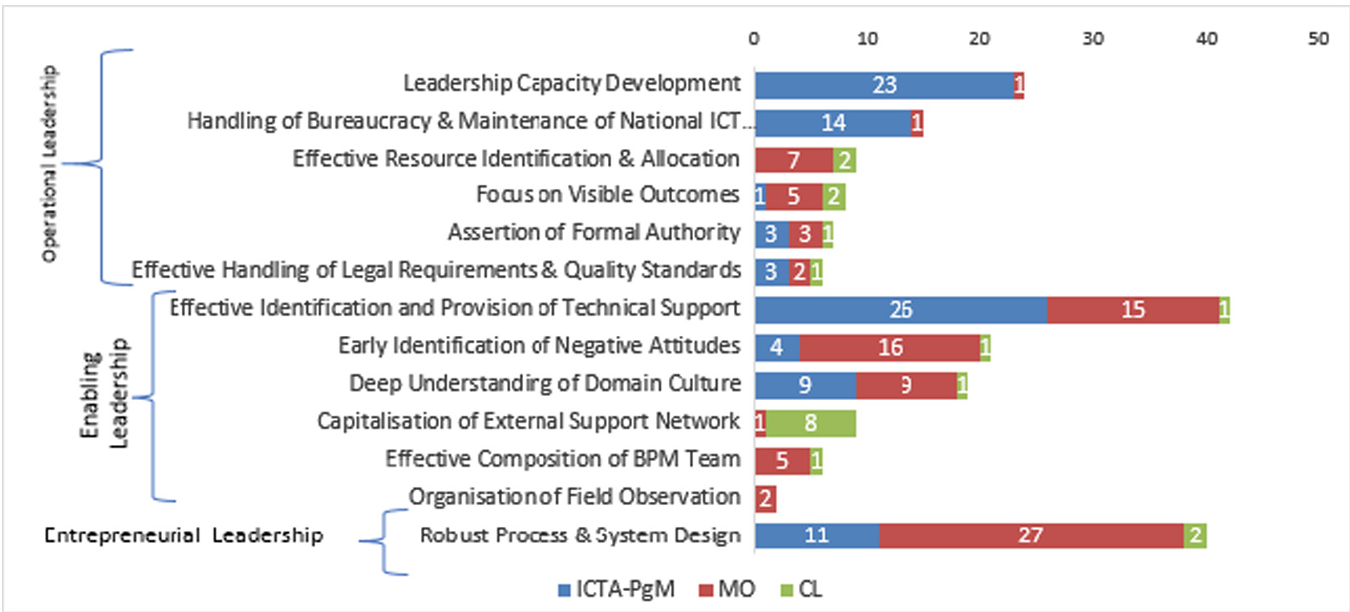
The success of the Dompe initiative was not accidental. It was the result of 36 distinct leadership actions.
- Quantifiable Success: The model is now being replicated in 300 hospitals across Sri Lanka.
- Adaptive Outcomes: The hospital won the Presidential Award for Productivity, and the "chaotic" culture was replaced by a self-organizing, process-centric one.

Critical Analysis & Conclusion
Takeaway
The study proves that in public sector BPM, Enabling Leadership is the secret sauce. Without it, Entrepreneurial ideas are crushed by Operational bureaucracy. Leaders must act as "network weavers," constantly aligning the fluctuating interests of stakeholders with the technical requirements of the system.
Limitations
As a single case study focused on a hospital, the specific actions (like "Community Leader Liaison") might not translate directly to a Ministry of Finance or a private bank. However, the categories of actions remain highly relevant.
Future Outlook
For practitioners in developing countries, this paper provides a "Codebook." Instead of merely telling managers to "be better leaders," it suggests specific interventions—like peer-bonding and visible milestones—to navigate the treacherous waters of public sector digital transformation.