
Beyond Static Values: Maximizing Trust Behavior Propagation in Social Networks
Finding effective nodes to maximize the trusting behavior propagation in social networks
This paper introduces a novel behavioral trust propagation model in social networks that categorizes users into three distinct trusting modes: Optimistic (A), Moderate (B), and Pessimistic (C). It utilizes the Higgs Twitter dataset to demonstrate that maximizing the diffusion of specific trusting behaviors depends on identifying influential nodes through various centrality and community-based selection methods.
TL;DR
Trust is often treated as a simple numerical value in social network analysis, but this paper argues it's actually a dynamic behavior that spreads like a contagion. By defining three psychological modes—Optimistic, Moderate, and Pessimistic—the researchers developed a model to identify which "influencer" nodes can most effectively shift an entire community toward a specific trusting behavior, using real-world Twitter data to validate their findings.
The "Uniformity" Trap: Why Current Trust Models Fail
In most social network research, trust calculation is a "one-size-fits-all" affair. If User X interacts with User Y, a standard algorithm assigns a score. However, this ignores Human Subjectivity. An "Optimistic" user might trust after one retweet, while a "Pessimistic" user might require months of consistent positive interactions.
The authors argue that we must model the manner in which people trust. Furthermore, the goal isn't just to calculate trust, but to maximize its propagation. How do you turn a skeptical network into a trusting one? The answer lies in the diffusion of behavior, not just the movement of content.
Methodology: The ABCs of Trust
The paper formalizes three behavior modes based on the weighted impact of positive and negative interactions ( and ):
- Optimistic (Mode A): High tolerance; positive interactions outweigh negative ones.
- Moderate (Mode B): Balanced view; requires significant evidence before trusting.
- Pessimistic (Mode C): Strict requirements; highly sensitive to negative interactions and heavily influenced by Time Decay (recent interactions matter more).
The Propagation Engine
The core innovation is the transition mechanism. A node's mode is influenced by the "Average Impact" () of its neighbors.
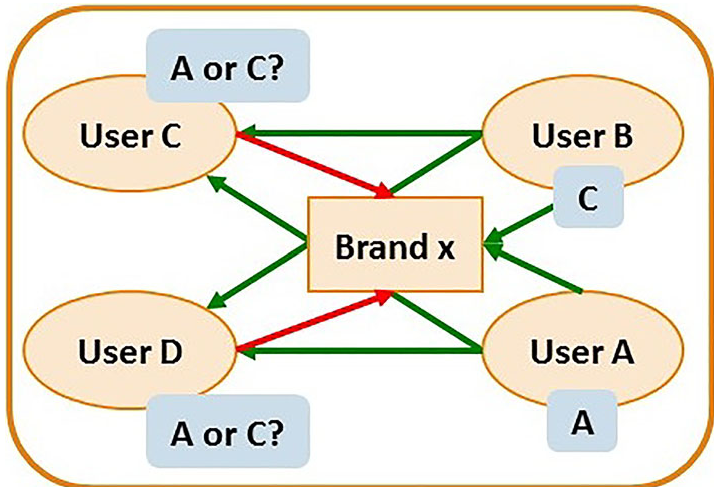 In the figure above, the interaction behavior of users A and B toward a brand triggers a secondary behavior change in users C and D through their social ties.
The researchers tested seven selection methods to find "Seed Nodes," including Betweenness Centrality, Eigenvector Centrality, and Community-based Out-degree selection.
Experiments and Results
Using the Higgs Twitter Dataset, the study evaluated three scenarios:
- Scenario 1: Turning a fully pessimistic network optimistic (e.g., a new brand launch).
- Scenario 2: Managing a diverse network with mixed behaviors.
- Scenario 3: Preventing a "pessimism outbreak" after a negative event.
Key Findings
- The In-Degree vs. Out-Degree Paradox: While In-degree measures popularity, Out-degree (how many people a node trusts) is the far superior predictor of spreading behavior.
- Community Matters: Selecting the most active nodes within localized clusters (Walktrap algorithm) led to the fastest and most stable behavior improvement.
- The Power of Pessimism: The results confirmed a sociological bias: it is significantly easier to spread a "Pessimistic" mode than an "Optimistic" one.
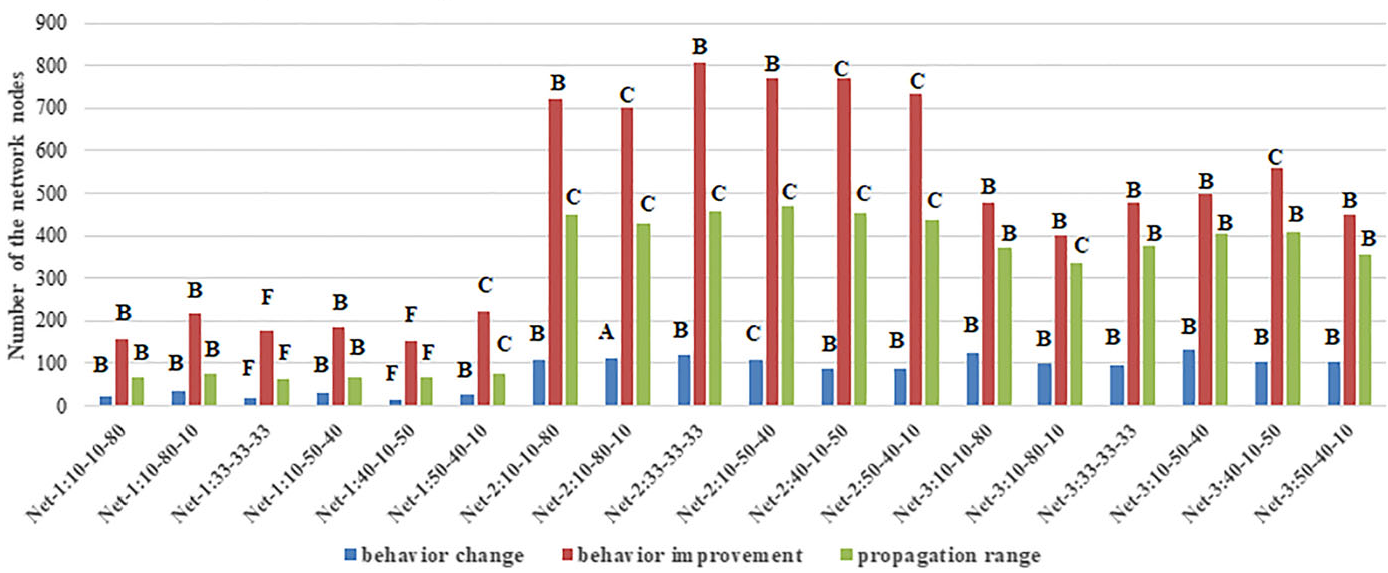 The charts above illustrate that Community-based selection (Method F/G) consistently outperforms random or simple centrality methods in propagation range.
Critical Insight & Future Outlook
This work shifts the paradigm from "Trust as Data" to "Trust as Psychology." By acknowledging that pessimistic users are "stickier" and harder to convert, it provides a realistic framework for brand managers and community moderators.
Limitations: The model currently struggles with disconnected networks—if the graph isn't fully connected, behavior propagation hits a dead end.
Future Work: The authors suggest integrating Semantic Similarity (analyzing what users say, not just that they interacted) and exploring the Dynamicity of network structures as edges appear and disappear in real-time.
Conclusion
To maximize trust in a community, don't just target the most "followed" individuals; target those who are active bridges between clusters and understand that their inherent "trusting mode" is a viral characteristic that defines the health of the entire network.