
SSCRA: Revolutionizing D2D Resource Allocation through Small Social Communities
8971_Effective Small Social Community Aware D2D Resource Allocation Underlaying Cellular Networks.
This paper proposes a Small Social Community Resource Allocation (SSCRA) scheme to optimize D2D communications by leveraging the geographic and social characteristics of small-sized groups. It transforms the resource allocation problem into a directed graph matching problem to maximize total network throughput in underlay cellular networks.
Executive Summary
TL;DR: This paper tackles the interference and complexity crisis in Device-to-Device (D2D) communications by exploiting the "Small Social Community" phenomenon. Instead of optimizing thousands of individual links, the authors propose the SSCRA (Small Social Community Resource Allocation) algorithm, which treats communities as single entities in a graph matching problem. This approach significantly reduces computational overhead while boosting throughput by over 35% compared to random allocation.
Positioning: This work is a strategic optimization of D2D resource management, shifting the focus from purely physical distance to a hybrid "Physical-Social" geographic awareness.
The "Small Community" Bottleneck
In modern urban environments, people gather in small clusters based on shared interests (e.g., Pokémon Go players or commuters at a bus stop). These are Small Social Communities.
Current SOTA methods face two major issues in these settings:
- Intra-community Interference: When multiple D2D pairs in a 30m radius reuse the same cellular channel, the signal-to-interference ratio collapses.
- Scalability: Standard optimization algorithms are often -hard or have exponential complexity relative to the number of users, making real-time BS (Base Station) allocation impossible in dense areas.
Methodology: From Users to Graphs
The core insight of this paper is to abstract the resource sharing relationship into a Directed Graph .
1. The Graph Mapping
Each vertex represents a community. A directed edge from community to signifies that a D2D user in community is reusing the spectrum of a Cellular User (CU) in community . This eliminates the need to calculate every single user-to-user interference path, focusing instead on community-level interference weights ().
2. The SSCRA Algorithm
The authors develop a two-phase process:
- Phase 1 (Greedy Initialization): Communities select the "cleanest" resources based on minimum interference from CUs.
- Phase 2 (Edge Switching): The algorithm identifies "saturated" communities where D2D-to-D2D interference is high and iteratively switches edges to non-saturated communities to balance the load.
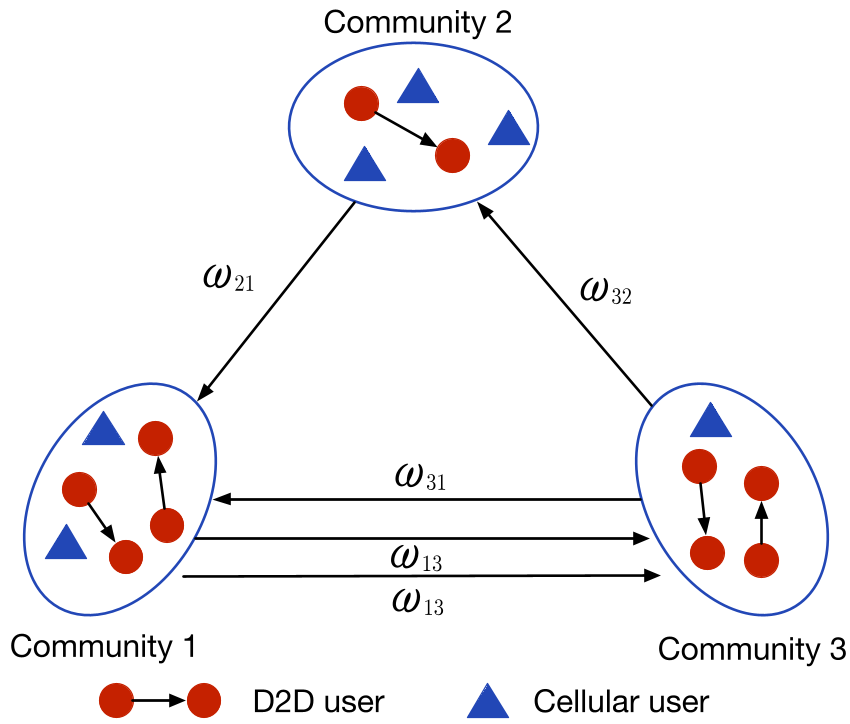 Figure 1: Example of community-based graph matching for resource allocation.
Performance & Experiments
The authors validated SSCRA against several baselines, including SCRA (Same Community), FFRA (Farthest First), and SGUM (Social Group Utility Maximization).
Key Findings:
- Superior Throughput: SSCRA maintains high throughput even as the number of D2D users increases, whereas Bipartite Graph Matching (BGM) fails when the D2D load exceeds the available cellular resources.
- Complexity Reduction: While SGUM achieves similar results, it is computationally prohibitive. SSCRA achieves near-identical performance with a complexity of only .
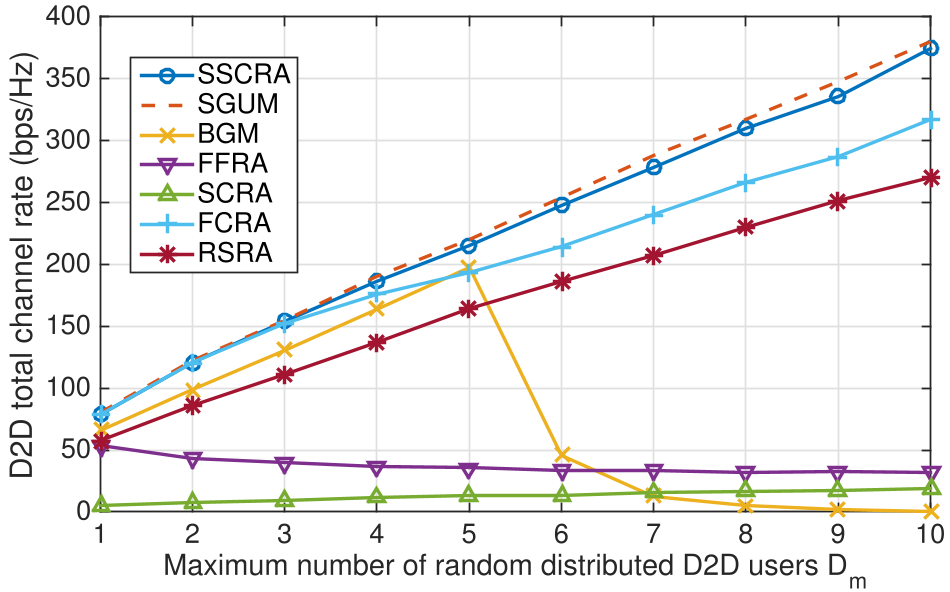 Figure 2: Performance comparison showing SSCRA's throughput advantage in varying D2D loads.
Critical Insight & Conclusion
Takeaway
The genius of this paper lies in the spatial simplification. In a small community (radius 10-30m), the channel conditions for all users are statistically similar on a slow timescale. By ignoring individual micro-fluctuations and focusing on the community macro-structure, the authors transformed a chaotic optimization problem into a manageable graph matching task.
Limitations & Future Work
- Mobility: The model assumes relatively static communities. Future research should address high-mobility scenarios where communities dissolve and reform rapidly.
- Cross-Layer Design: Integrating this community-aware approach with MAC-layer scheduling could further reduce latency for real-time social applications.
In conclusion, SSCRA provides a practical, low-complexity roadmap for mobile operators to handle the impending "dense D2D" era by looking at the social fabric of the network, not just the radio waves.