
Beyond Connectivity: Quantifying Social Tie Strength via Trajectory Entropy
Effective social relationship measurement based on user trajectory analysis
This paper introduces the Hierarchical Entropy-based Relationship Measurement Approach (HERMA), a framework designed to quantify the strength of social relationships by analyzing physical co-location records extracted from user trajectories. Unlike traditional methods that focus on binary relationship existence, HERMA leverages spatial-temporal data to model tie strength through novel entropy metrics and a multi-layer regional architecture.
TL;DR
While most social network analysis tells us who is connected, it rarely tells us how strongly. This paper introduces HERMA, a framework that mines user trajectory data to transition from binary link prediction to nuanced relationship strength measurement. By introducing User and Area Entropy, the system distinguishes between a casual meeting in a mall and a significant interaction at a private residence.
The "Weak Link" in Social Computing
Traditional Online Social Network (OSN) research has a blind spot: it treats all "friends" as equal nodes. In reality, your relationship with a roommate is fundamentally different from that of a high school acquaintance you occasionally "Like" on Facebook.
The authors argue that physical interactions are the gold standard for social strength. However, using raw GPS data is noisy. If you and a stranger both wait at the same bus stop every morning, does that make you friends? Existing "co-location count" methods would say yes. HERMA says no, by looking at the entropy and context of those encounters.
Methodology: The HERMA Framework
The core innovation lies in treating space and behavior as information-theoretic problems. The approach consists of three pillars:
1. User and Area Entropy
- User Entropy (UE): Quantifies how "active" a person is. If a user visits many different places equally, their entropy is high. A meeting with a high-entropy user is weighted less than a meeting with a low-entropy user (who is more selective about their interactions).
- Area Entropy (AE): Measures the "openness" of a location. A shopping mall has high entropy (visited by many people); a private home has low entropy. HERMA posits that physical interactions in low-entropy (private) areas are much stronger indicators of a social bond.
2. Hierarchical Region Structure
Social interactions happen at different scales. Some friends you only see when you are in the same city; others you see in the same specific office or room.
Note: The structure models co-location from coarse layers (Level 1: Global) down to fine layers (Level H: Specific Grids), allowing the model to capture the "spatial significance" of a meeting.
3. The Measurement Formula
The strength is calculated by summing interactions across all layers, weighted by the inverse of User and Area entropy. Essentially:
Experimental Validation
To test HERMA, the authors simulated a community of 500 users with distinct life patterns (Home vs. Cafe "socializing").
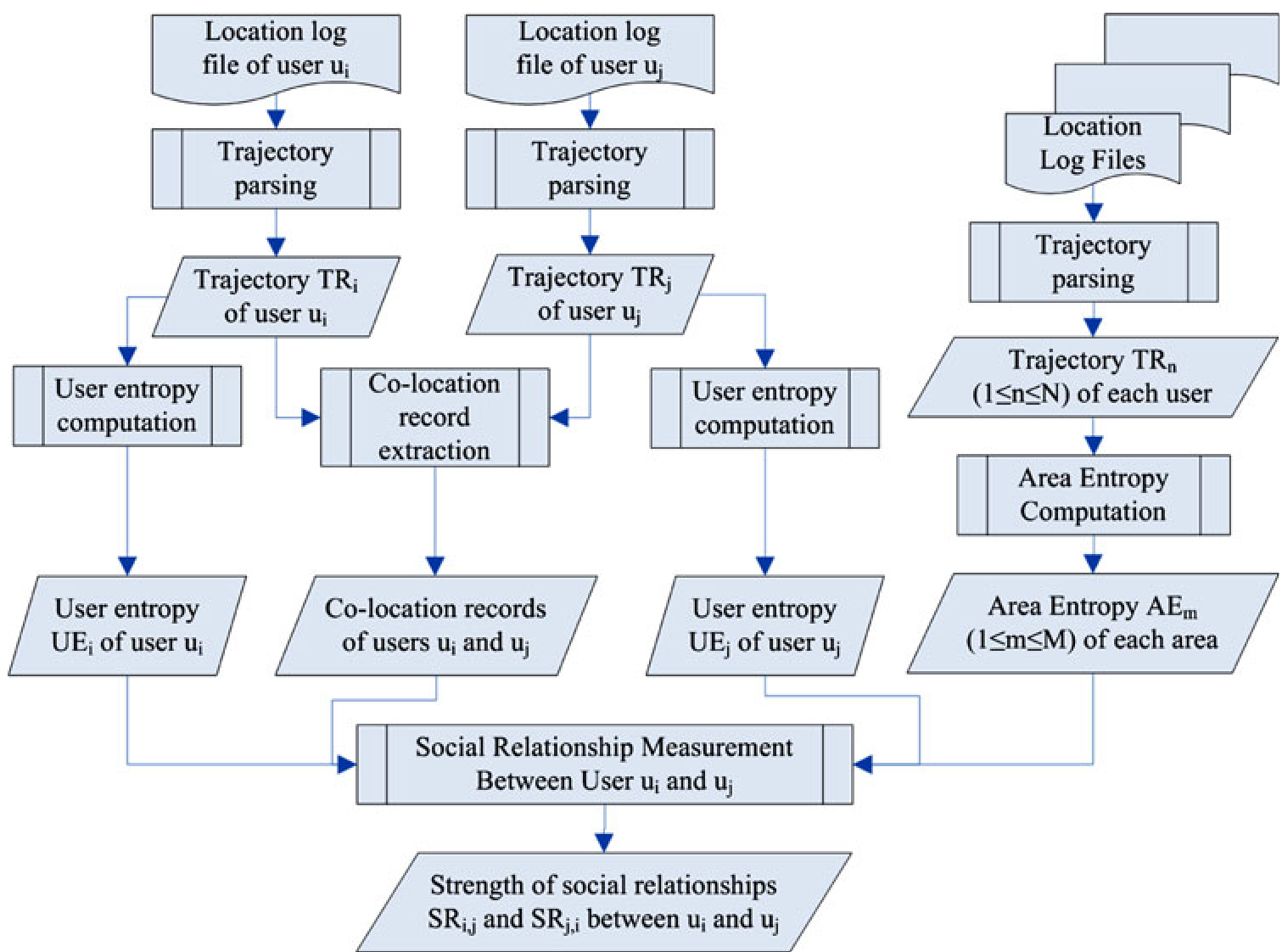
Key Experimental Insights:
- Hierarchy Matters: Performance peaked at around 4-5 layers. Beyond this, the granularity became too fine, leading to "overfitting" on noise.
- Entropy beats Counts: Simple co-location counting (the "Hier-Count" baseline) failed to reach the accuracy of entropy-based methods because it couldn't filter out the "stranger at the bus stop" effect.
- The "Goldilocks" Zone: The model is sensitive to the co-location grid size () and time threshold (). Too small/short, and you miss real meetings; too large/long, and you drown in noise.
Critical Insight & Future Outlook
The genius of HERMA is its ability to extract "high-level intelligence" (friendship strength) from "low-level sensing data" (GPS lat/long). By recognizing that where you meet is as important as how often you meet, it provides a much more realistic model of human society.
Limitations: The study relies heavily on simulated data due to the difficulty of obtaining "ground truth" strength rankings in real-world datasets like MIT Reality Mining.
Future Directions: The authors suggest a decentralized version of HERMA to protect privacy and the integration of diverse sensors (audio/speech recognition) to determine if a physical interaction is positive (sharing a meal) or negative (an argument). This would move us from "geographical proximity" to "emotional proximity."
Summary Takeaway
HERMA proves that in the age of big data, your trajectory is a digital fingerprint of your social life. By weighting interactions through the lens of spatial entropy, we can finally map the "strength" of the ties that bind us.