
[CMU Research] CAID: Why Branch-and-Merge is the "Silver Bullet" for Multi-Agent Software Engineering
Effective Strategies for Asynchronous Software Engineering Agents
The paper introduces CAID (Centralized Asynchronous Isolated Delegation), a multi-agent coordination paradigm for long-horizon software engineering (SWE) tasks. By leveraging specialized git-based primitives, it achieves state-of-the-art performance on Commit0 (Python library implementation) and PaperBench (AI research reproduction).
Executive Summary
TL;DR: CMU researchers have introduced CAID (Centralized Asynchronous Isolated Delegation), a framework that transforms how AI agents collaborate on massive coding projects. By moving away from "chatty" agents and toward Git-based physical isolation, CAID boosts accuracy in complex software tasks by up to 26.7%.
Context: This isn't just another role-playing agent setup. It is a fundamental shift in the coordination layer, positioning itself as a robust solution for "Long-Horizon" tasks—like implementing a Python library from scratch—where single agents inevitably hit a "cognitive wall" regardless of their iteration budget.
The "Coordination Tax" and the Failure of Chat
Modern AI agents are great at fixing single bugs, but if you ask three agents to build a neural network library simultaneously, chaos ensues.
- Silent Interference: Agent A renames a function; Agent B writes code calling the old name. Both "think" they are right.
- Context Explosion: As agents talk to each other to "sync," their context windows fill with logs and chatter, causing performance degradation.
- Instructional Soft Isolation: Simply telling agents "Don't touch the same file" is too fragile for complex dependencies.
Methodology: Engineering a Better Manager
CAID replaces vague instructions with Software Engineering (SWE) Primitives. The workflow follows a rigorous "Branch-and-Merge" philosophy:
- Dependency Graphing: The Manager agent doesn't just list tasks; it maps which files depend on which modules (e.g.,
autodiff.pymust exist beforelayers.pycan be tested). - Isolated Worktrees: Every engineer agent gets its own
git worktree. This ensures physical separation—two agents can never accidentally overwrite the same byte in the same workspace. - The Event Loop: Execution is asynchronous. The manager acts like a conductor, listening for "completion signals" (commits) and dynamically re-assigning tasks as upstream dependencies are met.
 Figure 1: The Manager orchestrator maintains the main branch while delegating tasks to isolated engineers.
Experimental Proof: More Iterations != Smarter Agents
One of the paper's most striking findings (Figure 2) is that giving a single agent more time (100 -> 200 iterations) often hurts performance. The agent gets lost in its own history or starts hallucinating fixes.
In contrast, CAID utilizes that same "computational budget" by distributing it across specialized instances. On the Commit0 benchmark (building libraries from scratch), Claude 4.5 jumped from 53.1% to 59.1% pass rate, while the weaker MiniMax 2.5 saw a massive leap from 42.3% to 57.0%.
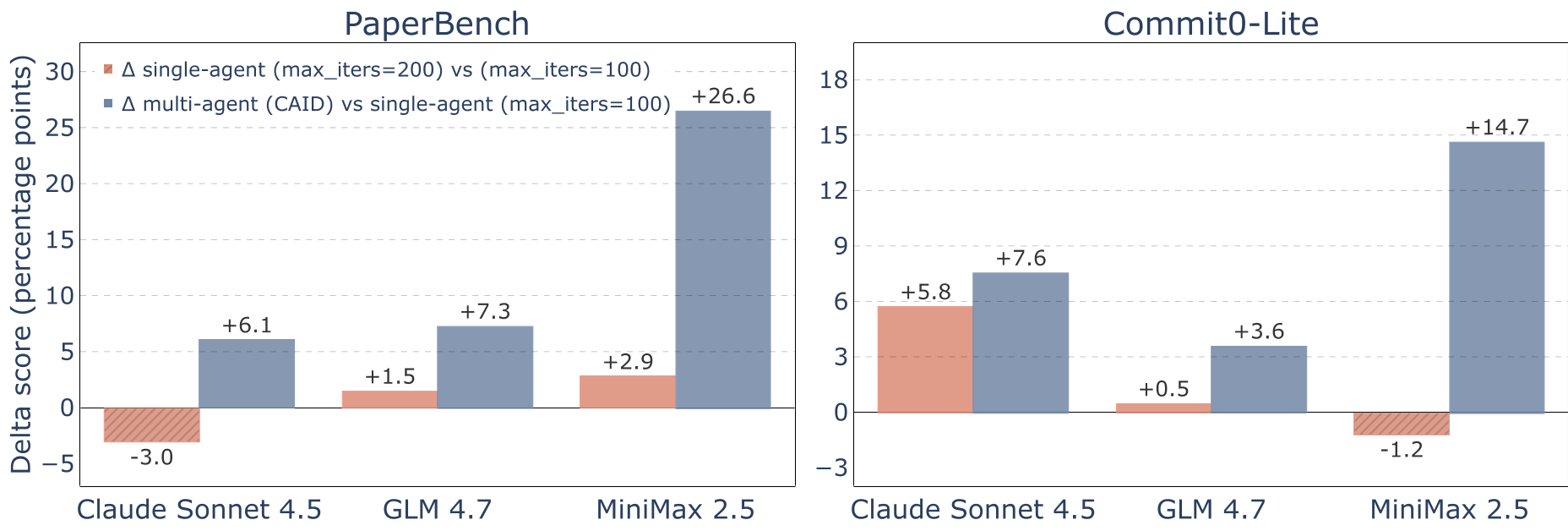 Figure 2: CAID effectively utilizes iteration budgets where single agents plateau or fail.
Deep Insight: The Value of "Physical" Isolation
A key ablation study in the paper compared Soft Isolation (telling agents to stay in their lane) vs. Worktree Isolation (using Git).
- On PaperBench, Soft Isolation actually performed worse than a single agent.
- Why? Without hard Git-level boundaries, agents produced inconsistent views of the shared state, leading to integration failures that were impossible to debug. Hard isolation via
git mergesurfaces conflicts explicitly, forcing the agent to resolve them with clear error signals.
Critical Analysis & Conclusion
Takeaway: The "Industry Standard" for AI software development is moving toward mirroring human infrastructure. If we want agents to build production-grade software, we shouldn't just improve their reasoning; we must give them Git.
Limitations: CAID is more expensive (higher API costs) and sequential integration (merging and testing) remains a wall-clock bottleneck. Future work needs to look at "Speculative Integration" or "Hierarchical Testing" to speed up or lower the cost of the coordination loop.
Verdict: CAID proves that the best way to manage a "society of agents" is through the same version-control principles that have governed human software teams for decades.