
This paper initiates the study of interactions between bulk massive particles and fluctuating strings/domain walls in the 3D Ising model. By introducing an Effective Field Theory (EFT) coupling and a renormalized parameter (\lambda), the authors predict universal corrections to the string tension and correlation functions, achieving a bridge between Effective String Theory (EST) and bulk particle dynamics.
In the study of Phase Transitions and Quantum Field Theory, the 3D Ising Model serves as a Rosetta Stone. While we've long understood how bulk particles behave in a vacuum, the interaction between these particles and extended excitations—namely, the fluctuating domain walls that separate different vacua—has remained surprisingly elusive.
A recent paper by Viana Parente Lopes et al. provides a rigorous Effective Field Theory (EFT) framework to bridge this gap, treating the domain wall not as a rigid boundary, but as a fluctuating quantum object that "dresses" the particles around it.
TL;DR
The authors develop an EFT that couples massive bulk particles to the Goldstone modes (branons) of a 3D Ising domain wall. They discover that wall fluctuations lead to a unique kinematic enhancement ((L^\chi)) in the free energy and turn standard exponential decays of correlation functions into Gaussian-like spreads near the wall.
The Problem: When Strings and Particles Collide
In a gapped theory like the ferromagnetic phase of the 3D Ising model, we have two types of excitations:
- Lightest Massive Particles: The "atoms" of the bulk phase.
- Strings/Domain Walls: Surfaces separating spin-up and spin-down regions.
The technical headache lies in the scales. Usually, the mass of the bulk particle (m) is of the same order as the string tension (\sqrt{\sigma}). If you try to scatter a particle off a string, the energy involved hits the UV cutoff of the string theory. To solve this, the authors focused on a clever kinematic window: momenta parallel to the wall must be small, even if the particle is on-shell.
Methodology: Coupling the Particle to the Surface
The core of the method is the interaction term: [ S_{\mathrm{int}} = \lambda_{0} \int d^{2} x \sqrt{h} \phi (x, \pi (x)) ] where (\phi) is the bulk field and (\pi(x)) represents the wall's height (the branon).
The "Roughness" Insight
A key takeaway is that the wall is "rough." Unlike a flat surface, the variance of the wall's position (d^2(x)) grows logarithmically with distance: [ d^{2} (x) \approx \frac{1}{\pi \sigma} \ln \left(\frac{| x |}{r_{0}}\right) ] When you average bulk operators over these fluctuations, the standard exponential decay is modified by a power-law factor ((|x|)^\chi), where (\chi = m^2/4\pi\sigma). This is the "fingerprint" of a fluctuating 2D surface.
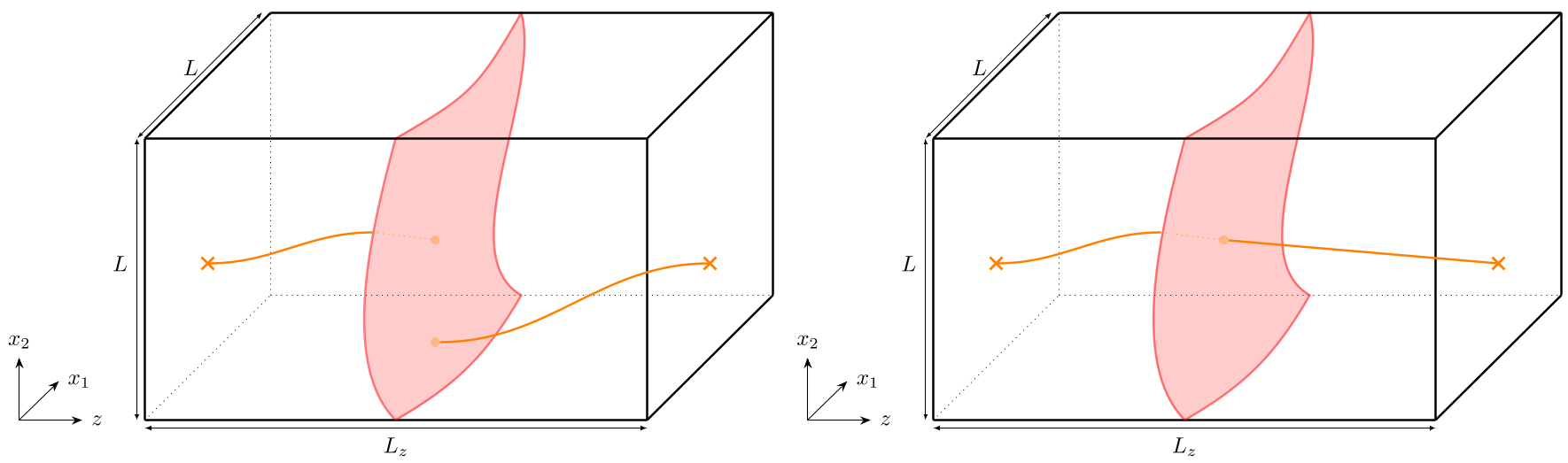 Figure 1: Feynman diagrams showing how bulk particles (lines) interact with the domain wall (surfaces) through multiple windings in a periodic volume.
Experiments: Monte Carlo Validation
The authors tested their EFT predictions using high-precision Monte Carlo simulations of the 3D Ising model.
1. One-Point Functions
The theory predicts that the presence of a wall shifts the average value of a bulk operator by a factor of (1/L_z) (transverse volume). This was confirmed by measuring the energy density (\epsilon) in anti-periodic versus periodic boundary conditions.
2. Two-Point Functions & The Gaussian Tail
Perhaps the most striking result is the visualization of the two-point function. Close to the wall, the correlation between two spins follow a Gaussian profile in the transverse direction, a direct consequence of the "smearing" caused by the branon's Gaussian fluctuations.
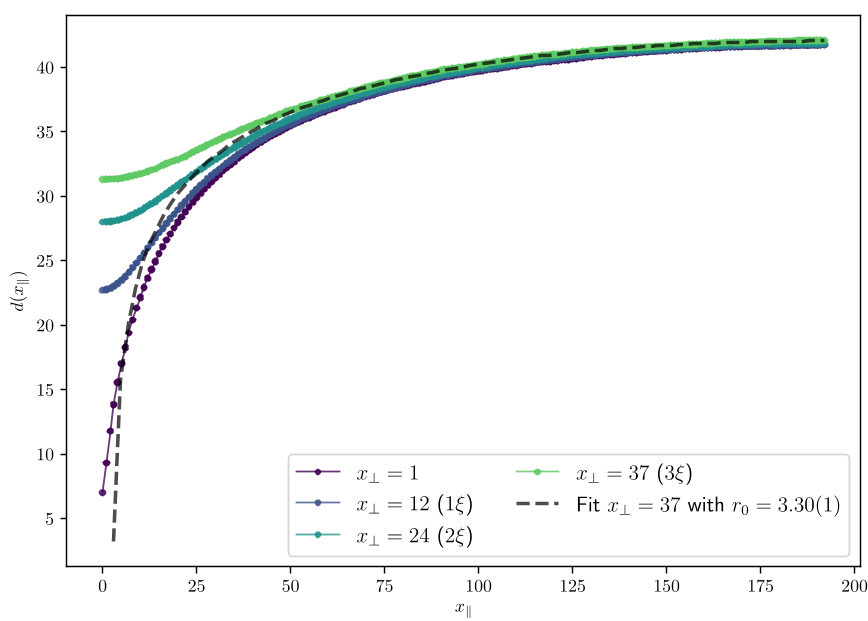 Figure 2: Extraction of the wall variance (d^2(x)) from spin-sector correlators, showing excellent agreement with the free massless-boson prediction (EST).
Critical Analysis & Future Outlook
While the "nearby" regime (close to the wall) is perfectly captured by the theory, the asymptotic regime (long distances) remains a challenge. The predicted scaling of ((m|x_\parallel|)^{2\chi} e^{-m|x_\perp|}) is subtle, and current lattice simulations barely scratch the surface of the distances needed to see the full power-law correction.
Why does this matter? Beyond the Ising model, this framework is a blueprint for confining gauge theories. In QCD, glueballs (particles) interact with flux tubes (strings). The authors show at the end of the paper how this exact EFT can predict the "intrinsic width" of a flux tube as probed by a local operator (like the energy density), a topic of intense current research in the lattice QCD community.
Conclusion
The study of domain walls has moved from a "thin-wall" geometry to a "quantum-surface" EFT. By treating the wall as a dynamic participant in the physics of the bulk, we can finally explain why bulk correlations seem to "broaden" and decay differently in the presence of interfaces.