
Safeguarding the Social Graph: An Integrated Algorithm for Robust SNS Privacy
Effectiveness of Using Integrated Algorithm in Preserving Privacy of Social Network Sites Users
The paper proposes an "Integrated Algorithm" that combines k-anonymity and ℓ-diversity to protect users' privacy in Social Network Sites (SNSs). By clustering users with similar quasi-identifiers and diversifying sensitive attributes, it aims to prevent re-identification through background knowledge and homogeneity attacks.
TL;DR
Online Social Networks (SNSs) are goldmines for attackers seeking to exploit personal data. While k-anonymity is a popular defense, it often fails against clever inference attacks. This paper introduces an Integrated Algorithm that blends k-anonymity with ℓ-diversity, using clustering and taxonomy-based generalization to ensure that users' identities remain hidden even when an attacker possesses significant background knowledge.
The Privacy Paradox in SNS
In the modern web, users often trust online communities more than offline ones, leading to the "Digital Dossier" effect—the accumulation of personal fragments that can be weaponized for blackmail, corporate espionage, or insurance profiling.
The core challenge is that even if you remove a user's name (Identifier), an attacker can use Quasi-identifiers (like Zip code, Birthday, or Gender) to "re-identify" them by cross-referencing public databases. Previous solutions like k-anonymity tried to group similar people together so that no one person stands out. However, if all people in a group happen to have the same "hidden" trait (e.g., they all have a specific medical condition), the anonymity is useless. This is known as a Homogeneity Attack.
Methodology: The Two-Pillar Defense
The authors propose a hybrid framework that tackles both identity exposure and attribute leakage.
1. Optimized K-Anonymity via Clustering
Instead of random partitioning, the algorithm uses a clustering approach to group users who are most similar in their quasi-identifiers.
- Generalization & Taxonomy Trees: To hide specific details, the algorithm moves up a "taxonomy tree." For example, a specific "City" might be generalized to a "State."
- Information Loss Metric: The paper emphasizes using deep hierarchies in taxonomy trees to minimize "Information Loss," ensuring the data remains useful for researchers while being safe for users.
2. Adding ℓ-Diversity to the Mix
Once -groups are formed, the algorithm applies ℓ-diversity. This requires that in each group, there are at least different values for sensitive attributes.
- Heuristic Workaround: If a user has multiple sensitive attributes (e.g., medical condition and political affiliation), the algorithm combines them into a single "Combined Sensitive Value" to simplify the diversification process.
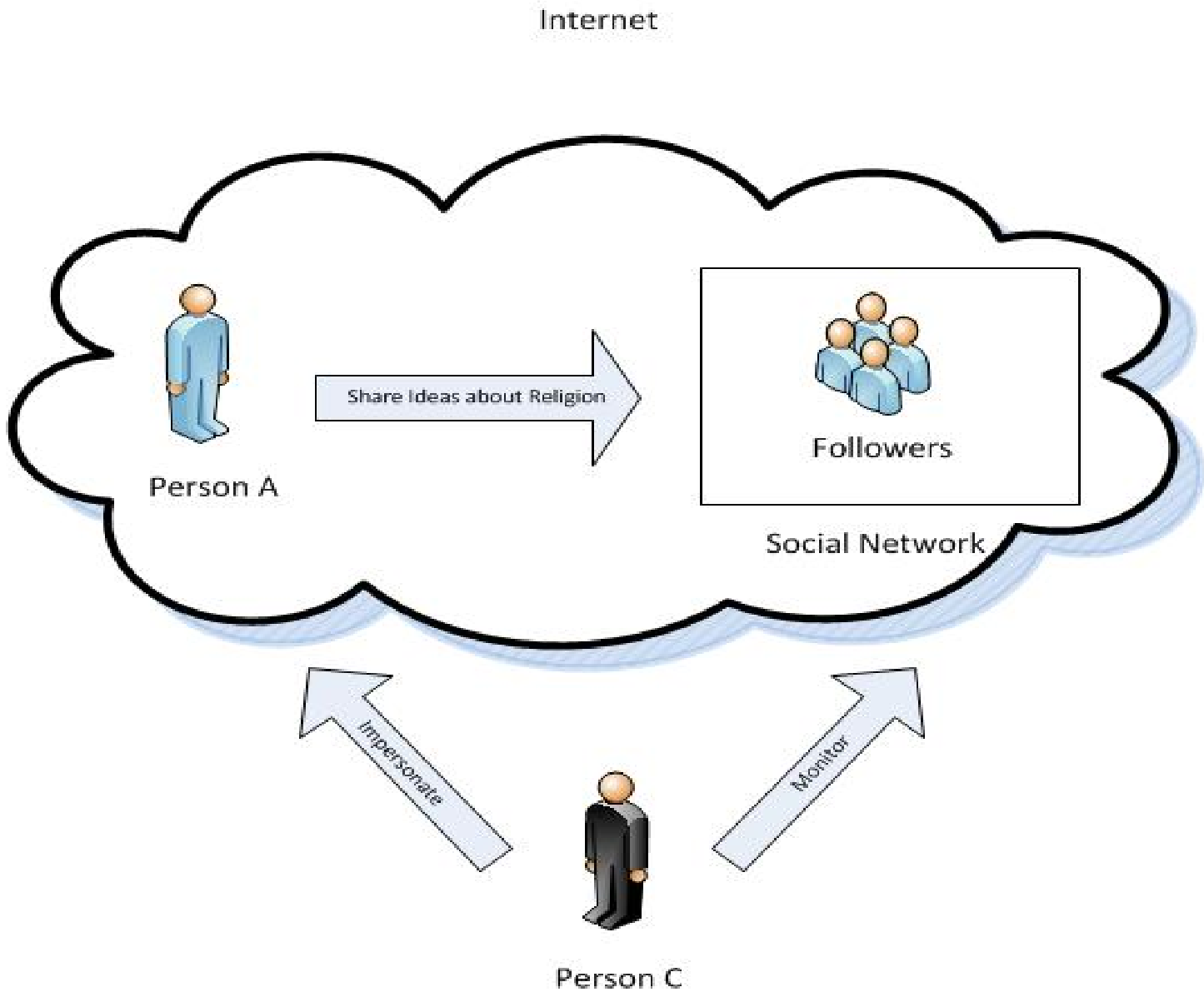 Above: The hierarchy of threats social networks face, from digital dossiers to social stalking.
Experimental Evidence & Effectiveness
The authors argue that their integrated approach is more "optimized" than conventional k-anonymity. By selecting records for clusters that satisfy the -diversity condition first, they maintain high data quality.
As shown in the paper's logic, as the value of increases (meaning more diversity in each group), the probability of an attacker guessing the correct sensitive attribute drops drastically.
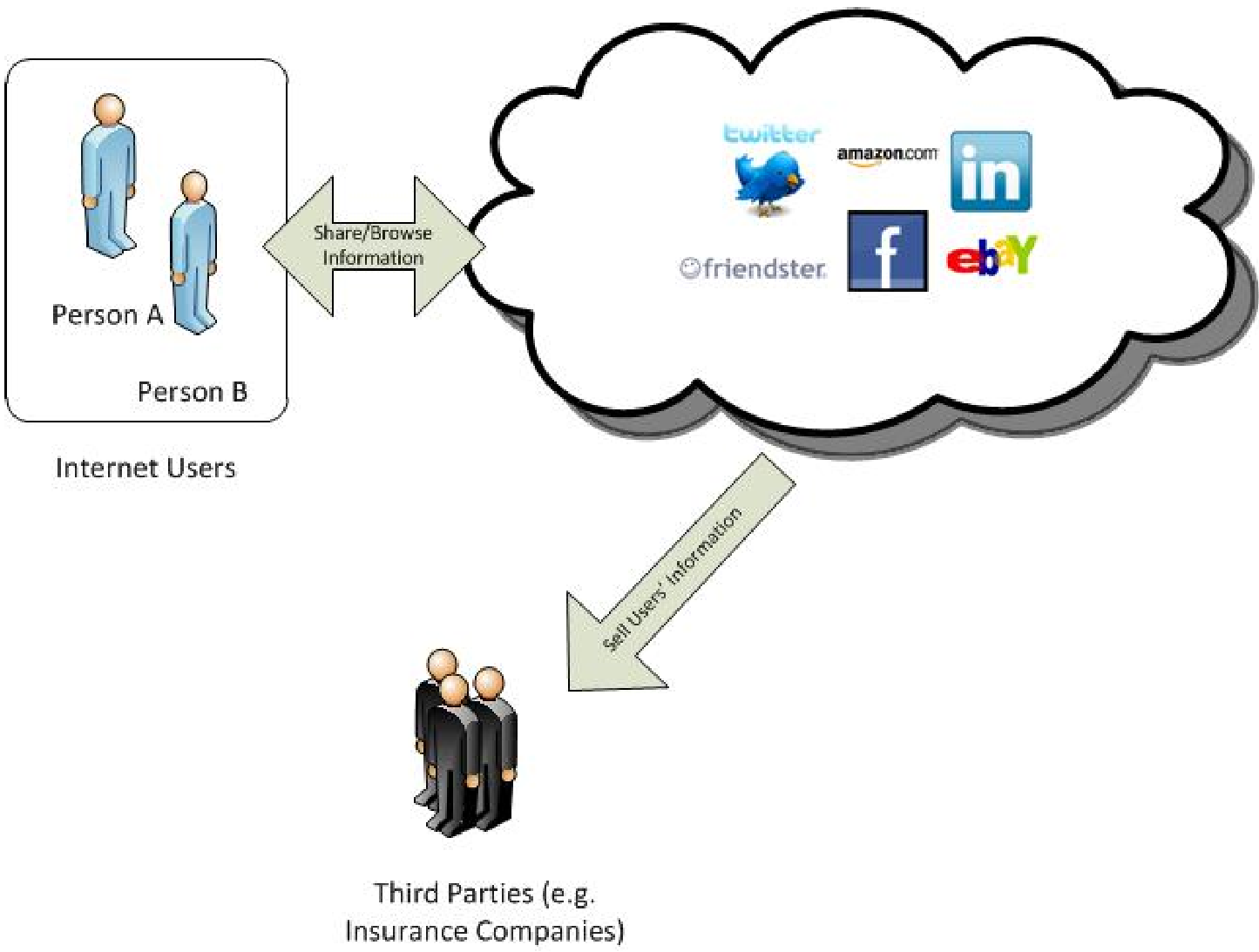 The architecture of an SNS Aggregator attack, which this algorithm seeks to mitigate by anonymizing shared data records.
Critical Analysis & Future Outlook
The "Integrated Algorithm" represents a significant step up from standard SNS privacy settings, which are often "not complete enough to cover all threats."
Strengths:
- Defense in Depth: Attacks that bypass k-anonymity are caught by the ℓ-diversity layer.
- Data Utility: Using clustering and taxonomy trees reduces the "distortion" caused by anonymization compared to naive suppression.
Limitations:
- Complexity: As the number of sensitive attributes grows, the complexity of maintaining diversity increases, which can lead to higher information loss.
- Future Scope: The paper notes that future work should focus on "t-closeness" or more advanced metrics to handle the distribution of sensitive attributes, preventing "skewness attacks" where the distribution of a trait in a group still reveals too much.
Conclusion
This research proves that privacy in the age of SNS is not a lost cause. By integrating robust data-masking algorithms into the very fabric of social platforms, we can protect users from the growing "Digital Dossier" threat without sacrificing the connectivity that makes social networks valuable.