
Beyond the Profile: The Growing Complexity of Obfuscation in Social Networks
On the Effectiveness of Obfuscation Techniques in Online Social Networks
This paper investigates the effectiveness of data obfuscation techniques in Online Social Networks (OSNs) to protect users against attribute inference attacks. It introduces a novel, classifier-independent obfuscation strategy based on the χ2 feature selection metric and evaluates its performance across 1.9 million Facebook profiles, achieving significant privacy gains while considering multi-attribute correlations and user preferences.
TL;DR
As Online Social Networks (OSNs) become treasure troves for data mining, protecting private attributes (like gender or relationship status) through data obfuscation—adding or changing "likes"—is becoming harder. This paper explores why simple "noise injection" fails when many people do it at once and proposes a dynamic, user-centric strategy that preserves privacy without making your profile look like a bot.
Background Position: This work moves beyond theoretical toy models to a large-scale (1.9M users) empirical analysis of how obfuscation performs in a competitive, evolving ecosystem.
The "Obfuscation Paradox"
The core insight of this paper is a warning: Privacy conscious behavior can actually help attackers.
Imagine you add "interests" to your profile to hide your gender. If you are the only one doing it, you disappear into the crowd. But if 10% of users use the same tool to add the same "fake" items, the attacker’s machine learning model learns that these specific items are now strong indicators of the very attribute you are trying to hide.
The authors found that while a single user could drop an attacker's accuracy to 45%, that same accuracy jumps back to 75% when just a fraction of the population adopts the same static protection strategy.
Methodology: The χ2 Strategy
To solve this without knowing exactly what algorithm the attacker is using (e.g., Naive Bayes vs. Random Forest), the authors utilized the χ2 (Chi-Squared) metric.
1. Feature Selection and Attack Model
The authors modeled the attack as a document classification problem. By calculating the χ2 score for thousands of items (movies, music, books), they identified which features "leak" the most information about private classes.
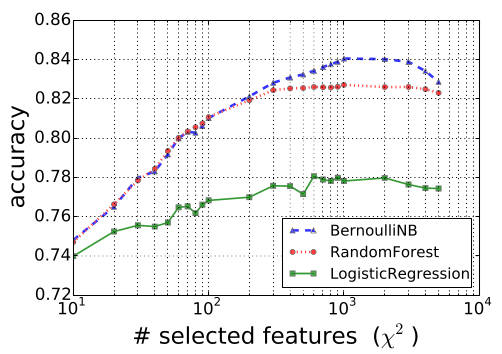 Figure 1: Accuracy plateaus quickly, meaning even a small profile with just 10 items is highly vulnerable.
2. Strategy Comparison
The paper compares several strategies:
- Optimal: Requires knowing the attacker's classifier (not practical).
- χ2: Uses statistical correlation to pick items (the proposed winner).
- Popularity/Random: Picking common items.
The authors found that replacing items is significantly more effective than just adding or removing them.
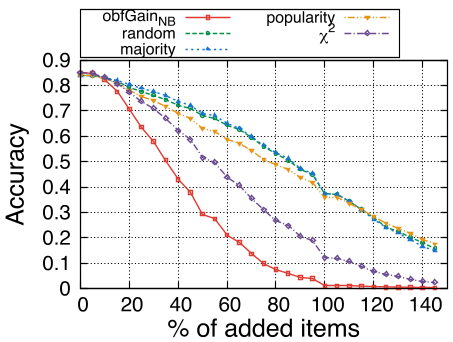 Figure 2: Comparison of adding, removing, and replacing items across different classifiers.
Dynamic and User-Friendly Protection
To combat the "Obfuscation Paradox," the authors propose Dynamic Obfuscation. By constantly refreshing the training data and recommendation items, the system ensures that "fake" items don't become new "dead giveaways."
Furthermore, through a user study, they discovered that people hate adding "low-quality" or "uncool" items to their profiles.
- The Solution: A "User-Friendly" strategy that intersects high χ2 protection scores with popular and high-rated IMDb movies. This strategy achieves protection levels nearly as high as the raw χ2 method but with items users actually find acceptable.
Critical Insight: Multi-Attribute Correlation
One of the most profound takeaways is the correlation between attributes. Obfuscating your "Relationship Status" might inadvertently reveal your "Gender" because the items associated with being "Single" are often also gender-skewed. The paper maps these correlations on a 2D Cartesian plane, showing that attributes like "Gender" and "Interested In" are almost inseparable in their feature space.
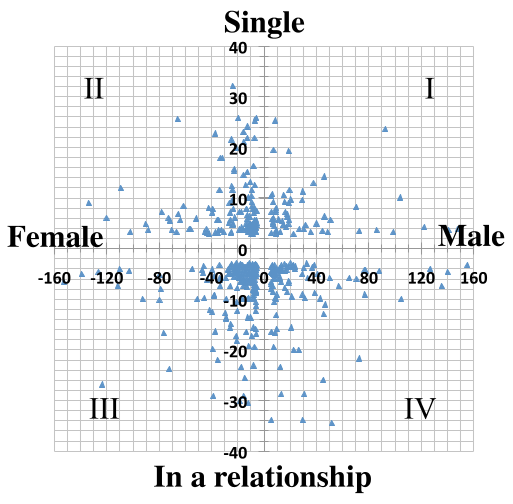 Figure 3: Quadrant mapping of χ2 scores across multiple attributes.
Conclusion & Future Outlook
The study proves that privacy in OSNs is not a static shield but an ongoing arms race. While the χ2 strategy is powerful, its success depends on:
- Dynamism: Regularly updating the noise to prevent pattern recognition by attackers.
- Human Factors: Ensuring the obfuscation items are "consistent" with the user's public image.
Limitations: The paper notes that a sophisticated attacker monitoring "abrupt profile changes" over time could still potentially flag obfuscated accounts. The future of OSN privacy likely lies in more subtle, long-term profile evolution rather than overnight changes.