
The Social Fabric of the Smart Home: Does the IoRT Lighten "Mother’s Burden"?
11127_The Effects of Internet of Robotic Things on In-home Social Family Relationships.
This study investigates the impact of the Internet of Robotic Things (IoRT) on in-home social family relationships by comparing a non-mediated IoRT environment against one mediated by a social robot (HuBot). Utilizing Social Network Analysis (SNA) in a living lab setting, the research demonstrates how robot mediation enhances interaction efficiency and alters domestic labor distribution.
TL;DR
Is your smart home actually making your life easier, or just more complicated? This study explores the Internet of Robotic Things (IoRT) and reveals that without a central social robot mediator, smart devices can actually make family interaction networks more inefficient. However, a social robot "mediator" can optimize the household network, allowing mothers to share their traditional "caring" burden with the younger generation.
Background: Technology’s Broken Promise
Historically, technological advancements like washing machines and vacuums didn't necessarily reduce housework for mothers; they often just shifted expectations (The "More Work for Mother" paradox). As we move from simple IoT to IoRT—where devices have agency and physical mobility—the question arises: Will these robots finally break the cycle, or will they become just another technical burden?
Methodology: The Living Lab and SNA
The researchers conducted a unique experiment using a Living Lab (a simulated home environment) and recruited two multi-generational families. To analyze the complex social dynamics, they applied Social Network Analysis (SNA), treating both humans and robots as "nodes" in a network.
They tested three specific environments:
- Non-robotic: Traditional manual appliances.
- IoRT without Mediator: Robotic things (vacuum, mop, etc.) controlled individually by family members.
- IoRT with Mediator (HuBot): All robotic things controlled through a central social robot.
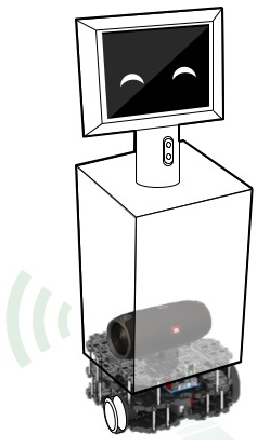 Figure: Examples of indirect interactions—how one member’s use of a robot serves the needs of another.
The "Caring Mediator" Insight
The study focused on Betweenness Centrality—a mathematical measure of how much an actor acts as a "broker" or "bridge" between others. In a family setting, the person with high betweenness is the Caring Mediator (traditionally the mother).
1. IoRT Without a Mediator: The Burden-Sharing Cost
When robotic things were introduced without a central point of control, younger family members grew more active. They felt empowered to use the technology, sharing the cleaning burden.
- The Catch: The network became inefficient. The "Average Shortest Path" increased, meaning interactions between members and devices were fragmented and less coordinated.
2. IoRT With a Mediator: Efficiency and Support
When HuBot (the social robot) was introduced as the interface for all other devices:
- Efficiency Skyrocketed: The average shortest path length decreased significantly.
- Mother’s Role: Mothers retained their central position in the family network, but the robot's role overlapped with theirs. The robot acted as a "partaker" in the caring role, reducing the cognitive and physical load on the mother without disrupting the established social structure.
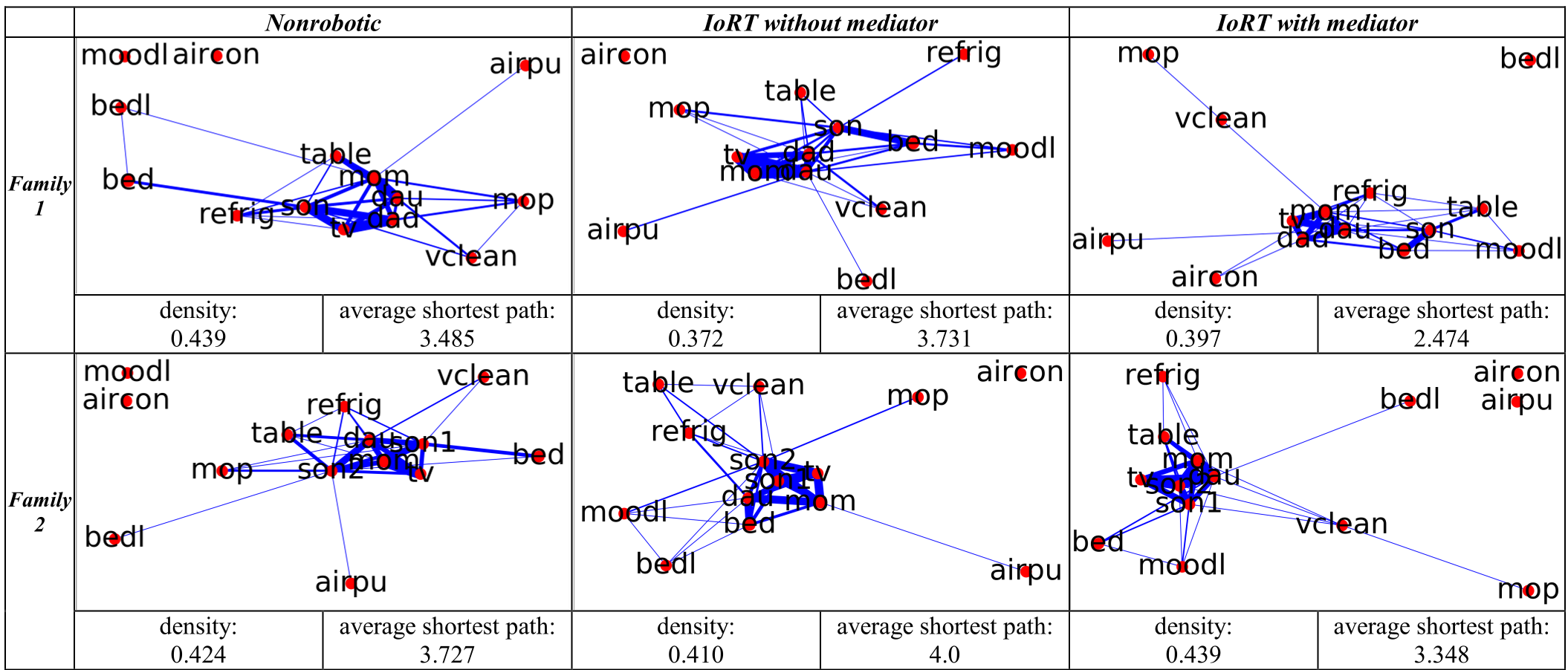 Table: Comparison of Network Density and Average Shortest Path across the three conditions.
Critical Analysis: Why This Matters
The most profound takeaway is that form factor and organization matter as much as function. The two IoRT conditions had identical functional capabilities (cleaning, lighting, TV control), but the presence of the Mediator changed the social outcome.
- Generational Friction: Younger members preferred direct control (IoRT without mediator), while the network as a whole performed better with a mediator.
- The Mother-Robot Overlap: By identifying with the robot's role, mothers felt a sense of partnership. The robot didn't "replace" the mother; it "supported" her agency.
Conclusion
The study concludes that as we design future smart homes, we cannot treat robots as isolated tools. They are social actors that reshape the "Product Ecology" of the home. For the IoRT to truly improve quality of life, it must be designed with the social network of the family in mind—potentially favoring a centralized social mediator to keep the household running efficiently while easing the traditional burdens of care.
Future Outlook: One limitation is the small sample size (two families). Future work should explore if these dynamics hold across different cultures and socio-economic backgrounds where "traditional" family roles may differ.