
Timing is Everything: How Activity Breakpoints Dictate Mobile Crowdsourcing Success
Effects of activity breakpoints on mobile crowdsourcing task performance
This paper investigates the impact of different activity breakpoints on mobile crowdsourcing task performance. By classifying breakpoints into five categories based on preceding and upcoming activities, the authors conducted a six-week Experience Sampling Method (ESM) study with 30 users to find optimal "opportune moments" for task execution.
TL;DR
Mobile crowdsourcing relies on "micro-moments," but not all breaks are created equal. This study reveals that users are most likely to contribute data when transitioning between two different types of activities. Crucially, if your previous task was mentally taxing, you are far less likely to pick up a crowdsourcing task, regardless of how "free" you currently are.
Background: The Myth of Constant Availability
Smartphones allow us to work "anywhere, anytime," but human attention is a finite resource. Current crowdsourcing apps often send notifications at fixed intervals or based on location. However, these prompts often feel interruptive. This paper positions itself as a refinement of Interruptibility Theory, moving beyond just knowing a user is at a breakpoint to understanding what kind of breakpoint it is.
The Taxonomy of Breakpoints
The researchers categorized the moments between activities into five specific types:
- Within-Activity: A pause inside a single task (e.g., a break while writing a long email).
- Between-Activities: Transitioning from one task to a completely different one (e.g., finishing work and preparing to commute).
- Leading-Only: Preceded by an activity but with nothing planned next.
- Trailing-Only: No prior activity but something is about to start.
- Void: Neither preceded nor followed by a specific activity (true idle time).
Methodology: Tracking Reality
To capture authentic behavior, the team developed a custom Android research tool using the Accessibility Service. This allowed them to detect exactly when users opened apps like Google Local Guides or Google Crowdsource.
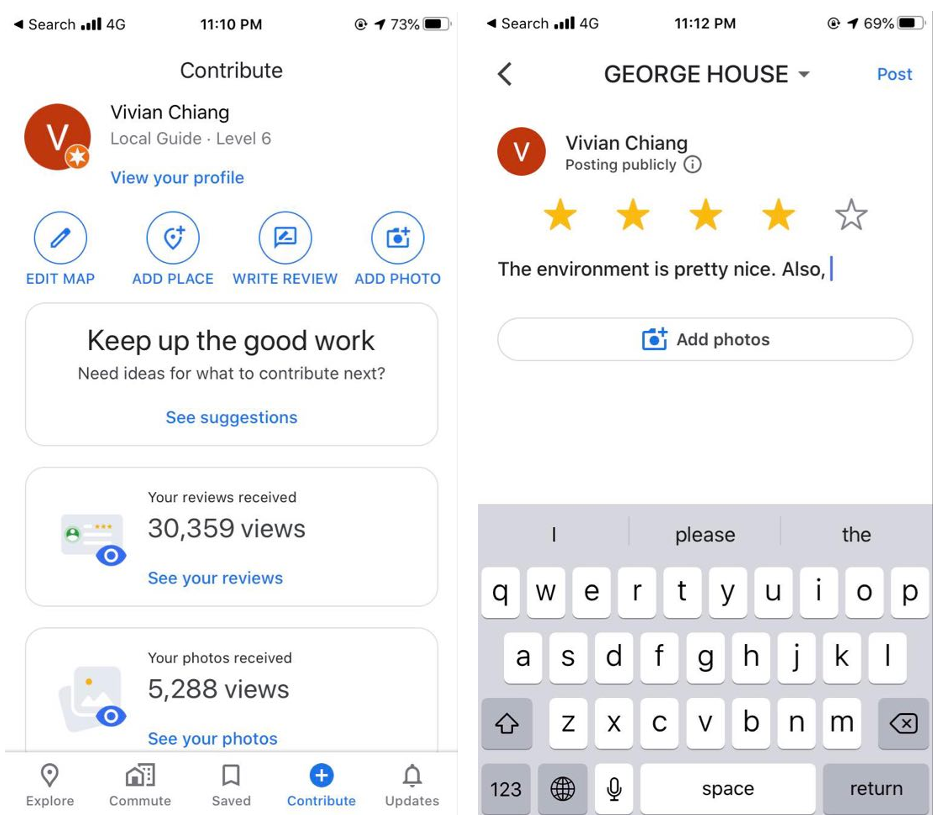 Figure: The research app (left) and the target crowdsourcing interface (right) used for data collection.
Key Insight 1: Transitions are the Sweet Spot
The study found that users are much more receptive during transitions between dissimilar activities. In "consistent situations" (staying within the same activity context), the execution rate was notably lower. This suggests that the mental "context switch" already occurring during a transition makes the introduction of a crowdsourcing task feel less like an interruption and more like a natural filler.
Key Insight 2: Narrative Inertia and Cognitive Load
One of the most profound findings relates to the Complexity of tasks.
- Preceding Activity Complexity: If the user just finished a difficult, high-concentration task, the execution rate for crowdsourcing dropped. The cognitive "hangover" prevents the user from wanting to engage in further mental effort.
- Upcoming Activity Complexity: Surprisingly, knowing a difficult task was coming up did not stop users from performing a quick crowdsourcing task.
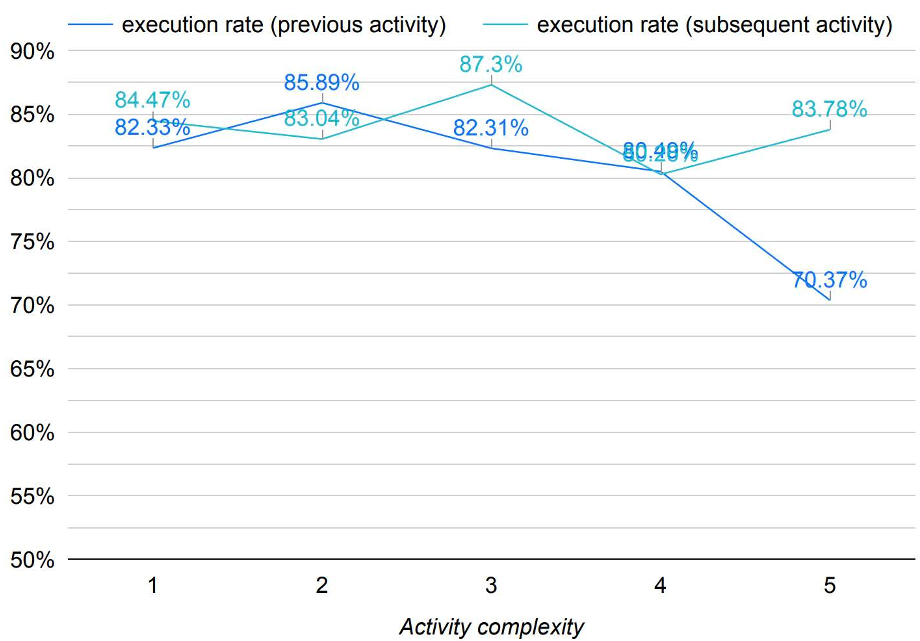 Figure: Influence of task complexity on execution rates. Note the sharp decline as previous task complexity increases.
Critical Analysis & Conclusion
This research provides a clear directive for UX designers and system architects in the mobile space: Context is not just where you are, but where you just came from.
Limitations
The study relies on self-reported activity definitions through ESM, which can introduce subjective bias. Additionally, while the complexity of preceding tasks was analyzed, the valence (was the task pleasant or stressful?) was not fully explored.
Future Outlook
The next generation of "Receptive UI" will likely use sensor fusion to detect these breakpoints automatically. Imagine an OS that silences crowdsourcing prompts not just because you are "busy," but because you just finished a high-stress Zoom call and need a cognitive "cool-down" period. This work moves us closer to a world of Harmonious Ubiquitous Computing.