
Spectral Defense: Leveraging Structural Centrality to Quench Social Network Rumors
Effects of Inoculation Based on Structural Centrality on Rumor Dynamics in Social Networks
The paper introduces a novel inoculation strategy for suppressing rumors in social networks based on "Structural Centrality" derived from Spectral Graph Theory. By utilizing the Moore-Penrose pseudo-inverse of the Laplacian matrix, the authors identify influential nodes in Scale-Free and real-world email networks, achieving superior rumor suppression compared to traditional random and degree-based (targeted) inoculation methods.
TL;DR
In the battle against misinformation, not all "influencers" are created equal. This paper shifts the focus from high-degree "hubs" to "structurally central" nodes—the hidden backbones of network geometry. By applying spectral graph theory and the Laplacian pseudo-inverse, the authors demonstrate an inoculation strategy that outperforms both random and degree-based targeting in suppressing rumors on Scale-Free and email networks.
Background: The study builds upon the Susceptible-Infected-Refractory (SIR) epidemic model, evolving it into a nonlinear rumor dynamics framework that accounts for the "forgetting" rate of individuals and the underlying graph topology.
The "Connector" Intuition: Why Degree Isn't Everything
Most existing research focuses on Targeted Inoculation, which assumes that the nodes with the most friends (High Degree) are the primary culprits in spreading rumors. However, the authors posit a different insight: a node might have few direct connections but could be a critical bridge between two massive clusters. This "structural" importance is often invisible to simple degree counts but is revealed through the Graph Spectrum.
Methodology: The Math of Network Geometry
The core of the methodology lies in Spectral Graph Theory. The authors use the Laplacian matrix (where is degree and is adjacency).
The Secret Sauce:
By calculating the Moore-Penrose pseudo-inverse matrix , they map nodes into a new Euclidean space. In this space, the value in the diagonal, , indicates how "far" a node is from the center of the network in terms of average commute hop distance.
- Low : The node is structurally central (needs fewer hops to reach everyone else).
- High : The node is on the periphery.
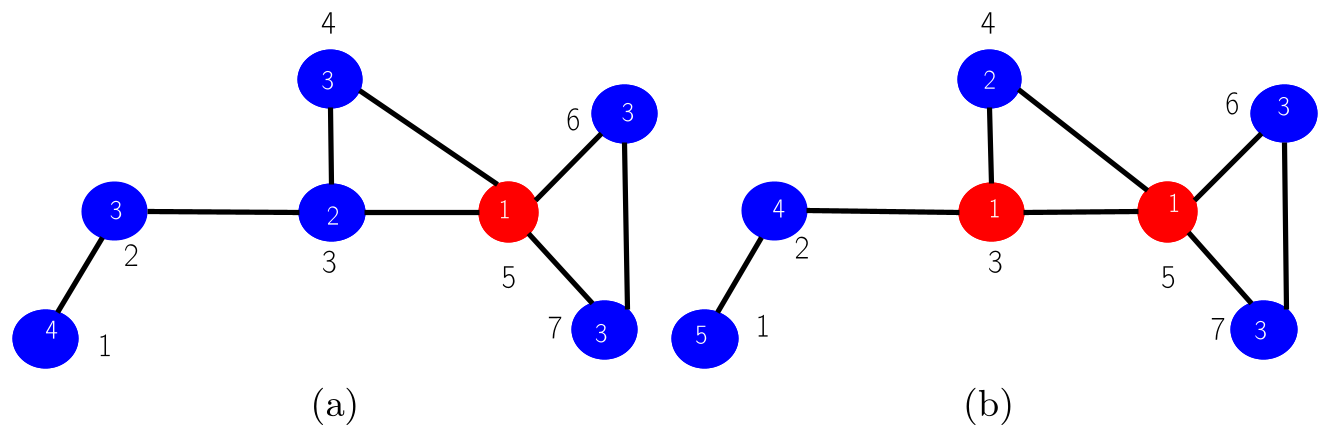 Figure 1: Comparison of nodal degree vs. structural centrality. Note how nodes 3 and 5 are identified as most influential, whereas node 3 has a lower degree than node 5.
Experiments: Real-World Verification
The authors tested their hypothesis on two main datasets:
- Synthetic Scale-Free (SF) Networks: Generated using power-law distributions ().
- Email Network Data: A representation of real-world communication flows.
Key Findings
- Rumor Suppression: Structural centrality consistently leads to a smaller final "Refractory" (informed) population than degree-based targeting.
- The "Late Bloomer" Effect: In some SF networks, degree-based inoculation works better for the first few time steps because hubs spread information instantly. However, structural centrality proves superior in the long run by cutting off the "arteries" of the network.
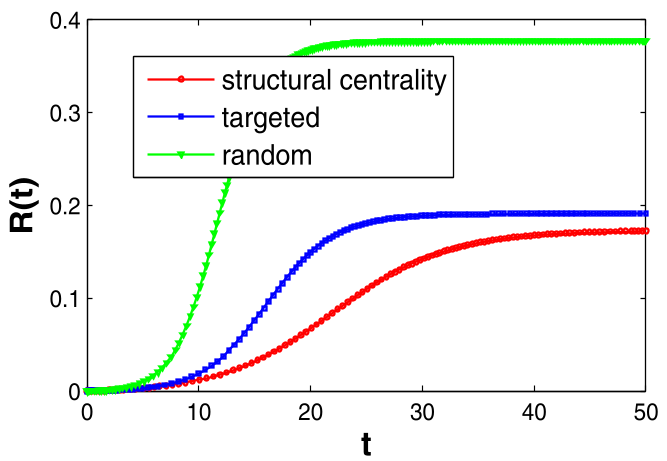 Figure 5: Rumor evolution in an Email Network. The structural centrality approach (lowest curve) shows the most significant reduction in rumor spread over time.
Critical Analysis & Conclusion
The Takeaway: This work provides a rigorous mathematical foundation for identifying influential nodes that are not necessarily "popular" (high degree) but are "essential" (structural). For network admins and social media platforms, this suggests that the most effective way to stop a rumor isn't just to mute the loudest accounts, but to protect the "bridges" that connect different communities.
Limitations: The main bottleneck is computational complexity. Calculating the pseudo-inverse for a network with millions of nodes is computationally expensive. Future work must focus on approximation algorithms for eigenvalues to make this strategy viable for platforms like Twitter or Facebook.
Future Outlook: The intersection of Spectral Graph Theory and epidemic modeling opens the door for more sophisticated "Inoculation 2.0" strategies, potentially integrating temporal dynamics—where the importance of a node changes as the rumor evolves.